Entrepreneurship is still too often reduced to a single question: how much money do you have?
This narrow framing is not just incomplete—it is actively misleading. It privileges those with access to financial resources while obscuring the deeper, more complex reality of how ventures are actually built, sustained, and scaled.
In practice, entrepreneurs draw upon a far richer portfolio of resources. These resources are not interchangeable, nor are they evenly distributed. Some are visible and measurable; others are intangible but decisive. Together, they form what can be understood as entrepreneurial capital—a multi-dimensional system of inputs that shapes opportunity recognition, venture creation, and long-term value.
Based on my research and applied work across entrepreneurship, education, and economic development, I propose eight forms of capital that every entrepreneur uses—whether consciously or not. Financial capital is just one of them. The real story lies in the interplay between all eight.
1. Financial Capital: Necessary but Not Sufficient
Let’s begin with the obvious.
Financial capital includes cash, credit, investment, and any form of monetary resource used to start or grow a business. It determines runway, enables hiring, supports marketing, and allows for experimentation.
But here is the uncomfortable truth: financial capital rarely creates entrepreneurial success on its own.
We have countless examples of well-funded ventures failing, and equally compelling examples of underfunded ventures thriving. Financial capital amplifies what already exists—it does not substitute for it.
Entrepreneurs who rely solely on funding often mistake liquidity for capability. In reality, financial capital is best understood as a multiplier, not a foundation.
2. Human (Experiential) Capital: What You Know and What You Can Do
Human capital refers to skills, knowledge, experience, and capabilities. But in entrepreneurship, this is not just about formal qualifications—it is about applied competence under uncertainty.
This includes:
Industry expertise
Technical skills
Problem-solving ability
Learning agility
Resilience under pressure
Experienced entrepreneurs often outperform novices not because they have more ideas, but because they can execute, adapt, and recover.
Crucially, human capital is cumulative. Every failure, every pivot, every difficult decision compounds into future advantage.
From an employability perspective, this is where entrepreneurship education often falls short. It focuses on knowledge transfer rather than capability development. Yet in practice, ventures are built on what people can do, not what they know in theory.
3. Social Capital: Who You Know—and Who Trusts You
Entrepreneurship is a relational activity.
Social capital includes networks, relationships, and the ability to mobilise others. It determines access to:
Customers
Partners
Investors
Mentors
Talent
But more importantly, it determines trust.
Two entrepreneurs with identical ideas and resources can achieve radically different outcomes depending on the strength of their networks. Introductions accelerate deals. Reputation reduces friction. Relationships unlock opportunities that are otherwise invisible.
In early-stage ventures especially, social capital often substitutes for financial capital. A trusted founder can secure credit, attract collaborators, and open doors without large upfront investment.
For policymakers, this raises a critical issue: entrepreneurial ecosystems are not built through funding alone—they are built through connection density and trust networks.
4. Cultural Capital: How You Understand the Game
Cultural capital is often overlooked, yet it shapes how entrepreneurs interpret and navigate their environment.
It includes:
Norms and values
Language and communication styles
Understanding of institutional expectations
Awareness of “how things are done” in specific contexts
For example, an entrepreneur operating in Silicon Valley understands pitching norms, risk tolerance, and growth expectations differently from someone operating in a rural economy or a traditional sector.
Cultural capital influences:
How opportunities are recognised
How ventures are positioned
How credibility is established
It also explains why entrepreneurship is unevenly distributed across regions and social groups. Those who “speak the language” of entrepreneurship are more likely to succeed—not necessarily because they are more capable, but because they are better aligned with the system.
5. Intellectual Capital: What You Can Codify and Scale
Intellectual capital refers to knowledge that can be formalised, protected, and leveraged.
Unlike human capital, which resides in individuals, intellectual capital can be embedded within the organisation. It enables scalability.
A business with strong intellectual capital can replicate its value proposition across markets without relying entirely on individual expertise.
In today’s economy, intellectual capital is increasingly dominant. Digital platforms, AI systems, and data-driven businesses are built on the ability to codify and scale knowledge.
However, many entrepreneurs fail to recognise this early. They operate informally, without documenting processes or protecting assets, limiting their long-term growth potential.
6. Manufactured Capital: The Tools and Infrastructure You Control
Manufactured capital includes physical assets and infrastructure:
Equipment
Facilities
Technology systems
Supply chains
Logistics networks
In traditional sectors—manufacturing, agriculture, construction—this form of capital is highly visible and often capital-intensive.
But even in digital ventures, manufactured capital still matters. Cloud infrastructure, software platforms, and operational systems all fall into this category.
The key question is not just what you own, but how efficiently you use it.
Entrepreneurs who optimise their use of manufactured capital—through lean operations, outsourcing, or platform-based models—can compete effectively with far larger organisations.
7. Natural Capital: The Environmental Context of Opportunity
Natural capital refers to environmental resources and conditions:
Land
Water
Energy
Biodiversity
Climate conditions
For many ventures, particularly in rural and resource-based industries, natural capital is foundational.
But its importance is expanding. Sustainability pressures, ESG requirements, and climate risks are reshaping markets across all sectors.
Entrepreneurs who understand and leverage natural capital can:
Develop sustainable business models
Access new funding streams
Align with regulatory trends
Create long-term resilience
Conversely, those who ignore it face increasing constraints.
Natural capital is not just a resource—it is becoming a strategic variable in competitive advantage.
8. Spiritual Capital: Purpose, Meaning, and Direction
The final form of capital is the least tangible, but often the most powerful.
Spiritual capital refers to:
Purpose
Values
Ethical frameworks
Sense of meaning
It answers the question: why does this venture exist?
Entrepreneurs operate in uncertain, high-pressure environments. Decisions are rarely clear-cut. Trade-offs are constant.
Spiritual capital provides direction under ambiguity.
It influences:
Strategic choices
Organisational culture
Leadership behaviour
Long-term vision
In practice, ventures with strong purpose often outperform those driven purely by financial metrics. They attract talent, build loyalty, and sustain momentum through difficult periods.
This is not about idealism—it is about alignment.
The Real Insight: It’s Not the Capitals, It’s the Combination
Understanding these eight forms of capital is useful. But the real value lies in recognising how they interact.
Entrepreneurial success is not determined by any single form of capital. It emerges from the configuration.
Consider a few examples:
A founder with limited financial capital but strong social and human capital can bootstrap effectively.
A well-funded venture with weak cultural and social capital may struggle to gain traction.
A purpose-driven business with strong spiritual and intellectual capital can build powerful brand loyalty.
This leads to a critical shift in thinking:
Entrepreneurship is not about resource scarcity—it is about resource orchestration.
The most effective entrepreneurs are not those with the most capital, but those who can combine, convert, and leverage different forms of capital over time.
Implications for Entrepreneurs
If you are building or growing a venture, this framework offers a more practical way to assess your position.
Ask yourself:
Where am I strong?
Where am I constrained?
Which forms of capital can I build quickly?
Which require long-term investment?
More importantly:
How can I convert one form of capital into another?
For example:
Social capital can attract financial capital
Human capital can generate intellectual capital
Cultural capital can unlock new markets
Entrepreneurship becomes a process of dynamic capital transformation.
Implications for Education and Policy
This perspective also challenges how we design entrepreneurship education and policy.
Too often, interventions focus narrowly on:
Access to finance
Business plan development
Start-up rates
But if entrepreneurship is multi-capital, then support systems must be as well.
This means:
Building networks, not just funding schemes
Developing capabilities, not just knowledge
Embedding cultural understanding, not just technical skills
Supporting purpose-driven ventures, not just profit-driven ones
For universities, this has direct implications for employability. Graduates need to develop multi-capital awareness and capability, not just disciplinary knowledge.
For policymakers, it means shifting from funding-led models to ecosystem-led models.
A More Honest Definition of Entrepreneurship
Ultimately, this framework points to a more accurate definition:
Entrepreneurship is the process of mobilising and transforming multiple forms of capital to create value under conditions of uncertainty.
This moves us beyond the simplistic idea of “starting a business.”
It recognises entrepreneurship as:
A capability
A system
A process
A form of value creation
And crucially, it opens the door to more inclusive and effective approaches—because it acknowledges that people start with different capital endowments, not just different ideas.
Final Thought
If we continue to define entrepreneurship in financial terms, we will continue to exclude those who do not start with capital.
But if we recognise the full spectrum of entrepreneurial capital, we begin to see opportunity differently.
We see that:
Capability can substitute for capital
Networks can unlock resources
Purpose can drive performance
Context shapes outcomes
And most importantly:
Every entrepreneur already has capital. The question is whether they know how to use it.
Entrepreneurship has been reduced—often carelessly—to a single, visible act: starting a business. It is a definition that fits neatly into policy targets, university league tables, and social media narratives. It is also deeply misleading.
If we define entrepreneurship purely as business formation, we misunderstand how value is actually created in modern economies. We incentivise the wrong behaviours, design ineffective education systems, and ultimately fail to develop individuals capable of navigating uncertainty, creating opportunity, and driving innovation.
Entrepreneurship is not an event. It is a process. More importantly, it is a way of thinking and acting that extends far beyond the act of launching a company.
This distinction matters.
The Problem with the “Start-Up” Definition
At first glance, defining entrepreneurship as “starting a business” seems logical. After all, many entrepreneurs do start businesses. Governments track new firm registrations. Universities celebrate student start-ups. Investors seek scalable ventures.
But this definition suffers from three fundamental flaws.
1. It focuses on the outcome, not the capability
Starting a business is an output. Entrepreneurship is the capability that precedes it.
By focusing on the visible outcome, we ignore the underlying skills that actually matter: opportunity recognition, resource mobilisation, resilience, and value creation. These capabilities can exist without a business being formed—and often do.
A graduate who identifies inefficiencies in a public service and redesigns a process is demonstrating entrepreneurial behaviour. So is an employee who creates a new product line within an existing firm. Neither has “started a business,” yet both are acting entrepreneurially.
2. It creates a false binary
The traditional definition forces individuals into two categories: entrepreneurs and non-entrepreneurs. You either start a business, or you don’t.
Reality is far more nuanced.
Entrepreneurial behaviour exists on a spectrum. Individuals move in and out of entrepreneurial activity throughout their careers. A corporate manager may act entrepreneurially in one role and not in another. A retiree may develop a small lifestyle venture that is entrepreneurial in intent but not in scale.
By reducing entrepreneurship to a binary state, we ignore this fluidity—and, in doing so, fail to support it.
3. It distorts incentives in education and policy
When entrepreneurship is measured by start-up numbers, institutions respond accordingly.
Universities push students to “start something,” often prematurely. Policymakers prioritise business formation statistics over business survival or value creation. Support programmes focus on incorporation rather than capability development.
The result is predictable: a proliferation of low-quality start-ups, high failure rates, and a generation of individuals who associate entrepreneurship with short-lived ventures rather than sustained value creation.
Entrepreneurship as a Process, Not an Event
A more useful way to understand entrepreneurship is as a staged process of value creation under conditions of uncertainty.
In my own work, this is reflected in the 9 Stages of the Entrepreneurial Lifecycle:
Discovery – recognising or creating opportunity
Modeling – shaping the business model and strategy
Startup – mobilising resources
Existence – establishing product-market fit
Survival – achieving financial viability
Success – scaling or stabilising
Adaptation – responding to change
Independence – achieving maturity and strength
Exit – transitioning ownership or legacy
The act of “starting a business” sits within just one of these stages—Startup—and even then, it is only a part of it.
By focusing solely on start-up activity, we ignore the complexity of what comes before and after. Opportunity recognition, for example, is arguably the most critical stage. Without it, no meaningful venture emerges. Similarly, adaptation and survival often determine long-term success far more than the initial launch.
Entrepreneurship, therefore, is not defined by the moment a company is registered. It is defined by the journey of creating, shaping, and sustaining value over time.
The Central Role of Value Creation
If starting a business is not the defining feature of entrepreneurship, what is?
The answer is value creation.
Entrepreneurship is the process of identifying, creating, and delivering value in new ways. This value may be economic, social, environmental, or cultural. It may occur within a new venture, an existing organisation, or even outside formal structures.
This reframing shifts the focus from structure to impact.
A start-up that fails to create value is not entrepreneurial in any meaningful sense—it is simply a business that did not work. Conversely, an individual who creates significant value within an organisation is demonstrating entrepreneurship, even without ownership.
This perspective aligns more closely with how modern economies function. Innovation increasingly occurs within networks, ecosystems, and hybrid organisational forms. The boundaries between “entrepreneur” and “employee” are blurred.
The Role of Entrepreneurial Capital
Understanding entrepreneurship as value creation also requires us to reconsider the resources involved.
Traditional models focus heavily on financial capital. Yet, in practice, entrepreneurs draw on a far broader set of resources—what I have described as entrepreneurial capital.
This includes:
Human capital (skills, knowledge, experience)
Social capital (networks and relationships)
Intellectual capital (ideas, IP, and insights)
Cultural capital (values, norms, and identity)
Experiential capital (learning through action)
Natural and manufactured capital (physical and environmental resources)
Spiritual capital (purpose and motivation)
These forms of capital are mobilised and combined throughout the entrepreneurial process. Crucially, they are not exclusive to business founders.
An individual can build and deploy entrepreneurial capital in many contexts: within organisations, communities, or personal projects. By focusing solely on business creation, we overlook this broader capability.
Entrepreneurship Beyond the Start-Up
To move beyond the narrow definition, it is useful to consider where entrepreneurial behaviour actually occurs.
1. Within organisations (Intrapreneurship)
Large organisations depend on individuals who can identify opportunities, innovate, and drive change from within. These intrapreneurs operate under constraints but often have access to greater resources.
Many of the most impactful innovations—new products, services, and processes—are developed inside existing firms rather than start-ups.
2. In public and third-sector contexts
Entrepreneurship is increasingly critical in public services and non-profit organisations. Social entrepreneurs address complex challenges, from healthcare to education to environmental sustainability.
Again, the focus is not on starting a business, but on creating value in new ways.
3. Through portfolio and lifestyle ventures
Not all entrepreneurship is about high-growth, venture-backed companies. Many individuals engage in small-scale, lifestyle, or portfolio entrepreneurship.
These ventures may prioritise autonomy, flexibility, or personal fulfilment over scale. They are no less entrepreneurial for it.
4. Across careers and life stages
Entrepreneurial behaviour evolves over time. A student experimenting with ideas, a mid-career professional innovating within a firm, and a retiree launching a small consultancy are all engaging in entrepreneurship in different ways.
Reducing entrepreneurship to start-up activity ignores this lifecycle.
The Consequences of Getting It Wrong
Misdefining entrepreneurship is not just an academic issue—it has real-world consequences.
For universities
When entrepreneurship education focuses on business start-up, it often neglects broader employability and capability development. Students may graduate with business plans but lack the skills to operate in uncertain environments.
A more effective approach is to embed entrepreneurial thinking across disciplines, focusing on problem-solving, creativity, and value creation.
For policymakers
Policies that prioritise start-up numbers can lead to superficial success metrics. High rates of business formation may mask low survival rates and limited economic impact.
A shift towards measuring value creation, innovation, and long-term sustainability would provide a more accurate picture.
For individuals
Perhaps most importantly, the narrow definition discourages many people from seeing themselves as entrepreneurial.
If entrepreneurship is equated with starting a business, those who do not wish to do so may disengage entirely. Yet they may possess significant entrepreneurial potential.
Redefining Entrepreneurship for a Changing Economy
So how should we define entrepreneurship?
A more useful definition might be:
Entrepreneurship is the capability and process of creating value through the identification and exploitation of opportunities under conditions of uncertainty.
This definition shifts the emphasis in several important ways:
From event to process
From structure to capability
From ownership to impact
From start-up to value creation
It also aligns more closely with the realities of a changing economy, where careers are non-linear, organisations are fluid, and innovation is distributed.
Implications for Practice
If we accept this broader definition, several practical implications follow.
1. Education must move beyond start-up support
Entrepreneurship education should focus on developing capabilities that are transferable across contexts: opportunity recognition, resourcefulness, resilience, and critical thinking.
Start-up support remains important—but as one pathway, not the endpoint.
2. Metrics must evolve
Success should not be measured solely by the number of businesses started. Instead, we should consider:
Value created (economic and social)
Innovation outcomes
Capability development
Long-term sustainability
3. Support systems must be more inclusive
Entrepreneurial support should extend beyond aspiring founders to include intrapreneurs, social innovators, and individuals at different life stages.
This requires a shift from programme-based interventions to ecosystem thinking.
A More Honest Conversation About Entrepreneurship
The narrative of entrepreneurship as “starting a business” is appealing because it is simple and visible. It provides clear stories, measurable outcomes, and identifiable heroes.
But it is also incomplete.
A more honest conversation acknowledges that entrepreneurship is messy, iterative, and often invisible. It involves failure, adaptation, and long periods of uncertainty. It is as much about thinking and behaving differently as it is about launching ventures.
For those of us working in education, policy, and practice, this shift is essential.
If we continue to equate entrepreneurship with business start-up, we will continue to produce the wrong outcomes. We will encourage activity without capability, quantity without quality, and visibility without value.
If, however, we redefine entrepreneurship as a process of value creation, we open up a far richer and more inclusive understanding. One that recognises the diverse ways in which individuals contribute to economic and social progress.
Conclusion
Starting a business is not entrepreneurship. It is one possible expression of it.
Entrepreneurship is the ability to see opportunities where others see problems, to mobilise resources where others see constraints, and to create value where none previously existed.
It is a capability that can be developed, applied, and sustained across contexts and throughout a lifetime.
And in a world defined by uncertainty, complexity, and rapid change, it is a capability we can no longer afford to misunderstand.
Entrepreneurship has been reduced to a narrow and ultimately unhelpful idea: starting a business.
Across universities, policy frameworks, and media narratives, entrepreneurship is framed through start-up activity—pitch decks, venture capital, and the pursuit of rapid scale. This interpretation is not simply incomplete; it is distorting how we educate students, design economic policy, and evaluate success.
The consequence is a system that rewards activity over impact, formation over function, and visibility over value.
If we are serious about improving productivity, employability, and long-term economic resilience, we need to move beyond the start-up myth and return to a more fundamental question:
What is entrepreneurship actually for?
The Problem: We Are Measuring the Wrong Thing
Entrepreneurship policy and education are dominated by simplistic metrics:
Number of start-ups created
Amount of funding raised
Survival rates over three to five years
These measures are easy to quantify, but they are poor proxies for what really matters: value creation.
A business can be launched, funded, and sustained without creating meaningful economic or social value. Equally, significant value can be created within existing organisations, communities, or informal economies without ever appearing in start-up statistics.
This misalignment has three critical consequences.
First, it leads to policy inefficiency. Governments invest heavily in start-up ecosystems without understanding whether those ventures contribute to productivity, innovation, or regional development.
Second, it creates educational distortion. Universities design entrepreneurship programmes around venture creation rather than capability development, leaving graduates underprepared for complex, non-linear careers.
Third, it results in entrepreneurial failure. Founders are encouraged to pursue ideas without understanding the resources, processes, and conditions required to create sustainable value.
In short, we are optimising for the wrong outcome.
Reframing Entrepreneurship: From Activity to Value
To correct this, entrepreneurship must be redefined.
Entrepreneurship is not the act of starting a business. It is:
The process of creating, capturing, and sustaining value through the effective orchestration of resources over time.
This definition shifts the focus in three important ways.
First, it places value at the centre, not activity. The purpose of entrepreneurship is not formation but transformation.
Second, it emphasises process, recognising that entrepreneurship unfolds over time rather than occurring at a single moment of creation.
Third, it highlights resource orchestration, acknowledging that entrepreneurs do not simply use resources—they combine, adapt, and transform them.
This reframing aligns more closely with established economic theory. Joseph Schumpeter, for example, positioned the entrepreneur as an agent of “creative destruction,” reshaping markets through innovation rather than merely creating firms (Schumpeter, 1934). Similarly, Peter Drucker emphasised entrepreneurship as a systematic practice of innovation and value creation (Drucker, 1985).
Yet despite this intellectual foundation, contemporary systems have drifted toward a far narrower interpretation.
The Missing Mechanism: Understanding Entrepreneurial Capital
If entrepreneurship is about value creation, the next question is straightforward:
How is value actually created?
The answer lies in capital—not just financial capital, but a broader set of resources that entrepreneurs draw upon and combine.
The Eight Capitals Model provides a more complete view:
Financial Capital (money and funding)
Human/Experiential Capital (skills, knowledge, experience)
Social Capital (networks and relationships)
Intellectual Capital (ideas, IP, systems)
Cultural Capital (norms, behaviours, identity)
Natural Capital (environmental and physical resources)
Manufactured Capital (infrastructure, tools, technology)
Spiritual Capital (purpose, values, motivation)
Traditional approaches overemphasise financial capital, yet evidence consistently shows that access to networks, knowledge, and institutional support often matters more in determining entrepreneurial outcomes (Acs et al., 2014).
Entrepreneurs do not simply deploy these capitals independently. They orchestrate them—combining different forms of capital to create new forms of value.
A founder launching a digital platform, for example, may rely heavily on intellectual and social capital in early stages, while scaling requires increasing levels of financial and manufactured capital.
Understanding this dynamic is critical. Without it, both education and policy remain fundamentally incomplete.
The Process Layer: The 9 Stages of Enterprise Development
While capital explains what resources are used, it does not explain how entrepreneurship unfolds.
Entrepreneurship is not a single act but a staged process. The 9 Stages of Enterprise Development provide a structured way to understand this progression:
Discovery
Modeling
Startup
Existence
Survival
Success
Adaptation
Independence
Exit
Each stage represents a different configuration of challenges, decisions, and resource requirements.
Crucially, value is created differently at each stage.
In Discovery, value lies in identifying opportunities
In Startup, it lies in mobilising resources
In Survival, it lies in achieving cash flow stability
In Adaptation, it lies in responding to environmental change
This staged perspective aligns with broader economic development theories, such as Walt Rostow’s model of economic growth, which highlights the importance of sequential development phases (Rostow, 1960). However, unlike linear economic models, entrepreneurship is iterative and adaptive.
The key insight is this:
Entrepreneurship is the dynamic interaction between capital and stages, producing value over time.
An Integrated Framework for Entrepreneurship
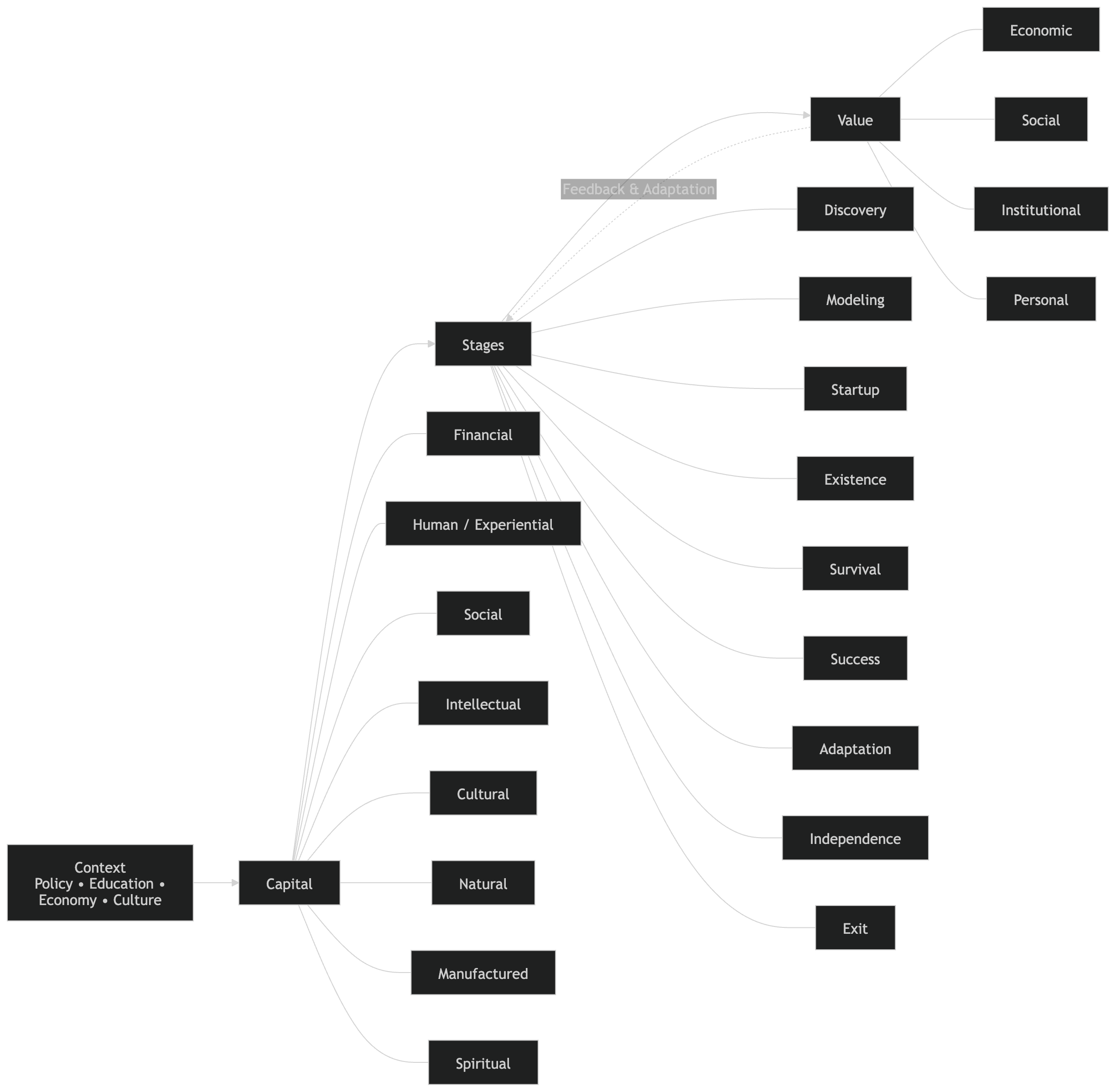
To move beyond fragmented thinking, these elements must be brought together into a single model.
Integrated Entrepreneurship Framework
This framework is deliberately simple but conceptually powerful.
Capital represents the resources available
Stages represent the process through which entrepreneurship unfolds
Value represents the outcome
Context shapes and constrains the system
Most existing approaches focus on only one of these elements. Effective entrepreneurship requires understanding all four—and, critically, how they interact.
Implications for Universities: From Knowledge to Capability
This framework exposes a fundamental weakness in higher education.
Universities largely focus on knowledge transfer, while entrepreneurship requires capability development.
Students are taught:
Business planning
Marketing theory
Financial modelling
But they are rarely taught:
How to mobilise different forms of capital
How to navigate different stages of development
How to create and measure value in real contexts
As a result, graduates leave with theoretical understanding but limited practical capability.
To address this, universities must:
Embed capital awareness into curricula Students should understand the different forms of capital and how to access them.
Align learning with stages Programmes should simulate the progression from discovery to growth, not just start-up.
Measure value creation capability Assessment should focus on outcomes, not outputs.
This is not a marginal adjustment. It is a structural shift in how education is designed.
Implications for Policy: From Start-Ups to Systems
The same issue applies at the policy level.
Entrepreneurship policy has become overly focused on:
Start-up grants
Incubators and accelerators
Venture capital ecosystems
While these have value, they represent only a small part of the system.
A more effective approach would focus on capital ecosystems:
Strengthening networks (social capital)
Investing in skills and education (human capital)
Supporting infrastructure (manufactured capital)
Enabling knowledge transfer (intellectual capital)
This is particularly important in regional and rural contexts, where traditional start-up models often fail to translate.
You cannot build entrepreneurial economies by funding businesses alone. You must build the systems that enable value creation.
Implications for Entrepreneurs: Better Decisions, Better Outcomes
For practitioners, this framework provides a more realistic lens.
Instead of asking:
“Is this a good idea?”
Entrepreneurs should ask:
“What value am I creating?”
“What capital do I need—and what am I missing?”
“What stage am I in—and what does that require?”
This shift leads to better decision-making.
It reduces overconfidence in early stages, improves resource allocation, and increases the likelihood of sustainable growth.
Conclusion: A Necessary Shift
Entrepreneurship matters—not because it creates businesses, but because it creates value.
If we continue to define entrepreneurship as start-up activity, we will continue to miseducate students, misallocate resources, and misunderstand economic growth.
The alternative is clear.
We must move toward a model that recognises:
The role of capital
The importance of process
The centrality of value
The influence of context
This is not simply an academic exercise. It is a practical necessity.
The future of entrepreneurship lies not in more businesses—but in better value creation.
References (APA Style)
Acs, Z. J., Autio, E., & Szerb, L. (2014). National systems of entrepreneurship: Measurement issues and policy implications. Research Policy, 43(3), 476–494.
Drucker, P. F. (1985). Innovation and entrepreneurship: Practice and principles. Harper & Row.
Schumpeter, J. A. (1934). The theory of economic development. Harvard University Press.
Rostow, W. W. (1960). The stages of economic growth: A non-communist manifesto. Cambridge University Press.
Neck, H. M., Greene, P. G., & Brush, C. G. (2014). Teaching entrepreneurship: A practice-based approach. Edward Elgar.
World Bank. (2020). Doing business 2020: Comparing business regulation in 190 economies. World Bank Publications.
OECD. (2021). Entrepreneurship at a glance 2021. OECD Publishing.
For decades, higher education has been sold on a simple promise: earn a degree, and better career opportunities will follow. This narrative has shaped student expectations, institutional strategies, and government policy alike. Yet, for many graduates today, the transition from university to work is anything but smooth.
Instead of a clear pathway, graduates encounter a fragmented, uncertain, and often frustrating journey into employment. The issue is not a lack of talent, ambition, or even opportunity. The problem is systemic.
The transition from degree to work is broken—and it requires urgent redesign.
The Myth of the Linear Pathway
At the core of the problem is an outdated assumption: that education leads directly to employment in a linear, step by step, predictable way.
This model assumes:
Students acquire knowledge
They graduate
They enter relevant employment
In reality, graduate pathways are far more complex. Careers are increasingly:
Non-linear
Iterative
Influenced by networks, experience, and timing
Graduates often move through multiple roles, sectors, and learning experiences before finding alignment. The expectation of a seamless transition is not only unrealistic—it sets students up for disappointment.
A Structural Disconnect Between Education and Work
One of the most significant issues is the disconnect between what universities deliver and what employers need.
Universities excel at:
Delivering theoretical knowledge
Developing critical thinking
Advancing disciplinary expertise
Employers, however, often prioritise:
Practical experience
Workplace behaviours
Adaptability and problem-solving
Commercial awareness
This is not a failure of universities per se. It is a failure of alignment.
The system operates in silos:
Universities design curricula independently
Employers articulate needs inconsistently
Policymakers attempt to bridge the gap through metrics and incentives
The result is a misaligned ecosystem where graduates must navigate the space between education and employment largely on their own.
Experience as the New Currency
Increasingly, employers are not just asking, “What degree do you have?” but “What have you done?”
Work experience has become a critical differentiator:
Internships
Placements
Part-time work
Projects and portfolios
Yet access to these opportunities is uneven.
Students from more advantaged backgrounds are more likely to:
Secure unpaid internships
Leverage personal networks
Gain early exposure to professional environments
Those without these advantages face structural barriers, reinforcing inequality in graduate outcomes.
In effect, the system rewards prior access to opportunity rather than potential.
The Hidden Curriculum
Much of what determines success in the transition to work is not formally taught.
Graduates must learn to:
Navigate recruitment processes
Build professional networks
Communicate their value
Understand workplace norms
This “hidden curriculum” is often acquired informally, through:
Family connections
Social capital
Prior exposure to professional environments
Students who lack this background are at a disadvantage, regardless of their academic ability.
Universities have made efforts to address this through employability programmes, but these are often:
Optional
Peripheral to core study
Insufficiently embedded
Fragmented Support Systems
Support for the transition from degree to work is often fragmented across institutions.
Students may encounter:
Careers services
Academic advisors
External programmes
Employer initiatives
However, these are rarely integrated into a coherent journey.
Common issues include:
Late engagement (often in final year)
Lack of personalisation
Limited continuity
As a result, students are expected to piece together their own pathway, often without the guidance or confidence to do so effectively.
The Role of Metrics and Incentives
Ironically, efforts to improve graduate outcomes have sometimes exacerbated the problem.
Metrics that focus on short-term employment outcomes encourage universities to:
Prioritise immediate job placement
Focus on measurable outputs
Treat employability as a compliance issue
This can lead to:
Superficial interventions
Reduced emphasis on long-term capability development
A narrow definition of success
Instead of transforming the system, metrics often reinforce its limitations.
Regional Inequality and Labour Market Realities
The transition from degree to work is also shaped by geography.
Graduates in regions with:
Strong labour markets
Diverse industries
High levels of investment
have greater opportunities.
Those in less economically dynamic areas face:
Fewer graduate-level roles
Lower wages
Limited career progression
Universities cannot control regional economies, yet they are often judged as if they can.
This creates a structural imbalance that disproportionately affects certain institutions and student groups.
The Rise of Alternative Pathways
At the same time, the nature of work itself is changing.
Traditional career pathways are being complemented—or replaced—by:
Freelancing and gig work
Entrepreneurship
Portfolio careers
Remote and global opportunities
These pathways offer flexibility and innovation but are poorly reflected in traditional transition systems.
Graduates pursuing these routes may appear “unsuccessful” in conventional metrics, even when they are building viable and meaningful careers.
Towards a Redesigned Transition System
If the current system is broken, what would a better model look like?
A redesigned transition system must move beyond the idea of a single handover point between education and employment. Instead, it should be understood as a continuous, integrated process.
1. Early and Embedded Employability
Employability should not be an add-on—it should be embedded from day one.
This includes:
Real-world projects within courses
Industry engagement in curriculum design
Continuous reflection on skills and development
2. Experience for All
Access to meaningful experience must be universal, not selective.
This could involve:
Guaranteed placements or project-based learning
Partnerships with employers
Simulation-based learning environments
3. Integrated Support Systems
Universities need to create coherent, personalised support journeys.
This means:
Aligning academic, careers, and external support
Providing consistent guidance over time
Using data to tailor interventions
4. Recognition of Diverse Pathways
The system must recognise that success takes many forms.
This requires:
Valuing entrepreneurship and self-employment
Supporting alternative career models
Expanding definitions of graduate success
5. Stronger Ecosystem Collaboration
The transition from degree to work cannot be solved by universities alone.
It requires collaboration between:
Universities
Employers
Policymakers
Regional stakeholders
This is fundamentally an ecosystem challenge.
Reframing the Transition
Perhaps the most important shift is conceptual.
The transition from degree to work should not be seen as:
A single moment
A final outcome
But as:
A developmental journey
A process of exploration and growth
Graduates are not products moving through a pipeline. They are individuals navigating complex, evolving careers.
Conclusion
The promise of higher education remains powerful, but the pathway from degree to work no longer reflects the realities of the modern world.
The system is not failing because graduates are unprepared or institutions are ineffective. It is failing because it is built on outdated assumptions, fragmented structures, and narrow definitions of success.
Fixing this requires more than incremental change. It requires a fundamental redesign—one that recognises the complexity of careers, the diversity of pathways, and the importance of capability over short-term outcomes.
Because the goal is not simply to help graduates get their first job.
It is to equip them to build meaningful, sustainable careers in a world that is constantly changing.
Rural economies are often positioned as fertile ground for entrepreneurship. They are rich in natural resources, community cohesion, and untapped opportunity. Yet, despite decades of policy interventions—from grants and incubators to training programmes—entrepreneurial outcomes in rural regions frequently lag behind urban counterparts. Business creation rates are lower, survival rates are fragile, and scale remains elusive.
The uncomfortable truth is this: most entrepreneurship policy fails rural economies not because of a lack of investment, but because of a misunderstanding of how rural entrepreneurship actually works.
The Urban Bias Problem
Much of modern entrepreneurship policy is designed with an implicit urban bias. Policymakers often assume that what works in cities—dense networks, access to finance, and rapid market validation—can simply be replicated in rural areas.
This assumption is flawed.
Urban ecosystems benefit from:
High population density
Access to venture capital
Proximity to universities and innovation hubs
Established infrastructure and supply chains
Rural economies, by contrast, operate under entirely different conditions:
Strong reliance on local identity and informal networks
When policy frameworks fail to recognise these structural differences, they impose solutions that are misaligned from the outset.
Misunderstanding Opportunity in Rural Contexts
Entrepreneurship policy often emphasises high-growth, innovation-led ventures, typically in sectors such as technology. While this is important, it overlooks the nature of opportunity in rural economies.
Rural entrepreneurship is frequently:
Place-based – rooted in local resources (agriculture, tourism, crafts)
Incremental – focused on steady income rather than rapid scaling
Diversified – combining multiple income streams (e.g. farming + hospitality + digital services)
Policies that prioritise “unicorns” over sustainable, diversified enterprises risk overlooking the real drivers of rural economic resilience.
The result is a mismatch between:
What policymakers fund
What rural entrepreneurs actually need
Fragmented Support Systems
Another major failure lies in the fragmentation of support systems. Rural entrepreneurs often face a complex and disjointed landscape of agencies, funding streams, and advisory services.
Typical challenges include:
Multiple organisations offering overlapping support
Lack of coordination between local, regional, and national bodies
Short-term funding cycles that disrupt continuity
For entrepreneurs, this creates confusion and inefficiency. Instead of enabling progress, the system becomes a barrier to navigation.
In urban environments, density compensates for fragmentation—networks fill the gaps. In rural areas, fragmentation is amplified by distance and isolation.
Access to Capital: A Structural Barrier
Access to finance remains one of the most persistent challenges in rural entrepreneurship.
Traditional policy responses—grants, loans, and subsidies—often fail because they do not address underlying structural issues:
Lower perceived investment attractiveness
Higher transaction costs for lenders
Limited local financial ecosystems
Moreover, many rural entrepreneurs do not seek venture capital. They require:
Patient capital
Microfinance
Community-based investment models
Policies designed around conventional finance mechanisms fail to recognise these needs, leaving a critical gap between supply and demand.
The Infrastructure Deficit
Entrepreneurship does not occur in a vacuum. It depends on enabling infrastructure.
In rural economies, this is often lacking:
Digital connectivity may be unreliable
Transport links are limited
Access to markets is constrained
While governments frequently invest in entrepreneurship programmes, they underinvest in the foundational infrastructure required for those programmes to succeed.
The consequence is predictable: businesses are created, but they struggle to grow.
Human Capital and Skills Mismatch
A further issue lies in the development of human capital. Entrepreneurship policies often focus on generic training programmes, assuming that skills are transferable across contexts.
However, rural entrepreneurship requires a distinct skill set:
Resourcefulness and bricolage (making do with limited resources)
Multi-skilling across sectors
Deep understanding of local markets and communities
Additionally, rural areas often experience:
Outmigration of young talent
Ageing populations
Limited access to higher education and training
Without addressing these structural dynamics, skills programmes alone cannot deliver meaningful change.
Ignoring Social and Cultural Capital
One of the most overlooked dimensions of rural entrepreneurship is social and cultural capital.
Rural communities are characterised by:
Strong social networks
High levels of trust
Deep-rooted cultural identities
These are powerful assets. They shape:
Opportunity recognition
Resource mobilisation
Market access
Yet, most entrepreneurship policies focus almost exclusively on financial and human capital, neglecting these relational and cultural dimensions.
This represents a significant missed opportunity.
The Scale Obsession
Policy success is often measured through metrics such as:
Number of startups
Growth rates
Investment raised
While these are important, they reinforce a narrow view of success.
In rural economies, success may look different:
Sustaining local employment
Supporting community resilience
Enhancing quality of life
By prioritising scale over sustainability, policymakers risk undervaluing the types of enterprises that are most relevant to rural contexts.
Towards a New Model of Rural Entrepreneurship Policy
If current approaches are failing, what should replace them?
A more effective model of rural entrepreneurship policy should be built on the following principles:
1. Contextualisation
Policies must be tailored to the specific characteristics of rural economies. This requires:
Place-based strategies
Local stakeholder engagement
Flexibility in design and implementation
2. Systems Thinking
Entrepreneurship should be viewed as part of a broader system, including:
Infrastructure
Education
Finance
Community networks
Interventions must be coordinated rather than fragmented.
3. Multi-Capital Approach
Drawing on emerging frameworks such as the Entrepreneurial Capital Model, policy should recognise multiple forms of capital:
Financial
Human
Social
Cultural
Natural
Rural economies, in particular, are rich in non-financial capital that can be leveraged for development.
4. Long-Term Investment
Short-term programmes are insufficient. Rural entrepreneurship requires:
Sustained investment
Long-term capacity building
Institutional continuity
5. Redefining Success
Metrics must evolve to reflect:
Resilience
Inclusivity
Sustainability
Rather than focusing solely on high-growth ventures, policy should support a diverse portfolio of enterprises.
Conclusion
Rural entrepreneurship holds enormous potential—not just for economic growth, but for addressing some of the most pressing challenges of our time, including inequality, sustainability, and community resilience.
However, unlocking this potential requires a fundamental shift in how we design and implement policy.
The failure of current approaches is not inevitable. It is the result of misaligned assumptions, fragmented systems, and narrow definitions of success.
By embracing a more nuanced, context-sensitive, and system-oriented approach, policymakers can move beyond failure and begin to build rural economies that are not only entrepreneurial, but truly thriving.
If you’re working in government, higher education, or regional development and want to rethink your approach to entrepreneurship policy, this is the moment to act. Rural economies do not need more of the same—they need something fundamentally better.
The UK apprenticeship system, while effective in achieving high sustained employment rates for its graduates, is structurally inhibited from cultivating entrepreneurs and self-employed individuals. This failure is a systemic consequence of a policy framework designed to prioritize the immediate, demand-led needs of established employers, fostering intrapreneurship (internal innovation) rather than independent market creation. The literature review identifies three primary, interconnected impediments:
Regulatory Exclusion: Statutory funding rules explicitly mandate a contract of employment and categorically exclude self-employed sole traders from eligibility, effectively penalizing apprentices who attempt to transition to independent work during or immediately after their training.
Structural Bias from the Levy: The Apprenticeship Levy has caused a market shift away from foundational skilled trades towards higher-level corporate training. This policy has marginalized Small and Medium Enterprises (SMEs)—the traditional incubators of entrepreneurial talent—which now account for only 37% of apprenticeship starts , limiting apprentice exposure to holistic small business operations.
Curricular Deficit: Apprenticeship Standards (KSBs) focus narrowly on technical and sector-specific competencies, resulting in a critical lack of mandatory, comprehensive commercial training essential for sole traders, such as tax compliance, invoicing, financial management, and small business law.
In contrast to successful international models, such as the German Dual System and its Meister qualification, the UK lacks a formal, quality-assured progression path that links technical mastery with validated business competence. Overcoming this deficit requires fundamental reform, including the establishment of a Dual-Track Apprenticeship Pathway to permit funded self-employment, mandatory integration of commercial training modules, and the introduction of a national Master Technician status to provide a recognized, structured route to independent business ownership. The current framework risks creating a cohort of highly skilled employees who remain commercially dependent on established organizations.
Executive Summary and Conceptual Foundation
The UK apprenticeship system, while successfully achieving its core mandate of improving employment rates and sustaining positive destinations for learners 1, demonstrates a systemic and structural failure to cultivate self-employed individuals and entrepreneurs. This deficiency is not an accidental oversight but the direct consequence of a policy framework fundamentally designed to serve the immediate needs of established employers, prioritizing the creation of a stable, productive workforce over the incubation of new economic entities. The analysis concludes that three primary, interconnected factors restrict the pathway to self-employment: explicit regulatory prohibition, structural biases embedded by the Apprenticeship Levy, and a significant deficit in mandatory commercial and managerial training within the curriculum.
Defining Entrepreneurship vs. Intrapreneurship in the Skills Economy
To accurately assess the failure of the system, it is necessary to establish a conceptual distinction between entrepreneurship and intrapreneurship. Entrepreneurship refers to the activity of creating and running an independent business, often operating as a sole trader, being responsible for success or failure, managing multiple clients, and handling taxation through mechanisms like HMRC Self Assessment.2 Conversely, intrapreneurship describes the cultivation of an entrepreneurial mindset—exhibiting initiative, problem-solving, and adaptability within the confines of an existing organizational structure.4
The current UK apprenticeship mandate is clearly structured to generate intrapreneurs. Academic providers explicitly frame entrepreneurship to apprentices as personal development, teaching them to innovate and add value while remaining employees within established companies.4 While this produces high-value employees who can adapt to change and solve problems on the job, it strategically avoids providing the essential legal and commercial knowledge required for independent business formation.4 This fundamental design choice—to create internal innovators rather than independent market entrants—sets the stage for the limited self-employment outcomes observed in the UK system.
The Evolution of UK Apprenticeship Policy: From Craft to Corporate Needs
The evolution of the UK vocational training landscape has shaped its current employment-centric focus. Apprenticeships have historically provided a crucial route into work for young people, combining on-the-job training with formal qualifications.6 However, the framework in England has been historically criticised for ignoring general and civic educational elements, often discounting the longer-term interests of the apprentices themselves.6
The policy shift in the early 21st century, influenced by reports like Leitch (2006), argued for a significant expansion in structured training to boost economic competitiveness.7 This led to considerable government investment and the establishment of the National Apprenticeships Service, designed to boost the supply of opportunities and make apprenticeships a mainstream option.7 Crucially, the literature review found that contemporary evidence on apprenticeships relates strongly to employers, reflecting the government’s explicit ambition to create a system where skills provision is demand-led.7 This structural decision, prioritizing the immediate skill needs defined by employers, inherently limits the curriculum and funding structure to favour the continuity of employment over the establishment of new, independent commercial ventures, thereby structurally constraining entrepreneurial preparation.6
Furthermore, the statistical measurement framework reinforces this non-prioritization. Government data focuses on ‘sustained positive destinations’ and ‘sustained employment’ rates.1 The proportion of apprenticeship learners in 2021/22 moving into sustained positive destinations was 94%, with 93% achieving a sustained employment rate.1 The absence of self-employment as a distinct, tracked Key Performance Indicator (KPI) within official government statistics 8 indicates that successful transition to independent business ownership is not considered a primary success metric for the Education and Skills Funding Agency (ESFA), confirming that the failure to foster entrepreneurial destinations is rooted in policy design that neglects this outcome from the outset.
Outline of the Failure Thesis: Regulatory, Curricular, and Structural Disconnects
The systematic failure to foster self-employment pathways is attributable to three systemic disconnects:
Regulatory Exclusion: The mandatory contract of employment and the explicit regulatory exclusion of sole traders from funding eligibility.9
Structural Bias: The impact of the Apprenticeship Levy, which has marginalized Small and Medium Enterprises (SMEs) 11—the traditional incubators of entrepreneurial talent—in favour of large corporate entities.
Curricular Deficit: The lack of mandatory, comprehensive business management, compliance, and financial training within Apprenticeship Standards.4
The Primary Regulatory Impediment: The Employment Contract Mandate
The most definitive and uncompromising barrier preventing apprentices from pursuing self-employment is the statutory framework governing apprenticeship eligibility and funding. This framework enforces a rigid model of employment that actively disqualifies self-starters.
Statutory Eligibility Requirements: The Exclusion of Self-Employed Sole Traders
The apprenticeship system requires, as a prerequisite for funding, that the apprentice must have a contract of employment from day one.9 This mandate firmly establishes the apprentice as an employee, necessitating payment via Pay As You Earn (PAYE).9
Analysis of the Apprenticeship Funding Rules reveals an explicit and categorical prohibition against funding individuals who operate as sole traders.10 The rules state clearly that a provider must not claim funding for individuals who are self-employed as a sole trader.10 This requirement establishes a strict condition for eligibility that binds the apprentice to the traditional employer-employee structure, effectively excluding those who wish to pursue a funded apprenticeship while simultaneously operating or developing an independent income stream.
Consequences of the Mandate: Deterring Self-Starters
The regulatory structure views a change in employment status to self-employment not as a positive career progression, but as a breach of funding requirements. If an apprentice becomes self-employed (as a sole trader) during their training period, they lose eligibility for funding, and the training provider is required to report them as having withdrawn from the programme.9 This consequence is highly detrimental, as it acts as a direct financial and educational penalty against entrepreneurial ambition, framing self-employment as a risk to compliance rather than a measure of success.
This regulatory ‘Compliance Trap’ disproportionately harms workers in skilled trades, such as construction 12, where self-employment is a highly desirable and natural progression route post-qualification. The framework forces skilled workers to choose between completing their funded qualification within a structured employment setting and applying their newly acquired skills immediately in an independent commercial environment. By enforcing this strict choice, the system discourages the immediate application of skills in an independent setting, potentially leading to dependency on employment and slowing down the rate of new business formation within key sectors.
Furthermore, the rule prevents experienced sole traders or freelancers from formalising their training relationships. A sole trader or subcontractor cannot legally hire someone and call them an “apprentice” if they pay them as a subcontractor; the apprentice must be a PAYE employee.9 This prevents the traditional, practical training model where an experienced independent tradesperson takes on a junior trainee, further limiting the potential pipeline for future self-employment.
The Ambiguity of Employment Status in the UK
The rigid regulatory stance taken by the Department for Education (DfE) in the apprenticeship funding rules contrasts sharply with the broader definitions of work used by HM Revenue and Customs (HMRC). HMRC acknowledges that a person can run a business and be employed simultaneously, representing the modern ‘portfolio worker’.2 Self-employed status is defined by factors such as being responsible for success/failure, invoicing for pay, providing equipment, and being able to hire others.2
By strictly adhering to the employee (PAYE) model, the apprenticeship framework fails to accommodate the commercial realities of dynamic, gig-heavy sectors. The regulatory model bypasses the flexibility inherent in the UK labour market, excluding highly motivated individuals who may seek training to formalize a business they already operate or plan to launch concurrently with their studies. This regulatory gap represents a fundamental failure to integrate vocational training with the rapidly evolving nature of modern work and business formation.
Structural Misalignment: The Apprenticeship Levy and SME Marginalisation
The introduction of the Apprenticeship Levy in 2017 caused a significant structural shift in the UK skills market, altering the profile of apprentices and the types of employers involved. This policy unintentionally created a bias that disadvantages small and medium-sized enterprises (SMEs), which are traditionally the most fertile ground for entrepreneurial incubation.
Impact of the Apprenticeship Levy on Start Composition
The Levy’s primary consequence was a market distortion characterized by a move away from foundational and trade-based training towards higher-level corporate training. Overall apprenticeship starts fell by 33% between 2014/15 and 2022/23.13 The decline was most pronounced at the entry levels: Intermediate (Level 2) apprenticeships fell by two-thirds, and Advanced (Level 3) starts declined by a quarter.14 Specifically, participation in Intermediate apprenticeships decreased by 28.3% between 2020/21 and 2024/25.8
Conversely, Higher Apprenticeship participation (L4-7) surged by 46.1% over the same period, leading to a tenfold growth in starts since 2013.8 This policy-driven shift created a ‘missing middle’ in UK skills provision, diverting funding and focus towards management and corporate training for existing large-scale employees. Evidence shows that 54% of organizations paying the Levy converted existing training into apprenticeships to claim back their allowance.15 This strategic ‘rebadging’ focuses resources on fulfilling internal skills needs (intrapreneurship) rather than expanding the pipeline for new skilled tradespeople who traditionally transition into self-employment. This financial segmentation systematically limits the resources flowing to the foundational training levels that underpin most independent commercial ventures.
The Critical Role of SMEs and Their Marginalisation
Small and medium-sized enterprises (SMEs) are essential incubators for entrepreneurs because they typically expose apprentices to the holistic operational context of a business—including commercial decision-making, finance, and client management—critical skills for eventual self-employment.
However, the UK apprenticeship market is structurally biased against them. SMEs (defined as 0-249 employees) accounted for only 37% of apprenticeship starts in 2022/23, a decrease from 40% in the previous year.11 This low figure is dramatically contrasted by successful international models, such as Germany, where approximately 98% of apprenticeships are offered through SMEs.14 The limited exposure of UK apprentices to the small business operational context due to this marginalisation reduces their likelihood of developing the necessary commercial awareness to transition effectively to self-employment.
Barriers to SME Participation
The barriers preventing SMEs from engaging are primarily administrative and structural. Research from the Social Market Foundation (SMF) found that small trades firms frequently lack the engagement necessary to navigate the complex recruitment and training process.16 A significant majority of businesses surveyed reported little to no interaction with local colleges (52% lack interaction) or independent providers (60% lack interaction).16 This lack of a “go-to” intermediary service forces SMEs to tackle the complexity alone, often resulting in them being unable to take on apprentices, thereby exacerbating skills shortages in skilled trades.16
While financial incentives exist—small, non-levy-paying businesses pay only 5% of training costs, and £1,000 incentives are paid for hiring younger apprentices 17—the financial burden remains a deterrent. Research indicates that 73% of small employers who already employ apprentices stated that the reintroduction of higher incentives (e.g., the previous £3,000 incentive) would encourage them to expand their capacity.18
Future Policy Instability: The Growth and Skills Levy
The UK government has acknowledged the failures of the current system, describing the existing Levy as “failing” and proposing its replacement with a Growth and Skills Levy.19 This proposed reform intends to allow employers up to 50% flexibility to spend Levy funding on non-apprenticeship training, such as short courses in critical areas like digital and engineering.19
While the intent is to drive investment in skills and address falling starts 20, this flexibility introduces a significant systemic risk. The inherent weakness of the previous Levy—its tendency to convert existing internal training 15—combined with this new flexibility, creates a potential scenario where large corporations may divert funds entirely away from structured apprenticeships and into short-term, internal skills development. This risks a further decline in overall apprenticeship starts, particularly at the foundational L2/L3 levels 21, further eroding the base of young entrants who might otherwise pursue trades and later transition to self-employment. The financial security of the existing pipeline, already strained, is therefore threatened by future instability.
Table 1: The Shift in UK Apprenticeship Start Composition (Pre- vs. Post-Levy)
Metric
Pre-Levy Context
Post-Levy (2022/23 Data)
Change (Interpretation)
Source
Total Apprenticeship Starts
High (500k+ annually pre-2017)
Declined by 33% (from 2014/15 to 2022/23)
Overall reduction in talent pipeline
13
Intermediate (L2) Starts
High Volume
Declined by two-thirds
Loss of foundational trade skills base
14
Higher (L4-7) Starts
Low (e.g., 9,800 in 2013)
High (e.g., 106,360 in 2022)
Tenfold growth, skewing focus to large employers/intrapreneurship
14
SME Share of Starts (0-249 Employees)
Higher (Pre-Levy)
37% (2022/23)
Decreased role of primary entrepreneurial incubators
11
Curricular and Pedagogical Deficits in Entrepreneurial Development
Even if the regulatory barriers to self-employment were removed, the current apprenticeship curriculum suffers from a pedagogical deficit, failing to equip apprentices with the critical commercial knowledge needed to operate a business successfully.
The Limited Scope of Knowledge, Skills, and Behaviours (KSBs)
Apprenticeship Standards are defined by the required Knowledge, Skills, and Behaviours (KSBs) necessary to undertake a specific occupation.22 These standards focus on sector-specific duties and competencies, ensuring technical proficiency.22 This prescriptive focus on job duties reinforces the employee-centric model, continuing the historical criticism that the framework often ignores broader, general educational elements that would serve the long-term career interests of the apprentice, such as advanced business management or civic education.6
The curriculum creates highly skilled technicians but leaves them commercially underprepared. For a sole trader, proficiency requires not just technical mastery but essential commercial skills, including tax compliance (HMRC requirements 2), quoting, invoicing, and financial management.24 These elements are often absent as mandatory components.
Critique of Off-the-Job Training Delivery (OTJT)
Apprentices must dedicate a minimum of 20% of their working hours to off-the-job training, typically delivered by the training provider.25 This OTJT time is where abstract, theoretical knowledge should be imparted.5 However, training providers are primarily incentivized by compliance and the achievement of core technical qualifications required by the employers who fund the placements.11
Consequently, the pedagogical environment often lacks robust commercial training. The required curriculum ensures technical compliance but fails to construct modules covering crucial business elements like registration, financial planning, marketing, and small business law.5 This structural reality means that training providers focus on achieving technical compliance, neglecting the niche business development training that is vital for future self-employment but not required by their dominant corporate clients. To overcome this, educators require targeted support to embed entrepreneurial projects and assessments into all disciplines.4
Fostering ‘Intrapreneurship’ as a Substitute
The pedagogical shortfall is mitigated, but not solved, by the deliberate framing of entrepreneurship as ‘intrapreneurship’. Providers recognize that many apprentices initially view themselves solely as employees.4 Therefore, they teach core entrepreneurial competencies—such as taking initiative, adapting to change, and solving problems on the job—which successfully creates individuals who drive innovation within established organizations.4
However, by stopping short of teaching the necessary legal and financial skills for independent operation, this approach reinforces the employee-centric model. Graduates leave with a valuable entrepreneurial mindset but often without the validated commercial and regulatory capability to launch and sustain their own business, forcing them into continued reliance on established companies.
Social Mobility and the Progression Cliff
The curricular limitations intersect with social mobility concerns. While intermediate apprenticeships (L2) can act as a stepping stone toward higher educational attainment for non-disadvantaged learners, this progression is significantly less applicable for disadvantaged learners.26 Furthermore, starts by apprentices from disadvantaged backgrounds declined up to 10 percentage points more than non-disadvantaged apprenticeships at L2/L3 levels, and up to 23 percentage points more at the higher level.26
If the foundational apprenticeships (L2/L3) utilized by these demographics fail to provide a viable self-employment exit route (due to the curricular deficit and regulatory exclusion), and if progression to higher educational levels is constrained, the apprenticeship risks limiting subsequent career flexibility. This creates a progression cliff, where highly skilled individuals from deprived areas may not be able to leverage their technical competence to achieve independent economic self-sufficiency through business ownership.
International Benchmarking: Integrated Pathways to Mastery and Self-Employment
To grasp the full extent of the UK’s structural failure, it is instructive to compare the system against international vocational models that successfully integrate technical training with a structured pathway to business ownership and mastery.
Case Study: The German Dual System and the Meister Qualification
The German Dual System provides a powerful counter-example to the UK’s employee-only focus. This model covers approximately 330 state-recognized occupations, with training heavily weighted toward the foundational EQF levels 3-4 (comparable to UK L2 and L3).14 A key differentiator is the high involvement of SMEs, which host 98% of German apprenticeships.14 This integration ensures apprentices are exposed to the full spectrum of business operations from the start, a fundamental prerequisite for becoming an entrepreneur.
The core structure enabling self-employment is the Meister (Master craftsperson) qualification. This is a formal, post-apprenticeship progression that combines extensive theoretical and practical knowledge.27 The Meister qualification serves four main aims: formal recognition of skill, capacity to assume management responsibilities, development of skills to train apprentices, and, critically, the equipping of individuals with the business knowledge required to set up or take over an existing business.27
The Regulatory and Commercial Functions of the Meisterbrief
The Meisterbrief (Master craftsperson’s certificate) acts as a powerful quality assurance mechanism and a regulatory prerequisite. In many German skilled trades, the Meister qualification is a legal requirement for independent work and business ownership.24 To achieve this status, individuals must pass comprehensive modules on commercial knowledge, which cover essential aspects of running a business, including financial calculation, expense management, tax preparation, and legal requirements.24
This systematic approach links high technical competence directly to validated commercial capability. Moreover, a Meister is formally required to train new apprentices.27 This creates a virtuous cycle where experienced, highly qualified entrepreneurs replenish the skills pipeline, ensuring quality and pedagogical continuity within the self-employed sector. This integration confirms that mandatory quality assurance standards are not just about training employees but are essential tools for guaranteeing the competence of the self-employed sector.
The Swiss VET Model and Integrated Ecosystems
The Swiss Vocational Education and Training (VET) model further highlights the importance of collaboration and ecosystem management. In Switzerland, VET is often determined by industry sectors in partnership with the State Secretariat for Education, Research, and Innovation (SERI), ensuring curriculum relevance.28
The successful development of regional Centres of Vocational Excellence (CoVEs) through initiatives like Erasmus+ 29 demonstrates how strong regional partnerships between educational institutions and SMEs can stimulate local business development and innovation. These publicly co-funded training alliances pool resources and facilitate knowledge exchange, providing a crucial and cost-effective method to tackle the scale and complexity challenges that prevent UK SMEs from engaging with the apprenticeship system.16
The Absence of a UK ‘Master Technician’ or ‘Master Craftsperson’ Status
The most significant structural deficit revealed by this international comparison is the absence of a formalized, recognized UK standard equivalent to the Meisterbrief.3 While the UK system offers progression to higher education (L4-7) 14 or informal professional body certification (e.g., chartered status in construction 12), there is no mandatory, comprehensive certification that links technical mastery, the pedagogical capacity to train others, and validated business competence.
The lack of this structured progression means that the transition from a technically competent employee to a self-employed business owner in the UK is largely unregulated and informal. This denies the market a clear quality signal for independent contractors and removes a powerful incentive for skilled tradespeople to complete essential business management training before launching their own ventures, thereby increasing the risk of business failure. This is compounded by the system’s fragmented oversight, which spreads regulatory responsibility across DfE, Ofqual, and OfS 30, hindering the integration of commercial requirements across all training pathways, unlike the coordinated industry self-regulation seen in Switzerland.31
Table 2: Comparative Analysis of Entrepreneurial Integration in Vocational Models
Feature
UK Apprenticeship System (England)
German Dual System (Meister Qualification)
Impact on Entrepreneurship Pathway
Source(s)
Eligibility for Sole Traders
Explicitly excluded from funded programmes. Must remain an employee (PAYE).
Apprentices are employees, but certification leads directly to authorized self-employment.
Regulatory barrier forces reliance on employment, delaying or preventing start-ups.
9
Business/Commercial Training
Optional or generalized (focus on ‘Intrapreneurship’).
Mandatory components (Part III/IV of Meisterprüfung) covering finance, legal, and management.
UK graduates lack validated business acumen for independent operation.
4
Post-Qualification Status
Sustained employment or higher academic qualification. No mandatory, recognized master status.
Formal Meisterbrief required for business ownership and training new apprentices.
Absence of quality assurance for self-employment; no structured progression to business leadership.
1
SME Engagement
Low (37-41% of starts).
High (approx. 98% of starts).
Low exposure to holistic business operational models critical for future founders.
11
Conclusions and Policy Recommendations
The failure of UK apprenticeships to develop entrepreneurs is a direct result of the system being structurally optimized for the corporate employee model, codified through regulation and reinforced by funding mechanisms. Overcoming this failure requires a concerted, multi-faceted reform effort that integrates international best practices and explicitly mandates entrepreneurial capability as a legitimate and tracked outcome.
Regulatory Reform: Implementing a Funded Dual-Track
To dismantle the primary barrier to self-employment, the Apprenticeship Funding Rules must be fundamentally revised.
The explicit exclusion of self-employed sole traders from funding eligibility 10 should be addressed by introducing a specialized, Dual-Track Apprenticeship Pathway. This pathway would operate in high self-employment sectors (e.g., construction, creative trades) and would legally permit individuals operating as self-employed sole traders to access funding, provided they meet strict compliance and training oversight rules. Furthermore, for Advanced (L3) and Higher (L4+) apprenticeships, particularly in dynamic sectors, the system should explore models that recognize a ‘learner-contractor’ status during the final stages of the programme, allowing for a managed transition to independent work while completing necessary End-Point Assessment (EPA).
Curriculum Mandates: Integrating Business Planning and Compliance
The current curricular focus on technical skills must be balanced by a mandatory inclusion of commercial acumen.
All Advanced (L3) and Higher (L4+) Apprenticeship Standards should mandate the integration of specific, compulsory training modules on essential business knowledge.4 This training must cover practical skills necessary for independent operators, including financial management, tax compliance (HMRC requirements 2), invoicing, pricing strategies, and small business law. This should be delivered through mandatory entrepreneurial projects and assessments 4, requiring apprentices to develop and cost a viable business plan relevant to their occupation, ensuring they graduate as commercially capable professionals. Furthermore, academic staff responsible for delivering these programmes require targeted support and recognition, potentially leveraging successful entrepreneurs and industry leaders as in-residence professionals or guest speakers.4
Structural Interventions: Establishing SME Intermediaries and Local Ecosystems
Addressing the marginalisation of SMEs is paramount, as they provide the natural training environment for future entrepreneurs.
The government must establish a dedicated, comprehensive SME Intermediary Service. This “go-to” brokerage service would significantly reduce the administrative complexity cited by small businesses 16 by actively strengthening local connections between SMEs and training providers, facilitating recruitment and managing administrative overhead. This service would complement broader employment reforms and ensure the necessary support is channelled effectively.16 Simultaneously, there must be sustained investment in developing regional Centres of Vocational Excellence (CoVEs), modelled after successful international public-private collaborations.29 These local ecosystems are essential for pooling resources and knowledge, thereby stimulating local business development and innovation by directly servicing the needs of SMEs.29
Developing a UK ‘Master’ Qualification
To provide a structured, quality-assured progression path to business ownership, the UK must develop a formal National Master Technician or Master Craftsperson Qualification.
This post-qualification certification, analogous to the German Meisterbrief27, should be nationally recognized and legally mandated for independent business ownership in key skilled trades. The attainment of Master status should require three mandatory components: demonstrated technical mastery, proven pedagogical capacity (the ability to train new apprentices), and mandatory completion of advanced commercial and managerial modules.24 This would not only provide a recognized, high-status progression route for skilled professionals but would also establish a vital public quality assurance mechanism for the self-employed sector, increasing consumer confidence and reinforcing the value of the apprenticeship pathway.
Post-Programme Mentorship and Incubation
The final stage of transition from employee to business owner must be supported by formalized incubation. Policy should acknowledge the need for post-apprenticeship mentorship and guidance, specifically for those seeking to launch businesses. This can be achieved by integrating formal support mechanisms, leveraging the expertise of third-sector organisations dedicated to empowering young entrepreneurs, such as The King’s Trust 32 and specialised mentorship programmes like EPIC, which targets young people from care backgrounds and disadvantaged communities.33 Continued access to business development resources and subsidized guidance must bridge the critical gap between qualification achievement and successful business launch.
A tripartite understanding of experiences of young apprentices: A case study of the London Borough of Hounslow – PubMed Central, accessed on December 1, 2025, https://pmc.ncbi.nlm.nih.gov/articles/PMC10175057/
Title: Reimagining the University-Industry Partnership: A New Model for Impact
There’s a certain quaintness to the traditional image of university-industry partnerships. Think career fairs, bake sales to fund student projects, perhaps a guest lecture from an industry leader. These are valuable initiatives, certainly, but they often feel like peripheral activities – a polite nod towards the ‘real world’ rather than a fundamental shift in how universities operate.
I’m not dismissing these efforts, mind you. I’ve participated in them myself, organizing career workshops and facilitating industry mentorship programmes. But after years of observing these interactions from both sides – as an academic deeply invested in research and a consultant advising businesses – I’m convinced that we need to fundamentally reimagine the university-industry partnership. We need a model that moves beyond simple transactional exchanges and embraces genuine collaboration, one that prioritizes shared value creation over short-term gains.
I’m not suggesting a radical overhaul, but rather a subtle recalibration – a shift in mindset that recognizes the inherent strengths of both institutions and leverages them to address complex societal challenges. It’s a vision born from witnessing firsthand the frustrating disconnect between academic research and real-world application, and fueled by a deep conviction that universities have a crucial role to play in driving innovation, productivity and economic growth.
The Current Landscape: A History of Missed Opportunities
Let’s be honest, the current landscape is often characterized by a degree of mutual skepticism. Universities are perceived as ivory towers, disconnected from the practical needs of businesses. Businesses, in turn, view universities as slow-moving bureaucracies, resistant to change and unwilling to commercialize their research.
This isn’t entirely unwarranted. The traditional model often prioritizes academic publications over practical impact, incentivizing researchers to publish in high-impact (don’t get me started on those) journals rather than seeking solutions to today’s real-world problems. The intellectual property landscape can be a minefield, with complex licensing agreements and conflicting interests hindering commercialization efforts. And let’s not forget the inherent cultural differences – the academic emphasis on rigorous peer review clashes with the business imperative for rapid iteration and market validation.
I recall one particularly frustrating experience advising a medtech startup that was struggling to secure funding for a promising new intervention. The university’s technology transfer office, while well-intentioned, was bogged down in lengthy negotiations with potential investors, delaying the project and ultimately jeopardizing its future. It was a stark reminder that good intentions alone aren’t enough; we need streamlined processes, clear incentives, and a shared commitment to driving impact.
A New Model: Shared Value Creation at the Core, Grounded in Experiential Learning
My vision for a reimagined university-industry partnership centres on the concept of shared value creation (The central premise of enterprise creation). It’s about moving beyond transactional exchanges and fostering deep, collaborative relationships that benefit both institutions and society as a whole. Crucially, this requires embedding experiential learning at the heart of our approach. Tools like SimVenture, for instance, offer unparalleled opportunities for students to grapple with real-world business challenges in a safe and engaging environment. Imagine undergraduate teams developing strategic plans for simulated companies, making investment decisions, navigating market fluctuations – all while receiving mentorship from industry professionals. This isn’s just theoretical learning; it’s applied knowledge, forged in the crucible of simulated experience.
Key Pillars of a Collaborative Future:
Here are some concrete steps we can take to build this collaborative future:
Embedded Industry Fellows: Imagine a programme where experienced industry professionals are embedded at the same level, within university departments, working alongside faculty and students on real-world projects. These fellows would bring valuable insights into market needs, provide mentorship to aspiring entrepreneurs, and help bridge the gap between academic research and commercial application.
Challenge-Driven Research: Instead of pursuing research topics in isolation, universities should actively solicit challenges from businesses and policymakers. This would ensure that our research is aligned with real-world needs, increasing its relevance and impact.
Flexible Intellectual Property Frameworks: We need to move away from rigid, one-size-fits-all intellectual property frameworks and embrace more flexible models that encourage collaboration and innovation.
Cross-Disciplinary Innovation Hubs: Universities should establish cross-disciplinary innovation hubs that bring together faculty, students, and industry partners from diverse fields to tackle complex challenges.
Data-Driven Impact Assessment: We need to develop robust data-driven impact assessment frameworks that measure the real-world benefits of our research.
Robust Subcontractual Oversight: Recognizing that complex projects often involve subcontracting, universities must implement rigorous oversight mechanisms. As detailed in my work on this topic, clear contractual provisions, independent audits, and transparent reporting are essential to ensure accountability, mitigate risks, and safeguard the integrity of collaborative ventures. This includes establishing clear lines of responsibility for performance, quality control, and ethical conduct across all tiers of the project.
The Role of Policy: Incentivizing Collaboration
Government policy also has a crucial role to play in incentivizing collaboration between universities and businesses. This could involve providing tax breaks for companies that invest in university research, creating grant programmes that specifically target collaborative projects, and streamlining regulatory processes to facilitate commercialization.
I remember advocating for a policy change in my own state that provided tax credits to companies that partnered with universities on research projects. The impact was immediate – we saw a surge in collaborative initiatives, leading to the creation of new businesses and high-paying jobs.
Embracing Imperfection: A Journey, Not a Destination
This isn’t about creating a utopian vision of perfect collaboration. It’s about acknowledging that the journey will be fraught with challenges, setbacks, and disagreements. There will be times when we stumble, make mistakes, and question our assumptions. But it’s through these experiences that we learn, adapt, and ultimately build a more effective partnership.
As I reflect on my own experiences, I’m filled with a sense of optimism and hope. I believe that universities have a vital role to play in driving innovation, creating jobs, and addressing some of the world’s most pressing challenges. And I believe that by reimagining our partnerships with businesses, incorporating experiential learning tools like SimVentures and implementing robust subcontractual oversight, we can unlock a new era of shared value creation and lasting impact.
Introduction: The Dual Lens of Academia and Consulting
As I sit at my desk in Worcester, England, surrounded by decades-old books on entrepreneurship and a whiteboard filled with frameworks for scaling startups, I can’t help but reflect on how my career has unfolded. Over the past 25 years, I’ve oscillated between academia and consulting—roles that at first glance might seem incompatible but, in reality, are deeply intertwined. My work spans university leadership, board governance, and advising governments on entrepreneurial ecosystems, all while publishing research that informs both sectors.
This post is a candid exploration of my journey: how I built credibility as an academic while cultivating expertise as a consultant, and the lessons I’ve learned along the way. It’s also a guide to those navigating similar paths, blending scholarly rigor with the actionable insights that consultants thrive on.
The Academic Foundation: Teaching, Research, and “Failing Forward”
My academic roots began in engineering, a discipline that taught me to value precision and systems thinking—a mindset I’ve carried into entrepreneurship. In 2015, as Senior Lecturer and Course Leader for Entrepreneurship at the University of Worcester, I designed a BA in Entrepreneurship that combined theory with practice. (A paper reviewing this course is here) Students weren’t just learning about business models; they were building them, often in collaboration with local businesses.
One pivotal moment came when I tried to integrate rural entrepreneurship into the curriculum at the Royal Agricultural University (RAU). I envisioned a programme where students could apply innovation to agricultural challenges, like sustainable food systems. But early attempts faltered—the disconnect between theoretical concepts and the practical needs of rural communities left me frustrated. I realized success required more than just syllabus design; it demanded partnerships with entreprenurial ecosystem: farmers, policymakers, and local startups.
Tip #1: Build bridges between academia and industry early. My learning at the RAU led to a revised approach: co-creating curricula with stakeholders.
The Consultant’s Edge: From Theory to Tangible Impact
Consulting forced me to abandon the comfort of academic abstraction. When I became Director of Employability and Entrepreneurship at GBS in 2022, I faced a stark reality: over 15,000 students—many from disadvantaged backgrounds—needed support moving beyond academia into meaningful careers.
The challenge was twofold: scaling services without diluting quality and addressing systemic barriers like poor English proficiency. My solution? A “staged competency approach,” rooted in my research, which tailored support to students’ readiness. We embedded employability into classroom curricula, paired struggling learners with language tutors, and built employer networks. The numbers? 2,639 new roles secured by students in one year—proof that frameworks matter when paired with execution.
Tip #2: Turn research into action. My 9 Stages of Entrepreneurial Lifecycle model wasn’t born in a vacuum; it emerged from years watching startups succeed or fail. When consulting, use your research as a lens—but adapt it to the client’s reality.
The Tension of Dual Roles: When Worlds Collide
Balancing academia and consulting isn’t without friction. At Albion Business School, where I serve as a Board Trustee, I championed globalizing entrepreneurship education. Yet negotiating institutional bureaucracy to adopt innovative programmes tested my patience. Similarly, advising startups in mobile gaming (via dojit, a past venture) taught me that the academic rigor of “agile methodologies” must flex to suit corporate timelines.
Emotional Insight: There were nights when I questioned whether my dual path was sustainable. My breakthrough? Embracing the dichotomy: academia lets me explore why entrepreneurship works; consulting forces me to answer how.
Emerging Frontiers: Opportunities in EdTech, Policy, and Rural Innovation
The future of entrepreneurial education is digital. While my work on open educational resources with Beijing Foreign Studies University showed promise, I’ve realized scalability requires more than just free content. Hybrid formats—like virtual incubators for African startups—could democratize access, especially in regions where universities are underfunded.
As a Fellow of The Centre for Entrepreneurs, I’ve advised governments on startup programmes and rural innovation hubs. My takeaway? Policy should incentivize ecosystems, not just businesses—for example, tax breaks for universities collaborating with local SMEs.
Tip #3: Advocate for systems change, not just individual success. My recent work in South Sudan reflects this philosophy: educating women isn’t about creating lone entrepreneurs but fostering an ecosystem where they can thrive.
Practical Takeaways for Aspiring Academic/Consultants
Leverage interdisciplinary expertise: My engineering background informs tech ventures, while my research on rural entrepreneurship shapes policy. Never dismiss a skill as irrelevant.
Embrace “messy” collaboration: My EdTech projects with China and India succeeded because we allowed cultural nuances to shape outcomes—not the other way around.
Measure what matters: When I assessed the impact of student startups, I shifted focus from mere business counts to metrics like job creation and community investment.
Conclusion: The Power of Dual Vision
Bridging academia and consulting isn’t just a career choice—it’s a lens. By wearing both hats, I’ve crafted frameworks that endure (my 9 Stages) and programmes that scale (at GBS). For newcomers, I urge you to resist silos: publish research and pitch it to boards; teach courses that align with industry trends.
As I look toward the next chapter, I’m focused on expanding free education models in Africa and refining my digital toolkits. Will it be easy? No. But then again, neither was convincing a roomful of farmers in Cirencester that gaming startups could revolutionize agriculture.
Final Thought: Your expertise has value in both ivory towers and boardrooms—use it to build bridges, not barriers.
As we try and secure Skills England to agree that an Entrepreneur is a valid occupation, lets look around the world for use cases.
This blog uses recent empirical and conceptual literature (2010–2025) on the Igbo Apprenticeship System (IAS, also called Igba-Boyi/Igba-Boi, Imu-Oru, etc.) in southeastern Nigeria, with emphasis on how the model develops entrepreneurship skills and fuels business creation. Sources include peer-reviewed articles, theses, working papers, and reputable journalistic and policy accounts. Key themes extracted: historical structure, mechanisms of learning and finance, skills outcomes, firm-creation impacts, constraints and reforms, and research gaps. Erasmus University Thesis Repository
1. What the IAS is — structure and origins
The IAS is a predominantly informal, community-based system in which young people (apprentices, often called boyi or odibo) live with and work for established traders/entrepreneurs (masters, oga/madam) to learn a trade, gain market access, and (crucially) receive start-up capital when they “graduate.” The arrangement is contractual but socially enforced: families mediate placements; mentors provide training, credit and networks; apprentices provide labour, loyalty and skill acquisition over a fixed period. Several contemporary studies stress that IAS is both vocational training and an indigenous small-business incubation model embedded in kin and ethnic networks. Wikipedia
2. Core mechanisms that generate entrepreneurial capacity
Through our literature review we have identified three mutually reinforcing mechanisms through which IAS builds entrepreneurship capacity:
Practice-based skill transfer. Apprentices learn technical trade skills on-the-job (from tailoring, carpentry to more complex commerce practices), acquiring tacit knowledge rarely conveyed in formal classrooms. This learning takes place via long-term observation, imitation, and scaffolded responsibility. Irene B
Embedded finance and graduated capital transfer. Many masters accumulate savings and then supply a pool of working capital — in cash, goods or credit facilities — to apprentices when they “cycle out.” This capital infusion is often the decisive enabler that converts acquired skills into an independent business. Several empirical studies highlight that this guaranteed capital distinguishes IAS from many other apprenticeship traditions. Ernest Jebolise Chukwuka
Networks and market access. Apprentices inherit supplier links, customer lists, and social reputation from their masters and from ethnic trading networks. These relational assets substantially lower market entry barriers and reduce transaction costs for new enterprises. African Business
3. Skills and capacities developed
Researchers group the IAS outcomes into skill clusters:
Technical and operational skills: sector-specific craft and trade abilities (e.g., accounting for small traders, inventory handling, pricing). Chukwuma-Nwuba
Business and managerial skills: informal training in bookkeeping basics, stock rotation, supplier negotiation, customer relations, and simple business planning learned through practice. ResearchGate
Entrepreneurial mindsets and soft skills: risk tolerance, resourcefulness, independence, time discipline, and opportunistic problem solving are repeatedly documented as cultural products of the IAS. Several qualitative studies argue that the IAS socialises entrepreneurial identity. Chukwuma-Nwuba
Social capital and reputation management: apprentices learn how to mobilise family and ethnic networks, important for scaling beyond micro-ventures. African Business
These capabilities together create readiness to found and run micro and small enterprises — often with higher survival probabilities because of the mentoring and capital aspects of the model. Chukwuma-Nwuba
4. Evidence on business creation, livelihoods and economic effects
A growing body of quantitative and qualitative work links the IAS to concrete entrepreneurial outcomes:
Start-up incidence: Studies and field reports show high rates of business formation among IAS alumni — many graduates immediately open shops, workshops or trading stalls using the capital/support from mentors. Kenneth Nduka Omede
SME growth and resilience: IAS-founded firms often evolve into stable micro and small enterprises; some scale to larger trading firms through network reinvestment and apprenticeship cycles (masters who were once apprentices themselves). Chukwuma-Nwuba
Poverty alleviation and employment: Research in southeastern Nigeria attributes significant livelihood creation and poverty reduction to the IAS by creating self-employment pathways where formal wage jobs are scarce. Kenneth Nduka Omede
While many studies are context-specific and observational, convergence across sources supports the claim that IAS is an effective grassroots engine for entrepreneurship and local economic development. African Business
5. Strengths — why IAS works where formal systems struggle
Literature highlights several comparative strengths:
Cost-effective human capital formation: IAS requires little public expenditure and is demand-driven (market signals determine what is learned). IIARD Journals
Integrated finance and training: The built-in post-training capital transfer solves a common gap—trained youth lacking start-up funds. Chukwuma-Nwuba
Cultural fit and trust: Embeddedness in family/ethnic networks provides enforcement and reduces moral hazard, a major advantage where formal contract enforcement is weak. African Business
6. Limitations, challenges and critiques
Scholars and policy commentators also document important limitations:
Informality and regulatory gaps: Lack of formal recognition can limit access to broader finance, formal certification, and scalable support from government or donors. epubs.ac.za
Variable quality and exploitation risk: Apprenticeship quality depends on the master; some apprentices face long hours, low pay, or exploitative conditions, and not all receive adequate business mentoring. Chukwu Udoka Helen
Gender and inclusion issues: Historically male-dominated in many trades; women and marginalized groups may have less access to the most profitable networks and capital transfers. Research calls for more gender-sensitive analyses. Nigerian Journals Online
Scaling and modernisation pressures: Integrating IAS with contemporary financial services, digital markets and formal vocational qualifications remains a policy and practical challenge. Vanguard News
7. Conclusion — synthesis
The Igbo Apprenticeship System (IAS) offers valuable lessons for strengthening the UK apprenticeship system, particularly in promoting entrepreneurship, business creation, and social mobility. At its core, the IAS combines practical, immersive learning with structured mentorship and a guaranteed transition into self-employment through start-up capital and access to markets. Integrating these principles into the UK context could address long-standing gaps in enterprise education and the progression of apprentices beyond employment into business ownership.
First, UK apprenticeship pathways could embed entrepreneurial apprenticeships that mirror the IAS model—pairing young people with experienced small business owners who provide hands-on coaching while developing commercial, financial, and customer-facing competencies. This would extend apprenticeships beyond technical skill acquisition to include core business capabilities such as sales, budgeting, supplier relations, and opportunity recognition.
Second, adopting the IAS principle of graduation support—through micro-grants, matched savings, or guaranteed access to start-up advice—would help apprentices transition into independent trading or micro-enterprise. Partnerships with local authorities, community lenders, and chambers of commerce could replicate the IAS’s capital and network transfer.
Finally, IAS-inspired models would strengthen place-based regeneration. By empowering apprentices to start local businesses, the UK could stimulate high-street renewal, build community wealth, and create a pipeline of resilient, locally rooted entrepreneurs.
Intro: Why the Workplace Is Changing Faster Than Ever
If you remember the office in 2005, it was a place of desks, water cooler gossip, and the occasional Friday happy hour. Fast forward to 2025 and that image has largely vanished. According to a recent Gartner study, 55 % of all jobs are now classified as “hybrid” or fully remote, and the same research shows that 70 % of professionals are juggling at least two career streams—whether that’s a full‑time role, freelance gigs, or entrepreneurial ventures.
My recent experience working with mature students shows that the majority had a job and a side hussle.
The COVID‑19 pandemic was the catalyst that accelerated a trend already in motion. Technology made it possible to collaborate across continents, and workers began to demand the flexibility that used‑to‑be “remote” jobs had promised. Employers, in turn, realized they could tap a global talent pool and reduce overhead costs by shifting to distributed teams. The result? A new workplace ecosystem that is fluid, multifaceted, and increasingly personalized.
If you’re reading this, chances are you already experience one or more of these shifts. Perhaps you work from home a few days a week, run a side hustle that keeps your evenings busy, or have multiple part‑time gigs that keep you on your toes. Whatever the mix looks like for you, this post will help you understand the dynamics at play and equip you with strategies to thrive.
1. The Evolution of Work: From Brick‑and‑Mortar Offices to Digital Ecosystems
1.1 Pre‑Digital: The Office 1.0 Era
Before the internet, jobs were almost always tied to a physical location. You’d arrive at a building, clock in, and leave at 5 pm. Productivity was measured by presence; collaboration happened over whiteboards or in conference rooms.
1.2 The Office 2.0 Transition
The rise of broadband, cloud storage, and collaboration tools (think Google Workspace, Microsoft Teams) began to loosen the strict tether between location and work. Small startups experimented with “remote first” policies, proving that performance could be maintained—if not improved—when employees were scattered across time zones.
1.3 The Pandemic Catalyst
When the world shut down in early 2020, companies were forced to pivot overnight. The ability to keep operations running from home became a test of resilience, not just technology. The lesson? Remote work is viable at scale.
1.4 Current Landscape: A Hybrid, Distributed, and Portfolio‑Based Future
Today’s workplace is a mosaic of:
Remote work (full‑time, hybrid)
Portfolio careers (multiple streams of income and expertise)
Side hustles (passion projects turned profits)
Gig economy roles (project‑based, flexible work)
The numbers back it up. A LinkedIn survey in 2024 found that over 60 % of professionals now have at least one freelance or contract role in addition to their full‑time job. Meanwhile, 43 % of companies report that a distributed workforce has become a permanent strategy post‑pandemic.
2. Remote Work: The New Normal
2.1 Defining Remote, Hybrid, and Distributed
Remote: Employees work entirely from outside the office.
Hybrid: A blend of in‑office and remote days, often scheduled to optimize collaboration.
Distributed: Teams are spread across multiple locations worldwide; there is no central office.
2.2 The Upside: Flexibility, Reach, and Cost Savings
Flexibility: Workers can schedule their days around personal commitments. A study by Buffer found that 80 % of remote workers say they’re happier with their work‑life balance.
Talent pool expansion: Companies can hire top talent regardless of geography, leading to richer diversity and innovation.
Reduced overhead: Office space costs can drop by up to 30 %, freeing capital for R&D or employee benefits.
2.3 The Downsides: Isolation, Over‑work, and Digital Fatigue
Social isolation: Without face‑to‑face interactions, employees may feel disconnected.
Blurring boundaries: The home becomes the office; many workers find it hard to “switch off.”
Zoom fatigue: A 2022 Microsoft study reported that average screen time for meetings increased by 38 % during the pandemic, correlating with higher stress levels.
2.4 Best Practices to Maximize Remote Success
Practice
Why It Works
Set a clear schedule
Signals availability to teammates and protects personal time.
Use asynchronous communication
Reduces the need for real‑time meetings and respects different time zones.
Prioritize video etiquette
Turning on a camera only when necessary can reduce fatigue while maintaining connection.
Invest in ergonomic gear
A proper chair and monitor setup can prevent long‑term health issues.
Schedule “office hours”
A weekly block where you’re available for impromptu chats mimics office dynamics.
3. Portfolio Careers: Multiple Hats, One You
3.1 What Is a Portfolio Career?
A portfolio career is a blend of full‑time employment, part‑time roles, consulting gigs, and entrepreneurial projects that together form a cohesive professional identity. It’s not about juggling for the sake of variety; it’s about strategic diversification that aligns with your skills, passions, and financial goals.
3.2 The Numbers: Why It’s Becoming Standard
70 % of professionals now juggle at least two career streams (LinkedIn 2024).
47 % of employers now actively encourage portfolio careers as a retention strategy.
3.3 Real‑World Examples
Dr. Maya Patel: Full‑time medical researcher + part‑time health consultant for tech startups.
Alex Rivera: Software engineer by day + freelance UX designer on the side, building a design portfolio that feeds into his full‑time role.
Sofia Chang: Marketing manager + author of a best‑selling e‑book on digital branding, generating passive income.
3.4 Skills That Transfer Across Roles
Communication: Clear messaging is essential whether you’re writing a grant proposal or pitching to investors.
Project management: Juggling deadlines across multiple projects sharpens your organizational skills.
Adaptability: Switching between industries or roles requires quick learning and flexibility.
4. Side Hustles & the Gig Economy
4.1 Why “Side Hustle” Is Booming
Low barrier to entry: Platforms like Etsy, Fiverr, and Upwork let you start with minimal upfront cost.
Technology: Cloud services enable you to build a storefront, run a SaaS product, or deliver content from anywhere.
Changing attitudes: Millennials and Gen Z now view side projects as legitimate career pathways rather than “hobbies.”
4.2 Types of Side Hustles
Type
Example
Typical Income Range
Freelance services
Graphic design, copywriting
30‑30‑200/hr
E‑commerce
Handmade goods on Etsy, dropshipping
500‑500‑5k/month
Content creation
YouTube channel, podcast
Variable (ads + sponsorships)
Digital products
E‑books, courses on Teachable
10‑10‑500 per sale
Gig economy
Ride‑share driver, delivery services
10‑10‑25/hr
4.3 Balancing Main Job & Hustle
Time‑boxing: Allocate specific blocks of time each week to your side hustle.
Prioritize high‑ROI tasks: Focus on activities that generate the most income per hour.
Set boundaries: Treat your side hustle like a client, not a hobby—keep professional communication separate.
4.4 Legal & Financial Considerations
Taxes: Side income is taxable; consider quarterly estimated payments.
Insurance: Depending on your gig, you may need professional liability or health insurance.
Contracts: Even for small gigs, a written agreement protects both parties.
5. Managing Multiple Careers
5.1 Prioritization Frameworks
Eisenhower Matrix (Urgent vs Important): Helps decide which tasks need immediate attention.
Pareto Principle (80/20 rule): Focus on the 20 % of tasks that produce 80 % of results.
Talent retention: Companies recognize that employees with diverse skill sets are more resilient.
Policy updates: Some firms now allow “dual employment” with prior approval, offering flexible contracts.
7. Strategies for Success
7.1 Build a Personal Brand That Spans Roles
Consistent voice: Whether on LinkedIn, Twitter, or your personal website, keep a cohesive narrative.
Portfolio showcase: Use platforms like Behance or GitHub to display cross‑industry work.
7.2 Automate Repetitive Tasks
AI assistants: Tools like ChatGPT can draft emails, generate content outlines, or analyze data.
Workflow automation: Automate invoicing, client onboarding, and social media scheduling.
7.3 Networking on LinkedIn & Niche Communities
Engage regularly: Comment, share insights, and publish short articles to stay visible.
Join groups: Find communities that align with each of your career streams.
7.4 Setting Up a “Career Calendar”
Quarterly focus: Dedicate each quarter to advancing one specific stream.
Monthly checkpoints: Review metrics (income, time spent, client satisfaction) and adjust.
8. The Future Outlook
8.1 AI‑Augmented Work
Automation of routine tasks: From data entry to basic analytics, AI frees up human creativity.
Hyper‑personalization: Customer experiences tailored by algorithms will become standard.
8.2 Micro‑Employers & Freelance Platforms
Rise of “micro‑employers”: Small companies offering project‑based work to a global talent pool.
Platform consolidation: We’ll see more integrated gig platforms offering end‑to‑end services (payment, tax filing, insurance).
8.3 Lifelong Learning Mandates
Skills passports: Digital credentials that prove competence in specific domains.
Employer‑sponsored learning: Companies will increasingly fund training to keep their workforce adaptable.
8.4 Future‑Proofing Your Skill Set
Tech fluency: Even non‑tech roles will require basic coding, data literacy, or AI knowledge.
Soft skills: Adaptability, emotional intelligence, and cross‑cultural communication will be in high demand.
Conclusion: Your Career Is Already the Future
If you’re already working remotely, juggling multiple gigs, or building a side hustle, you’ve taken the first step into the future of work. The challenge isn’t whether to adapt—it’s how you do it.
Use the strategies above to turn potential chaos into a well‑orchestrated career symphony. Keep learning, stay flexible, and remember that your diverse experiences are not a distraction; they’re a competitive advantage.
“The future of work is not a destination; it’s a mindset.” – Satya Nadella