The impact of any economic activity on the individual should be to develop a ‘sustainable livelihood’ or value. This is measured through the resources which are available to that person, in terms of capital. Here we define capital as a resource which can be stored, held or used for the benefit of the entrepreneur.A number of academic papers have discussed what forms of capital should be measured and how this should be analysed (Scoones, 1998; Berkes & Folke, 1992; Bebbington, 1999) especially when analysing sustainable rural businesses. The impact of the economic activity should therefore be measured by evaluating the development of the entrepreneurs’ capital, based on the eight forms of capital:
Cultural – Cultural capital functions as a social-relation within an economy of practices (system of exchange), and comprises all of the material and symbolic goods, without distinction, that society considers rare and worth seeking.
Experiential (Human) – We accumulate experiential capital through actually organizing a project or solving problems and developing solutions.
Financial – Money, currencies, securities and other instruments of the financial system
Intellectual – The value of a company or organization’s employee knowledge or any proprietary information that may provide the business or entrepreneur with a competitive advantage
Material – Non-living physical objects form material capital
Natural – Made up of the world’s stock of natural resources, which includes geology, soils, air, water and all living organisms
Social – The networks of relationships among people who live and work in a particular society
Spiritual – Practices of personal values, religion, spirituality, or other means of connection to self and universe.
Entrepreneurial activity may increase one or more of these capitals depending on the entrepreneur, the type of business and the stage of the business. This connection to capital also connects with Ahmad & Hoffman (2008) who specify the ecosystem of entrepreneurship as the combination of three factors: opportunities, skilled people and resources. These factors can be driven from our Capitals. Skilled People is intellectual capital. Entrepreneurial opportunity from our social and spiritual capital.
I think we should look at this set of capitals at both a personal, business and community level, its about a set of ecosystems. At any level not all of the capitals have to be used (A Buddhist priest on a personal level may never use Financial capital, An online blogger on a business level may never use Natural capital, A town council may never use the Spiritual capital).
Each entrepreneur has a unique set of capitals, which have specific generic root causes from the entrepreneur themselves, the business industry, the addressed market and locality ecosystem they are active. The skill is understanding which and a what level is required to lead a successful business at what stage.
The way we start businesses is changing and through academic research, additional knowledge, skills and tools, the process and issues around growing businesses have profoundly changed Entrepreneurship in the last twenty years. This article develops a new 9 Stages of Enterprise Creation model which is based on today entrepreneurial mindset and the business community ecosystem which molds entrepreneurs and allows their ventures grow.
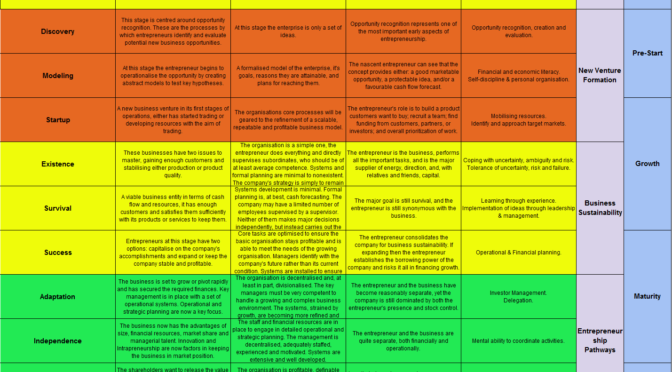
The first three stages of the Enterprise Creation stages which emerged are: Discovery, Modeling, and Startup which form the new venture formation stages. The next three Existence , Survival and Success develop the business into a sustainable business entity. The last three stages: Adaption, Independence and Exit provide the entrepreneurship pathways for the entrepreneur. These final elements complete the entrepreneurship model by focusing on the success of the business, how the entrepreneur progresses beyond the business, their separation into different entities and the entrepreneurs eventual exit. The 9 Stages of Enterprise Creation are set out below:
Stage 1 – Discovery
This first stage of the 9 Stages of Enterprise Creation is centred around the focal competency of Opportunity recognition, creation and evaluation. These are the processes by which entrepreneurs identify and evaluate potential new business opportunities. An opportunity by definition is a favorable set of circumstances which creates a need for a new product, business, or service. Opportunity recognition is the process by which the entrepreneur comes up with a prospective idea for a new venture. Evaluating the opportunity takes research, exploration, and understanding of current needs, demands, and trends from consumers and others. The process of researching and surveying allows the product or service idea to develop, so that it can be modelled.
Stage 2 – Modeling
The second stage is about developing the business logic to create a business model. This is split into three parts and starts by setting out a Strategy, formulating a business model and setting the business processes to achieve the strategy . These form the key elements for the plan to start the business and, are an integral piece of submitting any proposal for an entrepreneurial or intrapreneurial business. The model should be underpinned by the resources available and those which may still need to be secured. Resource allocation and availability are extremely important to startups because sustainability and profit (not loss) depend on proper planning and understanding of the internal and external environments.
Stage 3 – Startup
The fourth stage is starting the enterprise. Once the resources detailed in the business plan are mobilised the entrepreneurial process can be effected and implementation can take place. In this stage the business may be trading or begin to research or develop a product. The aim of this stage is to have the processes in place so that the business can have a scalable, repeatable and profitable business focused on distinct customers within an identified market.
Stage 4 – Existence
At this stage the business has two core focuses; to gain enough customers to create a profitable business and, at the same time establishing production or product quality. The majority of businesses fail at this stage due, in part, to either one or both of these factors. At this stage the organisation is a simple one, the entrepreneur does everything and directly supervises subordinates, who should be of at least average competence. Systems and formal planning are minimal to nonexistent. The company’s strategy is simply to remain alive which requires the focal competency of tolerance of uncertainty, risk and failure
Stage 5 – Survival
At this stage the business should be a viable entity in terms of cash flow and resources, it has enough customers and satisfies them sufficiently with its products or services to gain repeat sales. The organisation is still simple. The company may have a limited number of employees supervised by a junior manager or supervisor. Neither of them makes major decisions independently, but instead carries out the rather well-defined orders of the entrepreneur. Formal planning is, at best, cash forecasting. The major goal is still survival, and the entrepreneur is still synonymous with the business. The entrepreneur starts to implement ideas through leadership and management which provides opportunities to scale.
Stage 6 – Success
Entrepreneurs at this point of the 9 Stages of Enterprise Creation have a number of options: capitalise on the company’s accomplishments, expand or, keep the company stable and profitable. The entrepreneur has a number of ways to capitalise, from exit to taking a ‘founders dividend’ from the business. If the entrepreneur want to expand then the core tasks are to make sure the basic organisation stays profitable so that it will not outrun its source of cash and, to develop managers to meet the needs of the growing organisation. Through the entrepreneurs leadership all managers within the business should now identify with the company’s future opportunities rather than its current condition demonstrating a success to its stakeholders.
Stage 7 – Adaptation
Businesses which reach this stage normally have a number of factors pushing them to adapt, these are normally grounded in changes either to the micro or macro environments. Businesses at this stage will normally be entering a phase of rapid change and will have to have secured the required finances to develop. At this point key management is in place with a set of operational systems. Operational and strategic planning are now a key focus. The organisation is decentralised and, at least in part, divisionalised. The key managers must be very competent to handle a growing and complex business environment. The systems, strained by growth, are becoming more refined and extensive. Both operational and strategic planning are being done and involve specific managers. The entrepreneur and the business have become reasonably separate, yet the company is still dominated by both the entrepreneur’s presence and stock control.
Stage 8 – Independence
A business at this stage should now has the advantages of size, financial resources, market share and managerial talent. Innovation and Intrapreneurship are now key factors in keeping the business in market position. The organisation has the staff and financial resources to engage in detailed operational and strategic planning. The management is decentralised, adequately staffed, and experienced. Business systems are extensive and well developed. The entrepreneur and the business are quite separate, both financially and operationally.
Stage 9 – Exit
The last of the Enterprise Creation stages is focused on exiting the business and making their separation permanent. An exit strategy will give the entrepreneur a way to reduce or eliminate their stake in the business and, if the business is successful, make a substantial profit. This stage removes the entrepreneur from primary ownership and decision-making structure of the business. Common types of exit strategies include Initial Public Offerings (IPO), strategic acquisitions and management buyouts. The organisation at this stage is generally profitable, has a definable set of resources with a clear and realistic strategy to continue. The CEO and founder(s) are separate.
9 stages of Enterprise Creation
The full paper which develops the 9 Stages of Enterprise Creation: Bozward, David and Rogers-Draycott, Matthew Charles (2017) Developing a Staged Competency Based Approach to Enterprise Creation. Proceedings of the International Conference for Entrepreneurship, Innovation and Regional Development. ISSN 2411-5320, can be found at http://eprints.worc.ac.uk/5377/
A textbook that supports learning with multiple case studies is available on Amazon.
You will need to ensure you are motivated to exit the business and that means understand the path for your exit strategy. In every sense you must learn from the exit from your business and the experience should motivate you to build a new enterprise which is more amazing and motivated that this. The five common Exit Strategies are:
Initial Public Offering
The stock market offers you the opportunity to increase the capital available to the business, the money invested and also the rewards available to you. The motivation for being independent will have to reduce as shareholders and accountability move into play.
Acquisition
When you have created a truly unique, thriving and attractive business, it will be becoming an appealing proposition for other businesses. When they offer you the large sum of money for your business, what motivates you to say ‘Yes’? What will you do everyday when you no longer have your business to run? The opportunities are then truly amazing and you can become a member of ‘Serial Entrepreneurs’ club.
Liquidation
Walking along any footpath can be uneasy and the same is true about business. The vast majority of entrepreneurs have a company liquidation in there bag, an experience they will never forget, an event which created some the best lessons they have ever learnt. No expects you to walk straight away, so why do you expect to be able to manage a business from day one without making mistakes. This should be expected, however it is in the learning about business, enterprise and yourself which you can create a truly amazing and vibrant business next time around.
Sell to another Entrepreneur
One of my favour saying is that “People buy from people who are like them”. This is the case from buying your newspaper to buying a company. Entrepreneurs look for opportunities and therefore within your network you will know people who want to buy and run your company better and pay you for the chance.
Shareholder
This option which many entrepreneurs follow is to become a shareholder which then provides revenue for the rest of their lives (e.g. Bill Gates). In some cases the shareholder provides revenue for many generations to come, such as the Guinness family. This exit requires you to create a good team around you who are motivated to continue to move the business forward.
So before you start out on your venture, think about your exit strategy and what you will need the business to look like for you to achieve your goal.
After working with over 20,000 students in the last ten years, I have started to stereotype those coming through into five simple student entrepreneur categories. There is no real theory and a great amount of research here, but I just wanted to share my thoughts and observations on these student entrepreneurs.
Wanta-preneur
This group of people want to mega rich, famous and of course a owner of a super big business. They just want it all! Yet hard work, planning and dedication to entrepreneurship is not at the core of their motivations. They sometimes do start businesses, normally with co-founders who do all the work, while they talk about their business, the people they know and the mega plans they have.
Pros : Great talker who other may believe
Cons : Lacks hard work and dedication
Business-Anarchistic-preneur
Staying the same is not an option, so these people think of distributive technology, business models and taking all the biggest businesses, traditional methods and societies. They know that they will succeed as its only there ability to change the world that will save it.
Pros : Out of the box thinking
Cons : Others don’t take them seriously, just too radical
Social Entrepreneur
This group not only want to start a business but one that helps others. They have great amounts of passion, dedication and drive to see this business idea into a fully developed business. These people understand the need to develop others, work in teams and share the value of their business with as many people as possible.
Pros : A Team player
Cons : Takes too long as brings too many people with them
Geek-preneur
The richest people are Geeks, so why not start the the next Microsoft, Apple or Facebook. These people can make technology work for them and create small dynamic businesses which engage users throughout the world in their dream creation.
Pros : Easy to start boot strapped business
Cons : Lacks people skills to engage others
Just-do-It-preneur
This group just get on with it, never thinking for one moment they can’t. What they lack in skills, knowledge and network, they balance with the shear determination and brut force. They are the bull in the china shop style of entrepreneurship.
Pros : Self belief and determination to make it a success
Cons : Lacks style and skills which makes others believe
As with all people and businesses it about having the team, a set of skills and maybe every business should have a mix of these.
When I look at the process of creating a new venture, I often see people forget some of the basic elements in the process of developing a business plan.
The first three steps are:
Opportunity discovery,
Business modelling
Business planning
Opportunity Discovery
The best idea is the one which provides the best business opportunity. Therefore we are not looking for any idea but an idea which provides the best opportunity.
Therefore the process of ideation captures the current industry trends and the competitor in and around them. The technology innovation currently applied to this market and the outlook we see in terms of costs and market adoption trends.
The creative problem solving can not sit in isolation and needs to be surrounded by the context for it to be applied to create an outstanding value proposition later on.
Business Modelling
For most people this is filling out the Business Model Canvas, a tools which provides a powerful view of the business model. But again this is completed in isolation within a full understanding the ecosystem, actors and their behaviours.
The process of modelling is about understanding the relationship between the key actors within the ecosystem, it doesn’t matter if its designing a new road bridge, a tv or a new products. This dynamic relationship is so important in understanding the processes and metrics to be put in place to plan the business.
Business Planning
The core aspects of Business Planning are risk analysis, scenario planning and financial planning. Once these are done the rest, include product design, marketing strategy and operations are secondary.
All investors want to know you can manage this risk and act accordingly.
The process of developing a business plan are about understanding the dynamic relationship and how to mitigate the risks they pose to your business. Its not an exercise in writing or filling out the right amount of words in the right sections.
The process of developing a business plan is simple yet so many people get it wrong. Just remember to understand the dynamic nature of business and that your business startup will be connected with these and therefore needs to adjust to maintain a successful course through the early years.
Co-founders are normally people involved in the initial launch of startup companies. Anyone can be a co-founder, but frequently co-founders are entrepreneurs, engineers, hackers, funders, web developers, web designers and others involved in the ground level of a new venture. The first step in finding your co-founder is to map yours needs. Make sure you are perfectly clear on what skillsets/resources will be the most important for the success of the startup, and best fill a hole in your own resume and desired management team.
Friends from University – It worked for the guys at Facebook and Google, so just get out and meet other students.
Former co-workers – If you’ve worked together as employees, you might be able to work together as co-founders. You have the history and know each others skill sets.
People you meet over coffee – We see hot beds of startups co-locating themselves in coffee shops, just talk to the guy next to you.
Former co-founders in another venture – There’s no better person to launch with than someone that has started a company before.
Accelerators – Related to some of the other co-working suggestions, simply applying to a startup accelerator can lead to finding a co-founder.
At meet-ups – Tech Meetups are great places to find co-founders and they are easy to find and also go to.
As an entrepreneur we have lots of do, but sometimes we just do it wrong, we let obstacles get in our way. So what are the typical obstacles we entrepreneurs have to deal with:
Perfectionism – For entrepreneurs, practice doesn’t make perfect; action does. You simply cannot wait until you are 100 percent ready before you take action. Think MVP.
Procrastination – Sometimes its easier to delay the decision, the action or even dealing with the problem, so each day “Eat the Frog” and take action of the real issues within your business.
Fear – Entrepreneurs’ resolve is tested from the very first step of starting a business. In fact, one entrepreneur compared starting a business to jumping off a cliff and assembling your parachute on the way down.
Worry – As an entrepreneur, worry comes with the territory. In fact, over a third of entrepreneurs told Gallup they worried a lot about yesterday. While worry is a quotidian experience, it is not productive. You have to make peace with the things that concern you, and not let them stop you from taking action and pursuing your dreams.
Financing – Experienced entrepreneurs don’t have it easy when it comes to funding a new business, but they do have a few advantages over newcomers. They might have a pool of capital from a business they previously sold or a steady stream of revenue they can use to fund a new business’s cash flow.
Team building – This is especially hard if you’ve never run or managed a team before, but even if you have management experience, picking the right team for a startup is stressful and difficult. It’s not enough to find candidates who fill certain roles — you also need to consider their cost to the business, their culture fit and how they’ll work as part of your overall team. Such considerations are exceptionally hard when you’re under the pressure of filling those positions as soon as possible.
Decision-making – Believe it or not, this is probably the most stressful challenge on this list. New entrepreneurs are forced to make hundreds of decisions a day, from big, company-impacting decisions, to tiny, hour-affecting ones. Decision fatigue is a real phenomenon, and most new entrepreneurs will experience it if they aren’t prepared for the new level of stress.
In the last year I have had the amazing opportunity to design a venture creation BA (Hons) Entrepreneurship Programme which is oriented towards students who wish to combine study towards an honours degree with the opportunity to start their own business in a supported environment with guidance from specialist lecturers, practising entrepreneurs and mentors. Over the years I have seen many programmes and wanted to create something for Entrepreneurs, the student and for practitioners.
This is a practice-oriented degree, which focuses on the development of the students’ entrepreneurial effectiveness. This is achieved by embracing the concept of ‘learning by doing’ which ensures students are acquiring real knowledge and practical expertise to support their business start-up and business growth aspirations. There is a focus on real business experiences including master classes, enterprise events and interactions with local and global entrepreneurs. This philosophy is extended within the assessment primarily for (rather than ‘of’) learning Entrepreneurship (QAA (2012) Enterprise and Entrepreneurship Education: Guidance for UK Higher Education Providers, pp9).
Similarly, although there is an inherent emphasis on learning within the learner’s own start-up venture, the Entrepreneurship skills acquired will be transferable to other business environments and learning opportunities.
This BA (Hons) Entrepreneurship Programme aligns with the nation and international government agenda (The Impact and Effectiveness of Entrepreneurship Policy, NESTA 2013) and seeks to increase the number of entrepreneurs in the economy.
A range of teaching pedagogies are adopted to ensure the curriculum enhances the learning of all students both in the startup and in group learning environments. In addition to lectures, seminars, videos, podcasts, presentations and visiting entrepreneurs, students will participate in action learning sets and interactive activities to apply learning from businesses experiences in their startup. These approaches are intended to take into account the principles of inclusivity: the types of learner, their startup business, their prior experience and expectations and how they learn and will be supported to learn effectively.
Given the focus on developing a continued learning environment in which students develop an entrepreneurial mindset, there is an emphasis within the BA (Hons) Entrepreneurship Programme on tutoring and mentoring to support individual requirements, and also to reflect (at a meta-cognitive level) on their learning process. The programme is supported by more than 10 Entrepreneurs in Residence, regional business support agencies and local businesses.
There is always a real need to get student involved in Enterprise and Entrepreneurship within the university. They have a real need for enterprise skills and developing it into an Entrepreneurial career or a full blown Entrepreneur.
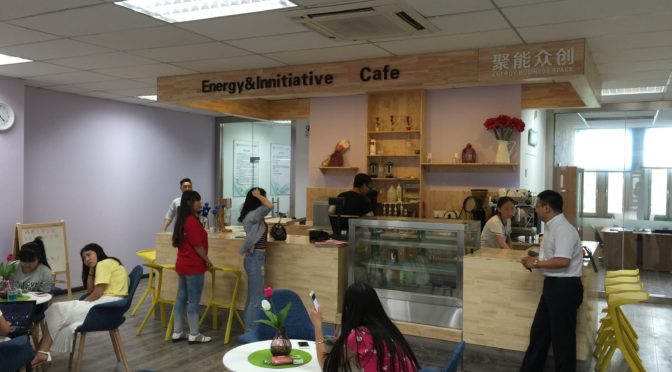
So on a recent visit to the the Tianjin Urban Construction Management Vocational Technology College, we had the opportunity to visit their incubator.
This college is looking at developing Energy Entrepreneurship, developing new businesses which address saving energy or using it in a more effective way, especially within China.
So the real surprise was the cafe within the business incubator was run by Students for Students and business owners. We had the chance to meet the three owners of the business and provide some advice and support. The development of this student led cafe provides a real insight into both the management of the college and also the students within it.
The management have placed trust in the students to start, run and make a success of the cafe. This has resulted in:
1, Trusting students is such an important part of Entrepreneurship and we sometime forget to place this on students.
2, The students have taken a opportunity to run the cafe, something which every student on campus will have an opinion about. I know many students wouldn’t do this as their peers would look down on them or have something to say. The risks and rewards associated with this is a great lesson, but the greatest one is that these students have the largest network on campus.
3, Having a go, should always provide winners, as experience of entrepreneurship will ensure students leave with more skills that we educators could ever teach them.
The cafe was the centre of the business incubator and so made it student led, the cafe was the heart of the space, just as it should be.
So when we arrange, we were saw a great space being used by other students and it was the centre of campus live. So good luck.
When Setting Objectives when Starting up a Business you should always use SMART objectives -the most well known method for setting objectives. S.M.A.R.T refers to the acronym that describes the key characteristics of meaningful objectives, which are:
Specific
WHAT am I going to do?
WHY is this important for me to do?
WHO is going to do what? Who else need to be involved?
WHEN do I want this to be completed?
HOW am I going to do this?
Measureable
How do I know when I have done it?
Can these measurements be obtained?
What are the numbers, quantity, comparisons?
Achievable
Can we get it done in the proposed timeframe?
Do I understand the limitations and constraints?
Can we do this with the resources we have?
Has anyone else done this successfully?
Is this possible?
Realistic
Do you have the resources available to achieve this objective?
Do I need to revisit priorities in my life to make this happen?
Is it possible to achieve this objective?
Time-Bound
When will this objective be accomplished?
Is there a stated deadline? (a defined time line)
Setting Goals Summary
Remember what gets measured gets done, so write your goals down, share them constantly with those who can help, are part of the goal and your team. Keep refining your goals to ensure achievable. If necessary, split goals down into achievable tasks.