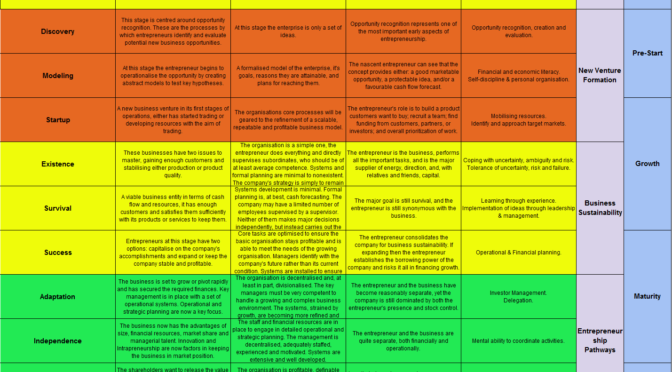
The way we start businesses is changing and through academic research, additional knowledge, skills and tools, the process and issues around growing businesses have profoundly changed Entrepreneurship in the last twenty years. This article develops a new 9 Stages of Enterprise Creation model which is based on today entrepreneurial mindset and the business community ecosystem which molds entrepreneurs and allows their ventures grow.
The first three stages of the Enterprise Creation stages which emerged are: Discovery, Modeling, and Startup which form the new venture formation stages. The next three Existence , Survival and Success develop the business into a sustainable business entity. The last three stages: Adaption, Independence and Exit provide the entrepreneurship pathways for the entrepreneur. These final elements complete the entrepreneurship model by focusing on the success of the business, how the entrepreneur progresses beyond the business, their separation into different entities and the entrepreneurs eventual exit. The 9 Stages of Enterprise Creation are set out below:
Stage 1 – Discovery
This first stage of the 9 Stages of Enterprise Creation is centred around the focal competency of Opportunity recognition, creation and evaluation. These are the processes by which entrepreneurs identify and evaluate potential new business opportunities. An opportunity by definition is a favorable set of circumstances which creates a need for a new product, business, or service. Opportunity recognition is the process by which the entrepreneur comes up with a prospective idea for a new venture. Evaluating the opportunity takes research, exploration, and understanding of current needs, demands, and trends from consumers and others. The process of researching and surveying allows the product or service idea to develop, so that it can be modelled.
Stage 2 – Modeling
The second stage is about developing the business logic to create a business model. This is split into three parts and starts by setting out a Strategy, formulating a business model and setting the business processes to achieve the strategy . These form the key elements for the plan to start the business and, are an integral piece of submitting any proposal for an entrepreneurial or intrapreneurial business. The model should be underpinned by the resources available and those which may still need to be secured. Resource allocation and availability are extremely important to startups because sustainability and profit (not loss) depend on proper planning and understanding of the internal and external environments.
Stage 3 – Startup
The fourth stage is starting the enterprise. Once the resources detailed in the business plan are mobilised the entrepreneurial process can be effected and implementation can take place. In this stage the business may be trading or begin to research or develop a product. The aim of this stage is to have the processes in place so that the business can have a scalable, repeatable and profitable business focused on distinct customers within an identified market.
Stage 4 – Existence
At this stage the business has two core focuses; to gain enough customers to create a profitable business and, at the same time establishing production or product quality. The majority of businesses fail at this stage due, in part, to either one or both of these factors. At this stage the organisation is a simple one, the entrepreneur does everything and directly supervises subordinates, who should be of at least average competence. Systems and formal planning are minimal to nonexistent. The company’s strategy is simply to remain alive which requires the focal competency of tolerance of uncertainty, risk and failure
Stage 5 – Survival
At this stage the business should be a viable entity in terms of cash flow and resources, it has enough customers and satisfies them sufficiently with its products or services to gain repeat sales. The organisation is still simple. The company may have a limited number of employees supervised by a junior manager or supervisor. Neither of them makes major decisions independently, but instead carries out the rather well-defined orders of the entrepreneur. Formal planning is, at best, cash forecasting. The major goal is still survival, and the entrepreneur is still synonymous with the business. The entrepreneur starts to implement ideas through leadership and management which provides opportunities to scale.
Stage 6 – Success
Entrepreneurs at this point of the 9 Stages of Enterprise Creation have a number of options: capitalise on the company’s accomplishments, expand or, keep the company stable and profitable. The entrepreneur has a number of ways to capitalise, from exit to taking a ‘founders dividend’ from the business. If the entrepreneur want to expand then the core tasks are to make sure the basic organisation stays profitable so that it will not outrun its source of cash and, to develop managers to meet the needs of the growing organisation. Through the entrepreneurs leadership all managers within the business should now identify with the company’s future opportunities rather than its current condition demonstrating a success to its stakeholders.
Stage 7 – Adaptation
Businesses which reach this stage normally have a number of factors pushing them to adapt, these are normally grounded in changes either to the micro or macro environments. Businesses at this stage will normally be entering a phase of rapid change and will have to have secured the required finances to develop. At this point key management is in place with a set of operational systems. Operational and strategic planning are now a key focus. The organisation is decentralised and, at least in part, divisionalised. The key managers must be very competent to handle a growing and complex business environment. The systems, strained by growth, are becoming more refined and extensive. Both operational and strategic planning are being done and involve specific managers. The entrepreneur and the business have become reasonably separate, yet the company is still dominated by both the entrepreneur’s presence and stock control.
Stage 8 – Independence
A business at this stage should now has the advantages of size, financial resources, market share and managerial talent. Innovation and Intrapreneurship are now key factors in keeping the business in market position. The organisation has the staff and financial resources to engage in detailed operational and strategic planning. The management is decentralised, adequately staffed, and experienced. Business systems are extensive and well developed. The entrepreneur and the business are quite separate, both financially and operationally.
Stage 9 – Exit
The last of the Enterprise Creation stages is focused on exiting the business and making their separation permanent. An exit strategy will give the entrepreneur a way to reduce or eliminate their stake in the business and, if the business is successful, make a substantial profit. This stage removes the entrepreneur from primary ownership and decision-making structure of the business. Common types of exit strategies include Initial Public Offerings (IPO), strategic acquisitions and management buyouts. The organisation at this stage is generally profitable, has a definable set of resources with a clear and realistic strategy to continue. The CEO and founder(s) are separate.

The full paper which develops the 9 Stages of Enterprise Creation: Bozward, David and Rogers-Draycott, Matthew Charles (2017) Developing a Staged Competency Based Approach to Enterprise Creation. Proceedings of the International Conference for Entrepreneurship, Innovation and Regional Development. ISSN 2411-5320, can be found at http://eprints.worc.ac.uk/5377/
A textbook that supports learning with multiple case studies is available on Amazon.