
Entrepreneurship has been reduced to a narrow and ultimately unhelpful idea: starting a business.
Across universities, policy frameworks, and media narratives, entrepreneurship is framed through start-up activity—pitch decks, venture capital, and the pursuit of rapid scale. This interpretation is not simply incomplete; it is distorting how we educate students, design economic policy, and evaluate success.
The consequence is a system that rewards activity over impact, formation over function, and visibility over value.
If we are serious about improving productivity, employability, and long-term economic resilience, we need to move beyond the start-up myth and return to a more fundamental question:
What is entrepreneurship actually for?
The Problem: We Are Measuring the Wrong Thing
Entrepreneurship policy and education are dominated by simplistic metrics:
- Number of start-ups created
- Amount of funding raised
- Survival rates over three to five years
These measures are easy to quantify, but they are poor proxies for what really matters: value creation.
A business can be launched, funded, and sustained without creating meaningful economic or social value. Equally, significant value can be created within existing organisations, communities, or informal economies without ever appearing in start-up statistics.
This misalignment has three critical consequences.
First, it leads to policy inefficiency. Governments invest heavily in start-up ecosystems without understanding whether those ventures contribute to productivity, innovation, or regional development.
Second, it creates educational distortion. Universities design entrepreneurship programmes around venture creation rather than capability development, leaving graduates underprepared for complex, non-linear careers.
Third, it results in entrepreneurial failure. Founders are encouraged to pursue ideas without understanding the resources, processes, and conditions required to create sustainable value.
In short, we are optimising for the wrong outcome.
Reframing Entrepreneurship: From Activity to Value
To correct this, entrepreneurship must be redefined.
Entrepreneurship is not the act of starting a business. It is:
The process of creating, capturing, and sustaining value through the effective orchestration of resources over time.
This definition shifts the focus in three important ways.
First, it places value at the centre, not activity. The purpose of entrepreneurship is not formation but transformation.
Second, it emphasises process, recognising that entrepreneurship unfolds over time rather than occurring at a single moment of creation.
Third, it highlights resource orchestration, acknowledging that entrepreneurs do not simply use resources—they combine, adapt, and transform them.
This reframing aligns more closely with established economic theory. Joseph Schumpeter, for example, positioned the entrepreneur as an agent of “creative destruction,” reshaping markets through innovation rather than merely creating firms (Schumpeter, 1934). Similarly, Peter Drucker emphasised entrepreneurship as a systematic practice of innovation and value creation (Drucker, 1985).
Yet despite this intellectual foundation, contemporary systems have drifted toward a far narrower interpretation.
The Missing Mechanism: Understanding Entrepreneurial Capital
If entrepreneurship is about value creation, the next question is straightforward:
How is value actually created?
The answer lies in capital—not just financial capital, but a broader set of resources that entrepreneurs draw upon and combine.
The Eight Capitals Model provides a more complete view:
- Financial Capital (money and funding)
- Human/Experiential Capital (skills, knowledge, experience)
- Social Capital (networks and relationships)
- Intellectual Capital (ideas, IP, systems)
- Cultural Capital (norms, behaviours, identity)
- Natural Capital (environmental and physical resources)
- Manufactured Capital (infrastructure, tools, technology)
- Spiritual Capital (purpose, values, motivation)
Traditional approaches overemphasise financial capital, yet evidence consistently shows that access to networks, knowledge, and institutional support often matters more in determining entrepreneurial outcomes (Acs et al., 2014).
Entrepreneurs do not simply deploy these capitals independently. They orchestrate them—combining different forms of capital to create new forms of value.
A founder launching a digital platform, for example, may rely heavily on intellectual and social capital in early stages, while scaling requires increasing levels of financial and manufactured capital.
Understanding this dynamic is critical. Without it, both education and policy remain fundamentally incomplete.
The Process Layer: The 9 Stages of Enterprise Development
While capital explains what resources are used, it does not explain how entrepreneurship unfolds.
Entrepreneurship is not a single act but a staged process. The 9 Stages of Enterprise Development provide a structured way to understand this progression:
- Discovery
- Modeling
- Startup
- Existence
- Survival
- Success
- Adaptation
- Independence
- Exit
Each stage represents a different configuration of challenges, decisions, and resource requirements.
Crucially, value is created differently at each stage.
- In Discovery, value lies in identifying opportunities
- In Startup, it lies in mobilising resources
- In Survival, it lies in achieving cash flow stability
- In Adaptation, it lies in responding to environmental change
This staged perspective aligns with broader economic development theories, such as Walt Rostow’s model of economic growth, which highlights the importance of sequential development phases (Rostow, 1960). However, unlike linear economic models, entrepreneurship is iterative and adaptive.
The key insight is this:
Entrepreneurship is the dynamic interaction between capital and stages, producing value over time.
An Integrated Framework for Entrepreneurship
To move beyond fragmented thinking, these elements must be brought together into a single model.
Integrated Entrepreneurship Framework
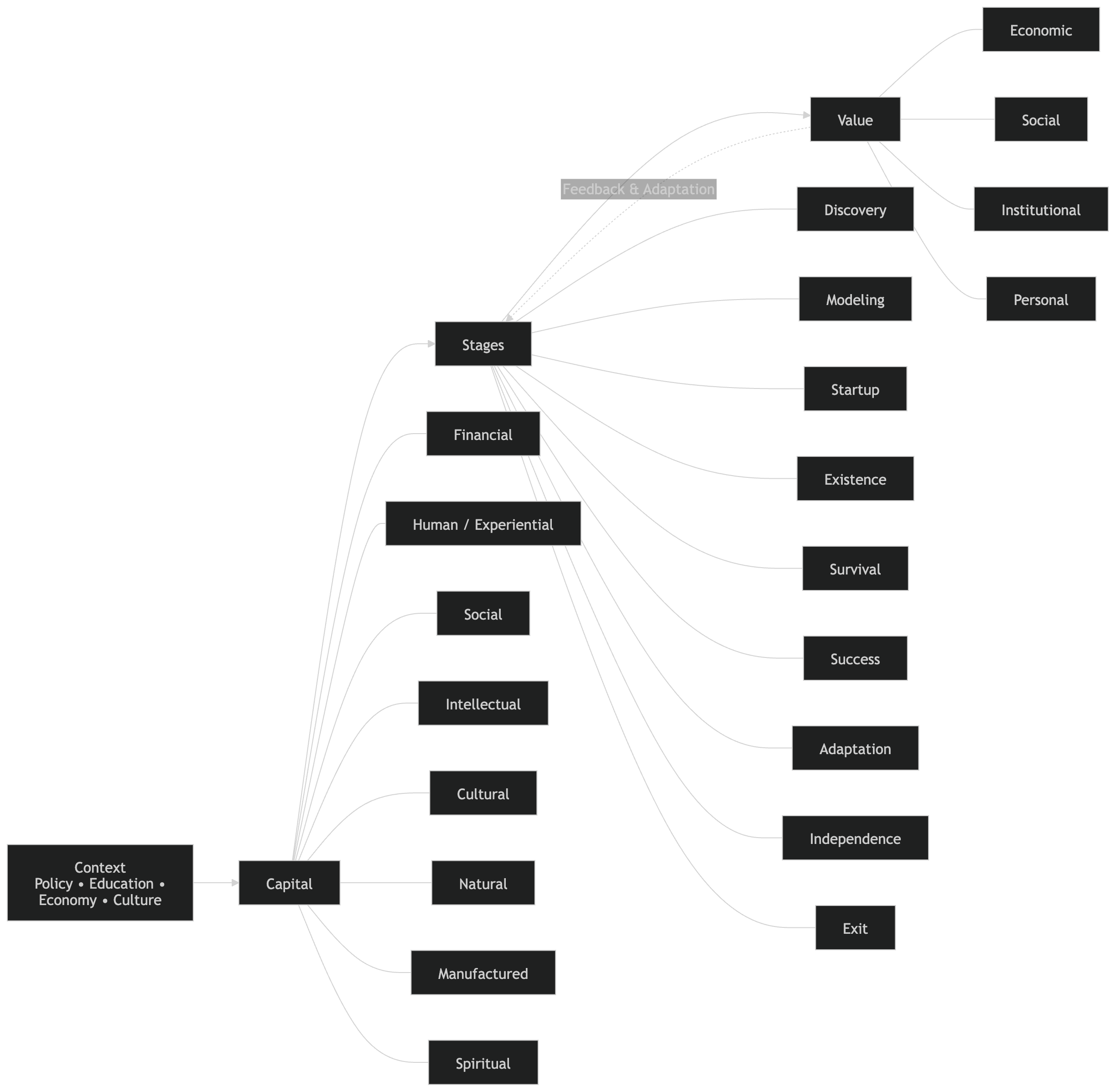
This framework is deliberately simple but conceptually powerful.
- Capital represents the resources available
- Stages represent the process through which entrepreneurship unfolds
- Value represents the outcome
- Context shapes and constrains the system
Most existing approaches focus on only one of these elements. Effective entrepreneurship requires understanding all four—and, critically, how they interact.
Implications for Universities: From Knowledge to Capability
This framework exposes a fundamental weakness in higher education.
Universities largely focus on knowledge transfer, while entrepreneurship requires capability development.
Students are taught:
- Business planning
- Marketing theory
- Financial modelling
But they are rarely taught:
- How to mobilise different forms of capital
- How to navigate different stages of development
- How to create and measure value in real contexts
As a result, graduates leave with theoretical understanding but limited practical capability.
To address this, universities must:
- Embed capital awareness into curricula
Students should understand the different forms of capital and how to access them. - Align learning with stages
Programmes should simulate the progression from discovery to growth, not just start-up. - Measure value creation capability
Assessment should focus on outcomes, not outputs.
This is not a marginal adjustment. It is a structural shift in how education is designed.
Implications for Policy: From Start-Ups to Systems
The same issue applies at the policy level.
Entrepreneurship policy has become overly focused on:
- Start-up grants
- Incubators and accelerators
- Venture capital ecosystems
While these have value, they represent only a small part of the system.
A more effective approach would focus on capital ecosystems:
- Strengthening networks (social capital)
- Investing in skills and education (human capital)
- Supporting infrastructure (manufactured capital)
- Enabling knowledge transfer (intellectual capital)
This is particularly important in regional and rural contexts, where traditional start-up models often fail to translate.
You cannot build entrepreneurial economies by funding businesses alone. You must build the systems that enable value creation.
Implications for Entrepreneurs: Better Decisions, Better Outcomes
For practitioners, this framework provides a more realistic lens.
Instead of asking:
- “Is this a good idea?”
Entrepreneurs should ask:
- “What value am I creating?”
- “What capital do I need—and what am I missing?”
- “What stage am I in—and what does that require?”
This shift leads to better decision-making.
It reduces overconfidence in early stages, improves resource allocation, and increases the likelihood of sustainable growth.
Conclusion: A Necessary Shift
Entrepreneurship matters—not because it creates businesses, but because it creates value.
If we continue to define entrepreneurship as start-up activity, we will continue to miseducate students, misallocate resources, and misunderstand economic growth.
The alternative is clear.
We must move toward a model that recognises:
- The role of capital
- The importance of process
- The centrality of value
- The influence of context
This is not simply an academic exercise. It is a practical necessity.
The future of entrepreneurship lies not in more businesses—but in better value creation.
References (APA Style)
Acs, Z. J., Autio, E., & Szerb, L. (2014). National systems of entrepreneurship: Measurement issues and policy implications. Research Policy, 43(3), 476–494.
Drucker, P. F. (1985). Innovation and entrepreneurship: Practice and principles. Harper & Row.
Schumpeter, J. A. (1934). The theory of economic development. Harvard University Press.
Rostow, W. W. (1960). The stages of economic growth: A non-communist manifesto. Cambridge University Press.
Neck, H. M., Greene, P. G., & Brush, C. G. (2014). Teaching entrepreneurship: A practice-based approach. Edward Elgar.
World Bank. (2020). Doing business 2020: Comparing business regulation in 190 economies. World Bank Publications.
OECD. (2021). Entrepreneurship at a glance 2021. OECD Publishing.