Employability has become one of the defining metrics of higher education. It sits at the centre of league tables, regulatory frameworks, and institutional strategy. Yet, despite the attention it receives, most universities are measuring it in ways that fundamentally misunderstand what employability actually is—and how it is created.
This is not a minor technical issue. It is a structural flaw. And it is quietly shaping the behaviour of institutions, the design of curricula, and the experiences of students in ways that ultimately undermine the very outcomes universities claim to prioritise.
The Problem: Measuring Outcomes, Ignoring Systems
Most universities measure employability through a narrow set of outcome indicators:
- Graduate employment rates (often within 6–15 months)
- Salary levels
- Progression into “highly skilled” roles
- Further study rates
These metrics are attractive because they are simple, comparable, and quantifiable. They allow regulators and rankings to create clean hierarchies. But they also create a dangerous illusion: that employability is an endpoint rather than a process.
In reality, employability is not something that happens after graduation. It is something that is developed—often unevenly—over time.
By focusing only on outcomes, universities overlook the underlying systems that produce those outcomes. This leads to three critical distortions:
- Short-termism – prioritising immediate employment over long-term career capability
- Attribution errors – assuming university input is the primary driver of outcomes
- Metric gaming – designing interventions to improve scores rather than substance
The result is a measurement system that is precise, but not accurate.
Employability Is Not Employment
The first conceptual error is simple but profound: employability is not the same as employment.
A graduate securing a job within six months tells us very little about their underlying capability. It tells us even less about their long-term trajectory.
Employment outcomes are shaped by multiple external variables:
- Local and national labour market conditions
- Socio-economic background and networks
- Prior work experience
- Industry demand cycles
- Geographic mobility
A student with strong social capital and access to networks may secure employment quickly, even with relatively underdeveloped skills. Conversely, a highly capable student without those advantages may take longer to secure a role.
If we measure employability purely through employment outcomes, we are effectively measuring advantage, not capability.
This distinction matters. Because universities are not primarily responsible for labour markets—but they are responsible for capability development.
The Missing Layer: Capability Development
At its core, employability is about the development of capabilities that allow individuals to:
- Enter the labour market
- Navigate uncertainty
- Create and capture value
- Adapt over time
These capabilities are multi-dimensional. They include:
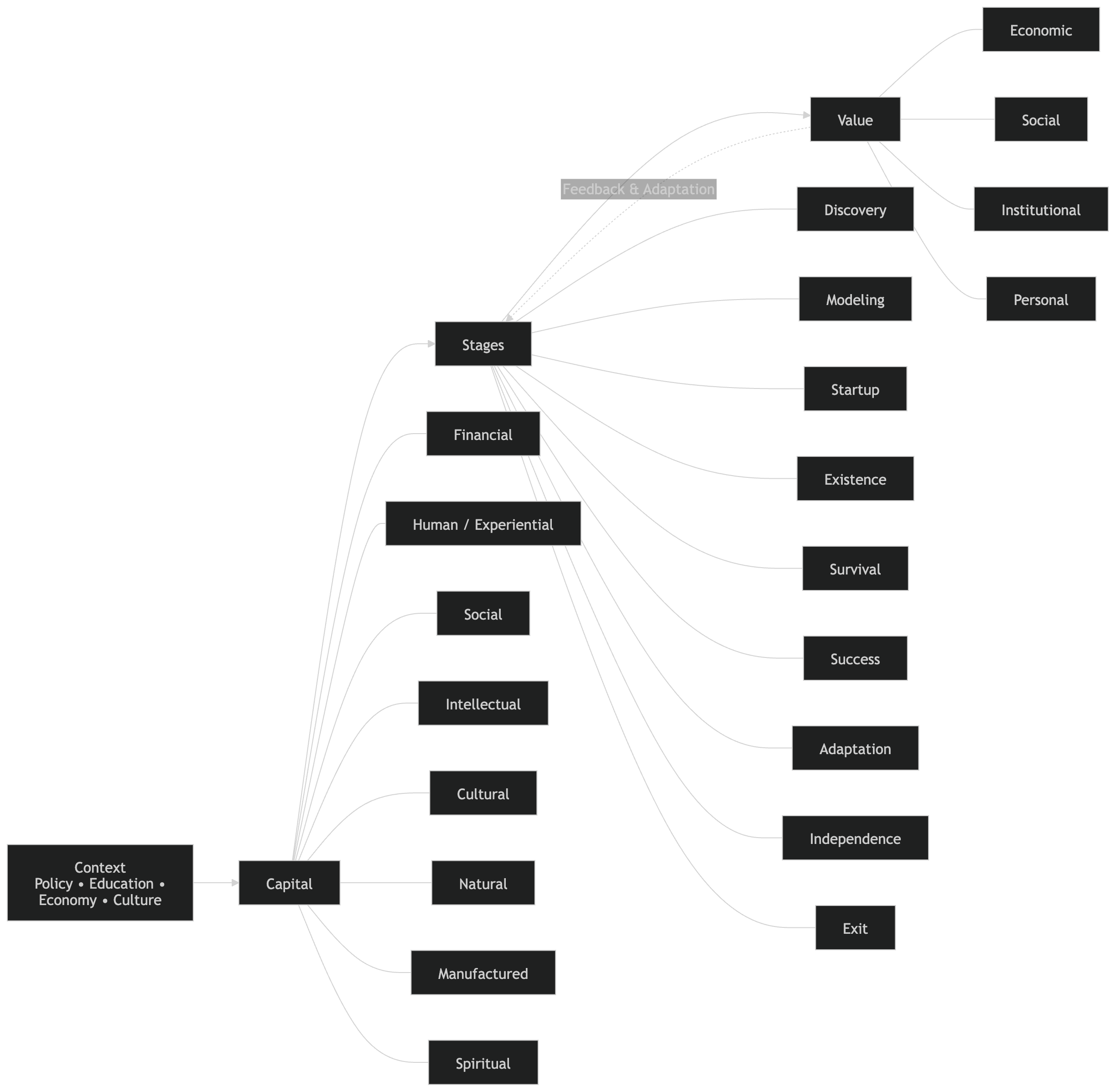
- Human capital (skills, knowledge, competencies)
- Social capital (networks, relationships, signalling)
- Cultural capital (confidence, norms, behaviours)
- Experiential capital (practical application, real-world exposure)
Most employability metrics fail to capture these dimensions in any meaningful way.
Instead, they rely on proxy indicators—such as employment status—that sit several steps removed from the actual developmental process.
This creates a measurement gap: universities are judged on outcomes they only partially control, while the capabilities they do influence remain largely invisible.
The Pipeline Fallacy
Universities often treat employability as a linear pipeline:
Education → Graduation → Employment
This model is intuitive—but wrong.
In reality, employability is a complex, iterative process that begins long before university and continues long after graduation.
Students do not enter university as blank slates. They bring with them:
- Prior educational experiences
- Family expectations
- Networks and connections
- Confidence (or lack of it)
- Exposure to the world of work
Similarly, graduation is not a fixed endpoint. Careers are no longer linear. They involve transitions, pivots, and periods of uncertainty.
By imposing a linear model onto a non-linear reality, universities create systems that are poorly aligned with how careers actually develop.
The Timing Problem: Measuring Too Late
One of the most significant flaws in current employability metrics is timing.
Most measurements occur after graduation—often 6 to 15 months later. By this point:
- The student has left the institution
- Multiple external factors have influenced outcomes
- The opportunity for intervention has passed
This is equivalent to evaluating a learning process only after the exam, without ever assessing progress during the course.
If universities are serious about employability, measurement must shift upstream.
We need to ask:
- What capabilities are students developing during their studies?
- How are these capabilities evolving over time?
- Where are the gaps—and how can they be addressed early?
Without this, employability becomes a retrospective exercise rather than a developmental one.
The Behavioural Consequences of Bad Metrics
Metrics do not just measure behaviour—they shape it.
When universities are judged primarily on graduate outcomes, they respond rationally:
- Focusing resources on final-year students
- Prioritising “quick wins” in employment outcomes
- Targeting students who are easiest to place
- Investing in reporting systems rather than developmental systems
This creates a skewed distribution of support, where those who need the most help often receive the least.
It also encourages surface-level interventions:
- CV workshops without real experience
- Mock interviews without industry context
- Job boards without network development
These activities are not inherently bad—but they are insufficient on their own. They treat employability as a set of discrete tasks rather than a deeply embedded process.
The Employability Illusion
Many universities can point to impressive employability statistics. High employment rates. Strong salary outcomes. Positive graduate surveys.
But these metrics often mask underlying issues:
- Students lacking confidence in real-world environments
- Graduates struggling to progress beyond entry-level roles
- Limited entrepreneurial capability
- Weak industry integration within curricula
This creates what might be called the employability illusion: the appearance of success without the underlying substance.
The danger is that institutions begin to believe their own metrics—while students experience a very different reality.
Reframing Employability: A Systems Perspective
To fix this problem, we need to move from an outcome-based model to a systems-based model.
Employability should be understood as the interaction of multiple systems:
- Curriculum systems – how learning is designed and delivered
- Experience systems – access to placements, projects, and real-world exposure
- Support systems – careers services, mentoring, coaching
- Network systems – employer engagement, alumni connections
- Student systems – motivation, agency, identity
Measurement must reflect this complexity.
Instead of asking, “Did the student get a job?” we should be asking:
- What capabilities has the student developed?
- What experiences have they accumulated?
- What networks have they built?
- How confident are they in navigating uncertainty?
These are harder questions—but they are the right ones.
A Better Model: Measuring Development, Not Just Outcomes
A more effective employability measurement framework would include three layers:
1. Input Measures (What Universities Provide)
- Integration of employability into curriculum
- Access to industry projects and placements
- Quality of employer engagement
- Availability of mentoring and coaching
2. Process Measures (What Students Do)
- Participation in work-based learning
- Engagement with careers services
- Development of portfolios and projects
- Network-building activities
3. Capability Measures (What Students Become)
- Problem-solving ability
- Communication and collaboration
- Adaptability and resilience
- Entrepreneurial thinking
Outcome measures (employment, salary) should still exist—but as one part of a broader system.
This shifts the focus from what happened to how it happened.
Embedding Employability, Not Bolting It On
One of the most persistent challenges is that employability is often treated as an add-on rather than a core function.
Careers services operate in parallel to academic departments. Workshops are optional. Engagement is uneven.
This model does not work.
Employability must be embedded into the curriculum itself:
- Assessment linked to real-world problems
- Industry projects integrated into modules
- Reflection on skills and development built into learning
- Continuous exposure to professional contexts
This requires a fundamental shift in how universities design education.
It also requires academic staff to see employability not as an external requirement—but as part of their core role.
The Role of Data: From Reporting to Insight
Universities are not short of data. The problem is how it is used.
Most employability data is designed for reporting—to regulators, rankings, and stakeholders. It is retrospective and static.
What is needed is developmental data:
- Real-time insights into student engagement
- Tracking of capability development over time
- Identification of at-risk students early
- Feedback loops that inform intervention
This is where systems such as integrated dashboards, longitudinal tracking, and learning analytics become critical.
But the purpose must be clear: not to produce better reports, but to enable better decisions.
The Equity Dimension
Current employability metrics also obscure issues of equity.
Students from disadvantaged backgrounds often face structural barriers:
- Limited access to networks
- Financial constraints limiting unpaid opportunities
- Lower confidence in professional environments
- Fewer role models
If universities are judged purely on outcomes, there is little incentive to address these deeper issues.
A capability-based model, by contrast, allows institutions to:
- Identify gaps early
- Target support where it is needed most
- Measure progress in a more nuanced way
This is not just a measurement issue—it is a question of fairness.
Entrepreneurship: The Missing Piece
Another major omission in employability measurement is entrepreneurship.
Most frameworks assume that success means entering employment. But for many students, particularly in a changing economy, value creation may take different forms:
- Starting a business
- Freelancing or portfolio careers
- Creating social enterprises
- Innovating within organisations
Entrepreneurial capability is increasingly central to employability. It includes:
- Opportunity recognition
- Resource mobilisation
- Risk management
- Value creation
Yet it is rarely measured explicitly.
This reflects a deeper issue: universities are still operating with an industrial-era model of employment, while the economy is moving towards a more fluid, entrepreneurial reality.
Towards a More Honest System
Fixing employability measurement does not require abandoning metrics. It requires making them more honest.
An honest system would:
- Acknowledge the limits of outcome data
- Measure capability development explicitly
- Track student engagement over time
- Reflect the diversity of career pathways
- Prioritise long-term outcomes over short-term wins
It would also require regulators and rankings to evolve—moving beyond simplistic indicators towards more nuanced frameworks.
Conclusion: From Metrics to Meaning
The current approach to employability measurement is not failing because it lacks data. It is failing because it is measuring the wrong things.
By focusing on outcomes rather than systems, employment rather than capability, and short-term metrics rather than long-term development, universities have created a model that is easy to report—but difficult to defend.
If we are serious about preparing students for a complex, uncertain, and rapidly changing world, we need to rethink what employability means—and how it is measured.
This is not just a technical adjustment. It is a strategic shift.
Because in the end, employability is not about whether a graduate gets a job.
It is about whether they can build a career, create value, and adapt over time.
And that is something no single metric can capture—but a well-designed system can support.