Tag: skills development

  • Why “Starting a Business” Is the Wrong Definition of Entrepreneurship

    Why “Starting a Business” Is the Wrong Definition of Entrepreneurship

    Entrepreneurship has been reduced—often carelessly—to a single, visible act: starting a business. It is a definition that fits neatly into policy targets, university league tables, and social media narratives. It is also deeply misleading.

    If we define entrepreneurship purely as business formation, we misunderstand how value is actually created in modern economies. We incentivise the wrong behaviours, design ineffective education systems, and ultimately fail to develop individuals capable of navigating uncertainty, creating opportunity, and driving innovation.

    Entrepreneurship is not an event. It is a process. More importantly, it is a way of thinking and acting that extends far beyond the act of launching a company.

    This distinction matters.


    The Problem with the “Start-Up” Definition

    At first glance, defining entrepreneurship as “starting a business” seems logical. After all, many entrepreneurs do start businesses. Governments track new firm registrations. Universities celebrate student start-ups. Investors seek scalable ventures.

    But this definition suffers from three fundamental flaws.

    1. It focuses on the outcome, not the capability

    Starting a business is an output. Entrepreneurship is the capability that precedes it.

    By focusing on the visible outcome, we ignore the underlying skills that actually matter: opportunity recognition, resource mobilisation, resilience, and value creation. These capabilities can exist without a business being formed—and often do.

    A graduate who identifies inefficiencies in a public service and redesigns a process is demonstrating entrepreneurial behaviour. So is an employee who creates a new product line within an existing firm. Neither has “started a business,” yet both are acting entrepreneurially.

    2. It creates a false binary

    The traditional definition forces individuals into two categories: entrepreneurs and non-entrepreneurs. You either start a business, or you don’t.

    Reality is far more nuanced.

    Entrepreneurial behaviour exists on a spectrum. Individuals move in and out of entrepreneurial activity throughout their careers. A corporate manager may act entrepreneurially in one role and not in another. A retiree may develop a small lifestyle venture that is entrepreneurial in intent but not in scale.

    By reducing entrepreneurship to a binary state, we ignore this fluidity—and, in doing so, fail to support it.

    3. It distorts incentives in education and policy

    When entrepreneurship is measured by start-up numbers, institutions respond accordingly.

    Universities push students to “start something,” often prematurely. Policymakers prioritise business formation statistics over business survival or value creation. Support programmes focus on incorporation rather than capability development.

    The result is predictable: a proliferation of low-quality start-ups, high failure rates, and a generation of individuals who associate entrepreneurship with short-lived ventures rather than sustained value creation.


    Entrepreneurship as a Process, Not an Event

    A more useful way to understand entrepreneurship is as a staged process of value creation under conditions of uncertainty.

    In my own work, this is reflected in the 9 Stages of the Entrepreneurial Lifecycle:

    1. Discovery – recognising or creating opportunity
    2. Modeling – shaping the business model and strategy
    3. Startup – mobilising resources
    4. Existence – establishing product-market fit
    5. Survival – achieving financial viability
    6. Success – scaling or stabilising
    7. Adaptation – responding to change
    8. Independence – achieving maturity and strength
    9. Exit – transitioning ownership or legacy

    The act of “starting a business” sits within just one of these stages—Startup—and even then, it is only a part of it.

    By focusing solely on start-up activity, we ignore the complexity of what comes before and after. Opportunity recognition, for example, is arguably the most critical stage. Without it, no meaningful venture emerges. Similarly, adaptation and survival often determine long-term success far more than the initial launch.

    Entrepreneurship, therefore, is not defined by the moment a company is registered. It is defined by the journey of creating, shaping, and sustaining value over time.


    The Central Role of Value Creation

    If starting a business is not the defining feature of entrepreneurship, what is?

    The answer is value creation.

    Entrepreneurship is the process of identifying, creating, and delivering value in new ways. This value may be economic, social, environmental, or cultural. It may occur within a new venture, an existing organisation, or even outside formal structures.

    This reframing shifts the focus from structure to impact.

    A start-up that fails to create value is not entrepreneurial in any meaningful sense—it is simply a business that did not work. Conversely, an individual who creates significant value within an organisation is demonstrating entrepreneurship, even without ownership.

    This perspective aligns more closely with how modern economies function. Innovation increasingly occurs within networks, ecosystems, and hybrid organisational forms. The boundaries between “entrepreneur” and “employee” are blurred.


    The Role of Entrepreneurial Capital

    Understanding entrepreneurship as value creation also requires us to reconsider the resources involved.

    Traditional models focus heavily on financial capital. Yet, in practice, entrepreneurs draw on a far broader set of resources—what I have described as entrepreneurial capital.

    This includes:

    • Human capital (skills, knowledge, experience)
    • Social capital (networks and relationships)
    • Intellectual capital (ideas, IP, and insights)
    • Cultural capital (values, norms, and identity)
    • Experiential capital (learning through action)
    • Natural and manufactured capital (physical and environmental resources)
    • Spiritual capital (purpose and motivation)

    These forms of capital are mobilised and combined throughout the entrepreneurial process. Crucially, they are not exclusive to business founders.

    An individual can build and deploy entrepreneurial capital in many contexts: within organisations, communities, or personal projects. By focusing solely on business creation, we overlook this broader capability.


    Entrepreneurship Beyond the Start-Up

    To move beyond the narrow definition, it is useful to consider where entrepreneurial behaviour actually occurs.

    1. Within organisations (Intrapreneurship)

    Large organisations depend on individuals who can identify opportunities, innovate, and drive change from within. These intrapreneurs operate under constraints but often have access to greater resources.

    Many of the most impactful innovations—new products, services, and processes—are developed inside existing firms rather than start-ups.

    2. In public and third-sector contexts

    Entrepreneurship is increasingly critical in public services and non-profit organisations. Social entrepreneurs address complex challenges, from healthcare to education to environmental sustainability.

    Again, the focus is not on starting a business, but on creating value in new ways.

    3. Through portfolio and lifestyle ventures

    Not all entrepreneurship is about high-growth, venture-backed companies. Many individuals engage in small-scale, lifestyle, or portfolio entrepreneurship.

    These ventures may prioritise autonomy, flexibility, or personal fulfilment over scale. They are no less entrepreneurial for it.

    4. Across careers and life stages

    Entrepreneurial behaviour evolves over time. A student experimenting with ideas, a mid-career professional innovating within a firm, and a retiree launching a small consultancy are all engaging in entrepreneurship in different ways.

    Reducing entrepreneurship to start-up activity ignores this lifecycle.


    The Consequences of Getting It Wrong

    Misdefining entrepreneurship is not just an academic issue—it has real-world consequences.

    For universities

    When entrepreneurship education focuses on business start-up, it often neglects broader employability and capability development. Students may graduate with business plans but lack the skills to operate in uncertain environments.

    A more effective approach is to embed entrepreneurial thinking across disciplines, focusing on problem-solving, creativity, and value creation.

    For policymakers

    Policies that prioritise start-up numbers can lead to superficial success metrics. High rates of business formation may mask low survival rates and limited economic impact.

    A shift towards measuring value creation, innovation, and long-term sustainability would provide a more accurate picture.

    For individuals

    Perhaps most importantly, the narrow definition discourages many people from seeing themselves as entrepreneurial.

    If entrepreneurship is equated with starting a business, those who do not wish to do so may disengage entirely. Yet they may possess significant entrepreneurial potential.


    Redefining Entrepreneurship for a Changing Economy

    So how should we define entrepreneurship?

    A more useful definition might be:

    Entrepreneurship is the capability and process of creating value through the identification and exploitation of opportunities under conditions of uncertainty.

    This definition shifts the emphasis in several important ways:

    • From event to process
    • From structure to capability
    • From ownership to impact
    • From start-up to value creation

    It also aligns more closely with the realities of a changing economy, where careers are non-linear, organisations are fluid, and innovation is distributed.


    Implications for Practice

    If we accept this broader definition, several practical implications follow.

    1. Education must move beyond start-up support

    Entrepreneurship education should focus on developing capabilities that are transferable across contexts: opportunity recognition, resourcefulness, resilience, and critical thinking.

    Start-up support remains important—but as one pathway, not the endpoint.

    2. Metrics must evolve

    Success should not be measured solely by the number of businesses started. Instead, we should consider:

    • Value created (economic and social)
    • Innovation outcomes
    • Capability development
    • Long-term sustainability

    3. Support systems must be more inclusive

    Entrepreneurial support should extend beyond aspiring founders to include intrapreneurs, social innovators, and individuals at different life stages.

    This requires a shift from programme-based interventions to ecosystem thinking.


    A More Honest Conversation About Entrepreneurship

    The narrative of entrepreneurship as “starting a business” is appealing because it is simple and visible. It provides clear stories, measurable outcomes, and identifiable heroes.

    But it is also incomplete.

    A more honest conversation acknowledges that entrepreneurship is messy, iterative, and often invisible. It involves failure, adaptation, and long periods of uncertainty. It is as much about thinking and behaving differently as it is about launching ventures.

    For those of us working in education, policy, and practice, this shift is essential.

    If we continue to equate entrepreneurship with business start-up, we will continue to produce the wrong outcomes. We will encourage activity without capability, quantity without quality, and visibility without value.

    If, however, we redefine entrepreneurship as a process of value creation, we open up a far richer and more inclusive understanding. One that recognises the diverse ways in which individuals contribute to economic and social progress.


    Conclusion

    Starting a business is not entrepreneurship. It is one possible expression of it.

    Entrepreneurship is the ability to see opportunities where others see problems, to mobilise resources where others see constraints, and to create value where none previously existed.

    It is a capability that can be developed, applied, and sustained across contexts and throughout a lifetime.

    And in a world defined by uncertainty, complexity, and rapid change, it is a capability we can no longer afford to misunderstand.

  • Entrepreneurship Is Not Start-Up: A New Framework for Value Creation, Education, and Economic Growth

    Entrepreneurship Is Not Start-Up: A New Framework for Value Creation, Education, and Economic Growth

    Entrepreneurship has been reduced to a narrow and ultimately unhelpful idea: starting a business.

    Across universities, policy frameworks, and media narratives, entrepreneurship is framed through start-up activity—pitch decks, venture capital, and the pursuit of rapid scale. This interpretation is not simply incomplete; it is distorting how we educate students, design economic policy, and evaluate success.

    The consequence is a system that rewards activity over impact, formation over function, and visibility over value.

    If we are serious about improving productivity, employability, and long-term economic resilience, we need to move beyond the start-up myth and return to a more fundamental question:

    What is entrepreneurship actually for?


    The Problem: We Are Measuring the Wrong Thing

    Entrepreneurship policy and education are dominated by simplistic metrics:

    • Number of start-ups created
    • Amount of funding raised
    • Survival rates over three to five years

    These measures are easy to quantify, but they are poor proxies for what really matters: value creation.

    A business can be launched, funded, and sustained without creating meaningful economic or social value. Equally, significant value can be created within existing organisations, communities, or informal economies without ever appearing in start-up statistics.

    This misalignment has three critical consequences.

    First, it leads to policy inefficiency. Governments invest heavily in start-up ecosystems without understanding whether those ventures contribute to productivity, innovation, or regional development.

    Second, it creates educational distortion. Universities design entrepreneurship programmes around venture creation rather than capability development, leaving graduates underprepared for complex, non-linear careers.

    Third, it results in entrepreneurial failure. Founders are encouraged to pursue ideas without understanding the resources, processes, and conditions required to create sustainable value.

    In short, we are optimising for the wrong outcome.


    Reframing Entrepreneurship: From Activity to Value

    To correct this, entrepreneurship must be redefined.

    Entrepreneurship is not the act of starting a business. It is:

    The process of creating, capturing, and sustaining value through the effective orchestration of resources over time.

    This definition shifts the focus in three important ways.

    First, it places value at the centre, not activity. The purpose of entrepreneurship is not formation but transformation.

    Second, it emphasises process, recognising that entrepreneurship unfolds over time rather than occurring at a single moment of creation.

    Third, it highlights resource orchestration, acknowledging that entrepreneurs do not simply use resources—they combine, adapt, and transform them.

    This reframing aligns more closely with established economic theory. Joseph Schumpeter, for example, positioned the entrepreneur as an agent of “creative destruction,” reshaping markets through innovation rather than merely creating firms (Schumpeter, 1934). Similarly, Peter Drucker emphasised entrepreneurship as a systematic practice of innovation and value creation (Drucker, 1985).

    Yet despite this intellectual foundation, contemporary systems have drifted toward a far narrower interpretation.


    The Missing Mechanism: Understanding Entrepreneurial Capital

    If entrepreneurship is about value creation, the next question is straightforward:

    How is value actually created?

    The answer lies in capital—not just financial capital, but a broader set of resources that entrepreneurs draw upon and combine.

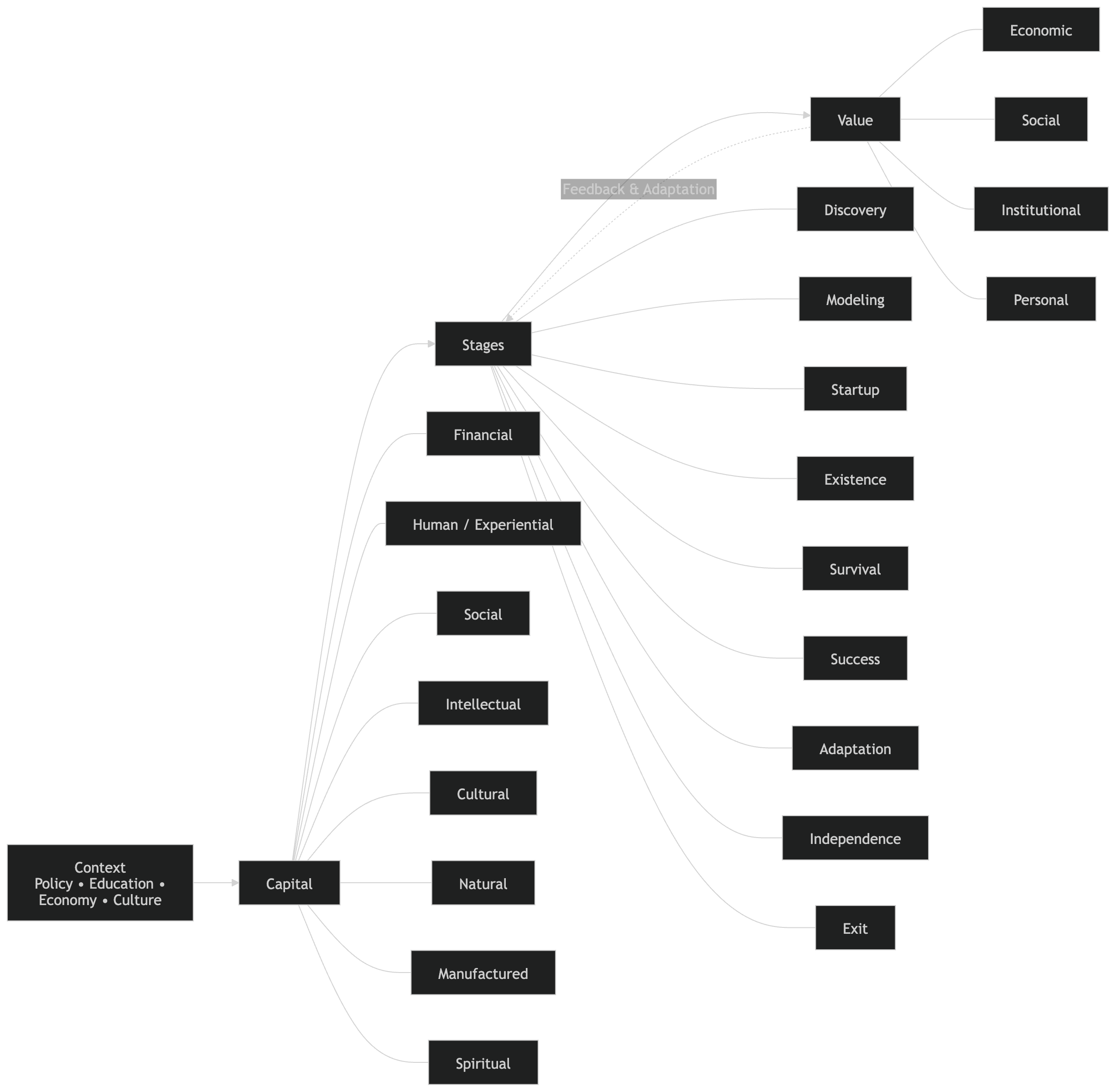
    The Eight Capitals Model provides a more complete view:

    • Financial Capital (money and funding)
    • Human/Experiential Capital (skills, knowledge, experience)
    • Social Capital (networks and relationships)
    • Intellectual Capital (ideas, IP, systems)
    • Cultural Capital (norms, behaviours, identity)
    • Natural Capital (environmental and physical resources)
    • Manufactured Capital (infrastructure, tools, technology)
    • Spiritual Capital (purpose, values, motivation)

    Traditional approaches overemphasise financial capital, yet evidence consistently shows that access to networks, knowledge, and institutional support often matters more in determining entrepreneurial outcomes (Acs et al., 2014).

    Entrepreneurs do not simply deploy these capitals independently. They orchestrate them—combining different forms of capital to create new forms of value.

    A founder launching a digital platform, for example, may rely heavily on intellectual and social capital in early stages, while scaling requires increasing levels of financial and manufactured capital.

    Understanding this dynamic is critical. Without it, both education and policy remain fundamentally incomplete.


    The Process Layer: The 9 Stages of Enterprise Development

    While capital explains what resources are used, it does not explain how entrepreneurship unfolds.

    Entrepreneurship is not a single act but a staged process. The 9 Stages of Enterprise Development provide a structured way to understand this progression:

    1. Discovery
    2. Modeling
    3. Startup
    4. Existence
    5. Survival
    6. Success
    7. Adaptation
    8. Independence
    9. Exit

    Each stage represents a different configuration of challenges, decisions, and resource requirements.

    Crucially, value is created differently at each stage.

    • In Discovery, value lies in identifying opportunities
    • In Startup, it lies in mobilising resources
    • In Survival, it lies in achieving cash flow stability
    • In Adaptation, it lies in responding to environmental change

    This staged perspective aligns with broader economic development theories, such as Walt Rostow’s model of economic growth, which highlights the importance of sequential development phases (Rostow, 1960). However, unlike linear economic models, entrepreneurship is iterative and adaptive.

    The key insight is this:

    Entrepreneurship is the dynamic interaction between capital and stages, producing value over time.


    An Integrated Framework for Entrepreneurship

    To move beyond fragmented thinking, these elements must be brought together into a single model.

    Integrated Entrepreneurship Framework

    This framework is deliberately simple but conceptually powerful.

    • Capital represents the resources available
    • Stages represent the process through which entrepreneurship unfolds
    • Value represents the outcome
    • Context shapes and constrains the system

    Most existing approaches focus on only one of these elements. Effective entrepreneurship requires understanding all four—and, critically, how they interact.


    Implications for Universities: From Knowledge to Capability

    This framework exposes a fundamental weakness in higher education.

    Universities largely focus on knowledge transfer, while entrepreneurship requires capability development.

    Students are taught:

    • Business planning
    • Marketing theory
    • Financial modelling

    But they are rarely taught:

    • How to mobilise different forms of capital
    • How to navigate different stages of development
    • How to create and measure value in real contexts

    As a result, graduates leave with theoretical understanding but limited practical capability.

    To address this, universities must:

    1. Embed capital awareness into curricula
      Students should understand the different forms of capital and how to access them.
    2. Align learning with stages
      Programmes should simulate the progression from discovery to growth, not just start-up.
    3. Measure value creation capability
      Assessment should focus on outcomes, not outputs.

    This is not a marginal adjustment. It is a structural shift in how education is designed.


    Implications for Policy: From Start-Ups to Systems

    The same issue applies at the policy level.

    Entrepreneurship policy has become overly focused on:

    • Start-up grants
    • Incubators and accelerators
    • Venture capital ecosystems

    While these have value, they represent only a small part of the system.

    A more effective approach would focus on capital ecosystems:

    • Strengthening networks (social capital)
    • Investing in skills and education (human capital)
    • Supporting infrastructure (manufactured capital)
    • Enabling knowledge transfer (intellectual capital)

    This is particularly important in regional and rural contexts, where traditional start-up models often fail to translate.

    You cannot build entrepreneurial economies by funding businesses alone. You must build the systems that enable value creation.


    Implications for Entrepreneurs: Better Decisions, Better Outcomes

    For practitioners, this framework provides a more realistic lens.

    Instead of asking:

    • “Is this a good idea?”

    Entrepreneurs should ask:

    • “What value am I creating?”
    • “What capital do I need—and what am I missing?”
    • “What stage am I in—and what does that require?”

    This shift leads to better decision-making.

    It reduces overconfidence in early stages, improves resource allocation, and increases the likelihood of sustainable growth.


    Conclusion: A Necessary Shift

    Entrepreneurship matters—not because it creates businesses, but because it creates value.

    If we continue to define entrepreneurship as start-up activity, we will continue to miseducate students, misallocate resources, and misunderstand economic growth.

    The alternative is clear.

    We must move toward a model that recognises:

    • The role of capital
    • The importance of process
    • The centrality of value
    • The influence of context

    This is not simply an academic exercise. It is a practical necessity.

    The future of entrepreneurship lies not in more businesses—but in better value creation.


    References (APA Style)

    Acs, Z. J., Autio, E., & Szerb, L. (2014). National systems of entrepreneurship: Measurement issues and policy implications. Research Policy, 43(3), 476–494.

    Drucker, P. F. (1985). Innovation and entrepreneurship: Practice and principles. Harper & Row.

    Schumpeter, J. A. (1934). The theory of economic development. Harvard University Press.

    Rostow, W. W. (1960). The stages of economic growth: A non-communist manifesto. Cambridge University Press.

    Neck, H. M., Greene, P. G., & Brush, C. G. (2014). Teaching entrepreneurship: A practice-based approach. Edward Elgar.

    World Bank. (2020). Doing business 2020: Comparing business regulation in 190 economies. World Bank Publications.

    OECD. (2021). Entrepreneurship at a glance 2021. OECD Publishing.

  • From Degree to Work: The Broken Transition System

    From Degree to Work: The Broken Transition System

    For decades, higher education has been sold on a simple promise: earn a degree, and better career opportunities will follow. This narrative has shaped student expectations, institutional strategies, and government policy alike. Yet, for many graduates today, the transition from university to work is anything but smooth.

    Instead of a clear pathway, graduates encounter a fragmented, uncertain, and often frustrating journey into employment. The issue is not a lack of talent, ambition, or even opportunity. The problem is systemic.

    The transition from degree to work is broken—and it requires urgent redesign.


    The Myth of the Linear Pathway

    At the core of the problem is an outdated assumption: that education leads directly to employment in a linear, step by step, predictable way.

    This model assumes:

    • Students acquire knowledge
    • They graduate
    • They enter relevant employment

    In reality, graduate pathways are far more complex. Careers are increasingly:

    • Non-linear
    • Iterative
    • Influenced by networks, experience, and timing

    Graduates often move through multiple roles, sectors, and learning experiences before finding alignment. The expectation of a seamless transition is not only unrealistic—it sets students up for disappointment.


    A Structural Disconnect Between Education and Work

    One of the most significant issues is the disconnect between what universities deliver and what employers need.

    Universities excel at:

    • Delivering theoretical knowledge
    • Developing critical thinking
    • Advancing disciplinary expertise

    Employers, however, often prioritise:

    • Practical experience
    • Workplace behaviours
    • Adaptability and problem-solving
    • Commercial awareness

    This is not a failure of universities per se. It is a failure of alignment.

    The system operates in silos:

    • Universities design curricula independently
    • Employers articulate needs inconsistently
    • Policymakers attempt to bridge the gap through metrics and incentives

    The result is a misaligned ecosystem where graduates must navigate the space between education and employment largely on their own.


    Experience as the New Currency

    Increasingly, employers are not just asking, “What degree do you have?” but “What have you done?”

    Work experience has become a critical differentiator:

    • Internships
    • Placements
    • Part-time work
    • Projects and portfolios

    Yet access to these opportunities is uneven.

    Students from more advantaged backgrounds are more likely to:

    • Secure unpaid internships
    • Leverage personal networks
    • Gain early exposure to professional environments

    Those without these advantages face structural barriers, reinforcing inequality in graduate outcomes.

    In effect, the system rewards prior access to opportunity rather than potential.


    The Hidden Curriculum

    Much of what determines success in the transition to work is not formally taught.

    Graduates must learn to:

    • Navigate recruitment processes
    • Build professional networks
    • Communicate their value
    • Understand workplace norms

    This “hidden curriculum” is often acquired informally, through:

    • Family connections
    • Social capital
    • Prior exposure to professional environments

    Students who lack this background are at a disadvantage, regardless of their academic ability.

    Universities have made efforts to address this through employability programmes, but these are often:

    • Optional
    • Peripheral to core study
    • Insufficiently embedded

    Fragmented Support Systems

    Support for the transition from degree to work is often fragmented across institutions.

    Students may encounter:

    • Careers services
    • Academic advisors
    • External programmes
    • Employer initiatives

    However, these are rarely integrated into a coherent journey.

    Common issues include:

    • Late engagement (often in final year)
    • Lack of personalisation
    • Limited continuity

    As a result, students are expected to piece together their own pathway, often without the guidance or confidence to do so effectively.


    The Role of Metrics and Incentives

    Ironically, efforts to improve graduate outcomes have sometimes exacerbated the problem.

    Metrics that focus on short-term employment outcomes encourage universities to:

    • Prioritise immediate job placement
    • Focus on measurable outputs
    • Treat employability as a compliance issue

    This can lead to:

    • Superficial interventions
    • Reduced emphasis on long-term capability development
    • A narrow definition of success

    Instead of transforming the system, metrics often reinforce its limitations.


    Regional Inequality and Labour Market Realities

    The transition from degree to work is also shaped by geography.

    Graduates in regions with:

    • Strong labour markets
    • Diverse industries
    • High levels of investment

    have greater opportunities.

    Those in less economically dynamic areas face:

    • Fewer graduate-level roles
    • Lower wages
    • Limited career progression

    Universities cannot control regional economies, yet they are often judged as if they can.

    This creates a structural imbalance that disproportionately affects certain institutions and student groups.


    The Rise of Alternative Pathways

    At the same time, the nature of work itself is changing.

    Traditional career pathways are being complemented—or replaced—by:

    • Freelancing and gig work
    • Entrepreneurship
    • Portfolio careers
    • Remote and global opportunities

    These pathways offer flexibility and innovation but are poorly reflected in traditional transition systems.

    Graduates pursuing these routes may appear “unsuccessful” in conventional metrics, even when they are building viable and meaningful careers.


    Towards a Redesigned Transition System

    If the current system is broken, what would a better model look like?

    A redesigned transition system must move beyond the idea of a single handover point between education and employment. Instead, it should be understood as a continuous, integrated process.

    1. Early and Embedded Employability

    Employability should not be an add-on—it should be embedded from day one.

    This includes:

    • Real-world projects within courses
    • Industry engagement in curriculum design
    • Continuous reflection on skills and development

    2. Experience for All

    Access to meaningful experience must be universal, not selective.

    This could involve:

    • Guaranteed placements or project-based learning
    • Partnerships with employers
    • Simulation-based learning environments

    3. Integrated Support Systems

    Universities need to create coherent, personalised support journeys.

    This means:

    • Aligning academic, careers, and external support
    • Providing consistent guidance over time
    • Using data to tailor interventions

    4. Recognition of Diverse Pathways

    The system must recognise that success takes many forms.

    This requires:

    • Valuing entrepreneurship and self-employment
    • Supporting alternative career models
    • Expanding definitions of graduate success

    5. Stronger Ecosystem Collaboration

    The transition from degree to work cannot be solved by universities alone.

    It requires collaboration between:

    • Universities
    • Employers
    • Policymakers
    • Regional stakeholders

    This is fundamentally an ecosystem challenge.


    Reframing the Transition

    Perhaps the most important shift is conceptual.

    The transition from degree to work should not be seen as:

    • A single moment
    • A final outcome

    But as:

    • A developmental journey
    • A process of exploration and growth

    Graduates are not products moving through a pipeline. They are individuals navigating complex, evolving careers.


    Conclusion

    The promise of higher education remains powerful, but the pathway from degree to work no longer reflects the realities of the modern world.

    The system is not failing because graduates are unprepared or institutions are ineffective. It is failing because it is built on outdated assumptions, fragmented structures, and narrow definitions of success.

    Fixing this requires more than incremental change. It requires a fundamental redesign—one that recognises the complexity of careers, the diversity of pathways, and the importance of capability over short-term outcomes.

    Because the goal is not simply to help graduates get their first job.

    It is to equip them to build meaningful, sustainable careers in a world that is constantly changing.

  • Why Employability Metrics Are Failing Universities

    Why Employability Metrics Are Failing Universities

    Universities are under increasing pressure to demonstrate that their graduates secure meaningful employment. In response, governments and regulators have embedded employability metrics into performance frameworks, funding models, and league tables. In the UK, for example, graduate outcomes (B3) data has become a central feature of regulatory oversight and institutional strategy.

    On the surface, this seems entirely reasonable. Students invest significant time and money into higher education, and they expect a return in the form of improved career prospects. Policymakers, in turn, want assurance that universities are delivering value.

    Yet, despite this growing emphasis, a fundamental problem persists:

    Employability metrics, as currently designed, are failing universities—and more importantly, they are failing students.


    The Illusion of Measurement

    At the heart of the issue lies a simple but powerful question: what exactly are we measuring?

    Most employability metrics rely on narrow indicators such as:

    • Graduate employment rates
    • Salaries after 15 months
    • Job classification (e.g. “professional” roles)(Don’t ask me about Models)

    While these measures provide a snapshot, they do not capture the complexity of graduate outcomes.

    Employment is not a binary state. Nor is it a static endpoint. Careers evolve over time, often through nonlinear and unpredictable pathways. By reducing employability to short-term outcomes, metrics create an illusion of precision while obscuring the reality of graduate transitions.


    The Timing Problem

    One of the most widely used measures in the UK is based on graduate destinations approximately 15 months after completion. This timeframe is deeply problematic.

    Many graduates:

    • Pursue further study
    • Start businesses (which at 15 months is traveling through the valley of death)
    • Take interim roles while exploring career options
    • Enter industries with longer entry pathways

    For these individuals, early outcomes may appear weak, even though their long-term trajectories are strong.

    The result is a systematic distortion: universities are judged on when outcomes occur, rather than how meaningful those outcomes ultimately become.


    Penalising the Wrong Institutions

    Employability metrics often fail to account for differences in student demographics and institutional missions.

    Universities that:

    • Serve widening participation students
    • Operate in economically disadvantaged regions
    • Recruit non-traditional learners

    are frequently penalised.

    These institutions play a critical role in social mobility, yet their graduates may face structural barriers in the labour market. Lower short-term employment outcomes do not necessarily reflect poor educational quality—they often reflect inequality in opportunity.

    By ignoring context, current metrics risk reinforcing the very inequalities they are meant to address.


    The Narrow Definition of Success

    Another major limitation is the narrow definition of what constitutes “success.”

    Metrics typically prioritise:

    • Full-time employment
    • High salaries
    • Traditional career pathways (Occupation codes last changed on 4 April 2024)

    However, this excludes a wide range of valuable outcomes, including:

    • Entrepreneurship and self-employment
    • Portfolio careers
    • Social impact work
    • Creative and cultural industries

    In an economy increasingly characterised by flexibility and diversity, these pathways are not marginal—they are central.

    Yet, because they do not fit neatly into existing metrics, they are often undervalued or ignored.


    Behavioural Distortions

    Perhaps the most concerning consequence of current employability metrics is how they shape institutional behaviour.

    When universities are measured on specific indicators, they naturally optimise for those indicators.

    This can lead to:

    • Overemphasis on short-term job outcomes
    • Strategic steering of students towards “safe” careers
    • Reduced support for entrepreneurship or risk-taking
    • Gaming of data through selective reporting or classification

    In extreme cases, employability becomes less about empowering students and more about managing metrics.

    This is a classic example of Goodhart’s Law:
    When a measure becomes a target, it ceases to be a good measure.


    The Missing Middle: Capability Development

    One of the most significant gaps in current frameworks is the absence of capability-based measures.

    Employability is not just about outcomes; it is about:

    • Skills development
    • Confidence and agency
    • Networks and social capital
    • The ability to navigate uncertainty

    These capabilities are developed over time and are often invisible in traditional metrics.

    For example, a student who:

    • Builds strong professional networks
    • Develops entrepreneurial skills
    • Gains meaningful project experience

    may be highly employable, even if their first job is not immediately “high status.”

    By focusing only on outcomes, metrics ignore the underlying processes that drive long-term success.


    Regional and Structural Blind Spots

    Employability metrics also fail to account for regional economic conditions.

    Graduates in areas with:

    • Limited job opportunities
    • Lower average wages
    • Sectoral decline

    are inherently disadvantaged in outcome-based measures.

    Universities cannot control local labour markets, yet they are judged as if they can.

    This creates a disconnect between:

    • Institutional performance
    • Regional economic realities

    and further disadvantages institutions located outside major economic hubs.


    Data Without Insight

    Another challenge is the overreliance on quantitative data without sufficient qualitative insight.

    Large-scale surveys provide valuable information, but they often lack depth. They do not capture:

    • Graduate experiences
    • Career aspirations
    • Barriers faced
    • Non-linear pathways

    Without this context, data can be misleading.

    For example, a graduate in a “non-professional” role may be:

    • Building experience in a chosen field
    • Transitioning between careers
    • Prioritising personal circumstances

    Yet, the metric records this simply as a negative outcome.


    Towards Better Employability Measures

    If current metrics are failing, what should replace them?

    A more effective approach would involve a shift from outcomes-only measurement to a multi-dimensional framework.

    1. Longitudinal Tracking

    Instead of focusing on short-term outcomes, metrics should track graduates over time:

    • 3 years
    • 5 years
    • 10 years

    This would provide a more accurate picture of career development.

    2. Contextualisation

    Metrics must account for:

    • Student demographics
    • Regional economic conditions
    • Institutional mission

    This would create fairer comparisons and more meaningful insights.

    3. Inclusion of Diverse Pathways

    Entrepreneurship, self-employment, and portfolio careers should be fully recognised and valued.

    This requires:

    • New classification systems
    • Better data collection methods

    4. Capability-Based Indicators

    Universities should be assessed on their ability to develop:

    • Skills
    • Networks
    • Confidence
    • Career management capabilities

    These are the foundations of employability.

    5. Integration with Skills Frameworks

    Linking outcomes to frameworks such as ESCO (European Skills, Competences, Qualifications and Occupations) would enable:

    • Better alignment with labour market needs
    • More granular analysis of skills development

    Reframing the Purpose of Employability

    Ultimately, the issue is not just technical—it is philosophical.

    What is the purpose of higher education?

    If employability is reduced to:

    • Immediate job outcomes
    • Salary levels

    then universities become training providers for the labour market.

    But higher education has a broader role:

    • Developing critical thinkers
    • Enabling social mobility
    • Fostering innovation and entrepreneurship
    • Contributing to society

    Employability should be understood as the capacity to create value over a lifetime, not just secure a job in the short term.


    Conclusion

    Employability metrics were introduced with good intentions: to ensure accountability, improve outcomes, and provide transparency.

    However, in their current form, they fall short.

    They:

    • Oversimplify complex realities
    • Ignore context
    • Distort behaviour
    • Undervalue diverse pathways

    Most importantly, they fail to capture what truly matters: the long-term ability of graduates to navigate, contribute to, and shape an ever-changing world.

    If universities are to fulfil their role in society, we must move beyond narrow metrics and embrace a richer, more nuanced understanding of employability.

    Because the goal is not just to produce graduates who get jobs.

    It is to develop individuals who can build careers, create opportunities, and drive the future of our economies.

  • Why Most Entrepreneurship Policy Fails Rural Economies

    Why Most Entrepreneurship Policy Fails Rural Economies

    Rural economies are often positioned as fertile ground for entrepreneurship. They are rich in natural resources, community cohesion, and untapped opportunity. Yet, despite decades of policy interventions—from grants and incubators to training programmes—entrepreneurial outcomes in rural regions frequently lag behind urban counterparts. Business creation rates are lower, survival rates are fragile, and scale remains elusive.

    The uncomfortable truth is this: most entrepreneurship policy fails rural economies not because of a lack of investment, but because of a misunderstanding of how rural entrepreneurship actually works.


    The Urban Bias Problem

    Much of modern entrepreneurship policy is designed with an implicit urban bias. Policymakers often assume that what works in cities—dense networks, access to finance, and rapid market validation—can simply be replicated in rural areas.

    This assumption is flawed.

    Urban ecosystems benefit from:

    • High population density
    • Access to venture capital
    • Proximity to universities and innovation hubs
    • Established infrastructure and supply chains

    Rural economies, by contrast, operate under entirely different conditions:

    • Sparse populations and dispersed markets
    • Limited access to finance and talent
    • Infrastructure gaps (digital, transport, logistics)
    • Strong reliance on local identity and informal networks

    When policy frameworks fail to recognise these structural differences, they impose solutions that are misaligned from the outset.


    Misunderstanding Opportunity in Rural Contexts

    Entrepreneurship policy often emphasises high-growth, innovation-led ventures, typically in sectors such as technology. While this is important, it overlooks the nature of opportunity in rural economies.

    Rural entrepreneurship is frequently:

    • Place-based – rooted in local resources (agriculture, tourism, crafts)
    • Incremental – focused on steady income rather than rapid scaling
    • Diversified – combining multiple income streams (e.g. farming + hospitality + digital services)

    Policies that prioritise “unicorns” over sustainable, diversified enterprises risk overlooking the real drivers of rural economic resilience.

    The result is a mismatch between:

    • What policymakers fund
    • What rural entrepreneurs actually need

    Fragmented Support Systems

    Another major failure lies in the fragmentation of support systems. Rural entrepreneurs often face a complex and disjointed landscape of agencies, funding streams, and advisory services.

    Typical challenges include:

    • Multiple organisations offering overlapping support
    • Lack of coordination between local, regional, and national bodies
    • Short-term funding cycles that disrupt continuity

    For entrepreneurs, this creates confusion and inefficiency. Instead of enabling progress, the system becomes a barrier to navigation.

    In urban environments, density compensates for fragmentation—networks fill the gaps. In rural areas, fragmentation is amplified by distance and isolation.


    Access to Capital: A Structural Barrier

    Access to finance remains one of the most persistent challenges in rural entrepreneurship.

    Traditional policy responses—grants, loans, and subsidies—often fail because they do not address underlying structural issues:

    • Lower perceived investment attractiveness
    • Higher transaction costs for lenders
    • Limited local financial ecosystems

    Moreover, many rural entrepreneurs do not seek venture capital. They require:

    • Patient capital
    • Microfinance
    • Community-based investment models

    Policies designed around conventional finance mechanisms fail to recognise these needs, leaving a critical gap between supply and demand.


    The Infrastructure Deficit

    Entrepreneurship does not occur in a vacuum. It depends on enabling infrastructure.

    In rural economies, this is often lacking:

    • Digital connectivity may be unreliable
    • Transport links are limited
    • Access to markets is constrained

    While governments frequently invest in entrepreneurship programmes, they underinvest in the foundational infrastructure required for those programmes to succeed.

    The consequence is predictable: businesses are created, but they struggle to grow.


    Human Capital and Skills Mismatch

    A further issue lies in the development of human capital. Entrepreneurship policies often focus on generic training programmes, assuming that skills are transferable across contexts.

    However, rural entrepreneurship requires a distinct skill set:

    • Resourcefulness and bricolage (making do with limited resources)
    • Multi-skilling across sectors
    • Deep understanding of local markets and communities

    Additionally, rural areas often experience:

    • Outmigration of young talent
    • Ageing populations
    • Limited access to higher education and training

    Without addressing these structural dynamics, skills programmes alone cannot deliver meaningful change.


    Ignoring Social and Cultural Capital

    One of the most overlooked dimensions of rural entrepreneurship is social and cultural capital.

    Rural communities are characterised by:

    • Strong social networks
    • High levels of trust
    • Deep-rooted cultural identities

    These are powerful assets. They shape:

    • Opportunity recognition
    • Resource mobilisation
    • Market access

    Yet, most entrepreneurship policies focus almost exclusively on financial and human capital, neglecting these relational and cultural dimensions.

    This represents a significant missed opportunity.


    The Scale Obsession

    Policy success is often measured through metrics such as:

    • Number of startups
    • Growth rates
    • Investment raised

    While these are important, they reinforce a narrow view of success.

    In rural economies, success may look different:

    • Sustaining local employment
    • Supporting community resilience
    • Enhancing quality of life

    By prioritising scale over sustainability, policymakers risk undervaluing the types of enterprises that are most relevant to rural contexts.


    Towards a New Model of Rural Entrepreneurship Policy

    If current approaches are failing, what should replace them?

    A more effective model of rural entrepreneurship policy should be built on the following principles:

    1. Contextualisation

    Policies must be tailored to the specific characteristics of rural economies. This requires:

    • Place-based strategies
    • Local stakeholder engagement
    • Flexibility in design and implementation

    2. Systems Thinking

    Entrepreneurship should be viewed as part of a broader system, including:

    • Infrastructure
    • Education
    • Finance
    • Community networks

    Interventions must be coordinated rather than fragmented.

    3. Multi-Capital Approach

    Drawing on emerging frameworks such as the Entrepreneurial Capital Model, policy should recognise multiple forms of capital:

    • Financial
    • Human
    • Social
    • Cultural
    • Natural

    Rural economies, in particular, are rich in non-financial capital that can be leveraged for development.

    4. Long-Term Investment

    Short-term programmes are insufficient. Rural entrepreneurship requires:

    • Sustained investment
    • Long-term capacity building
    • Institutional continuity

    5. Redefining Success

    Metrics must evolve to reflect:

    • Resilience
    • Inclusivity
    • Sustainability

    Rather than focusing solely on high-growth ventures, policy should support a diverse portfolio of enterprises.


    Conclusion

    Rural entrepreneurship holds enormous potential—not just for economic growth, but for addressing some of the most pressing challenges of our time, including inequality, sustainability, and community resilience.

    However, unlocking this potential requires a fundamental shift in how we design and implement policy.

    The failure of current approaches is not inevitable. It is the result of misaligned assumptions, fragmented systems, and narrow definitions of success.

    By embracing a more nuanced, context-sensitive, and system-oriented approach, policymakers can move beyond failure and begin to build rural economies that are not only entrepreneurial, but truly thriving.


    If you’re working in government, higher education, or regional development and want to rethink your approach to entrepreneurship policy, this is the moment to act. Rural economies do not need more of the same—they need something fundamentally better.

  • The Igbo Apprenticeship Model (IAS) and its benefits for entrepreneurship and business creation

    The Igbo Apprenticeship Model (IAS) and its benefits for entrepreneurship and business creation

    As we try and secure Skills England to agree that an Entrepreneur is a valid occupation, lets look around the world for use cases.

    This blog uses recent empirical and conceptual literature (2010–2025) on the Igbo Apprenticeship System (IAS, also called Igba-Boyi/Igba-Boi, Imu-Oru, etc.) in southeastern Nigeria, with emphasis on how the model develops entrepreneurship skills and fuels business creation. Sources include peer-reviewed articles, theses, working papers, and reputable journalistic and policy accounts. Key themes extracted: historical structure, mechanisms of learning and finance, skills outcomes, firm-creation impacts, constraints and reforms, and research gaps. Erasmus University Thesis Repository


    1. What the IAS is — structure and origins

    The IAS is a predominantly informal, community-based system in which young people (apprentices, often called boyi or odibo) live with and work for established traders/entrepreneurs (masters, oga/madam) to learn a trade, gain market access, and (crucially) receive start-up capital when they “graduate.” The arrangement is contractual but socially enforced: families mediate placements; mentors provide training, credit and networks; apprentices provide labour, loyalty and skill acquisition over a fixed period. Several contemporary studies stress that IAS is both vocational training and an indigenous small-business incubation model embedded in kin and ethnic networks. Wikipedia


    2. Core mechanisms that generate entrepreneurial capacity

    Through our literature review we have identified three mutually reinforcing mechanisms through which IAS builds entrepreneurship capacity:

    1. Practice-based skill transfer. Apprentices learn technical trade skills on-the-job (from tailoring, carpentry to more complex commerce practices), acquiring tacit knowledge rarely conveyed in formal classrooms. This learning takes place via long-term observation, imitation, and scaffolded responsibility. Irene B
    2. Embedded finance and graduated capital transfer. Many masters accumulate savings and then supply a pool of working capital — in cash, goods or credit facilities — to apprentices when they “cycle out.” This capital infusion is often the decisive enabler that converts acquired skills into an independent business. Several empirical studies highlight that this guaranteed capital distinguishes IAS from many other apprenticeship traditions. Ernest Jebolise Chukwuka
    3. Networks and market access. Apprentices inherit supplier links, customer lists, and social reputation from their masters and from ethnic trading networks. These relational assets substantially lower market entry barriers and reduce transaction costs for new enterprises. African Business

    3. Skills and capacities developed

    Researchers group the IAS outcomes into skill clusters:

    • Technical and operational skills: sector-specific craft and trade abilities (e.g., accounting for small traders, inventory handling, pricing). Chukwuma-Nwuba
    • Business and managerial skills: informal training in bookkeeping basics, stock rotation, supplier negotiation, customer relations, and simple business planning learned through practice. ResearchGate
    • Entrepreneurial mindsets and soft skills: risk tolerance, resourcefulness, independence, time discipline, and opportunistic problem solving are repeatedly documented as cultural products of the IAS. Several qualitative studies argue that the IAS socialises entrepreneurial identity. Chukwuma-Nwuba
    • Social capital and reputation management: apprentices learn how to mobilise family and ethnic networks, important for scaling beyond micro-ventures. African Business

    These capabilities together create readiness to found and run micro and small enterprises — often with higher survival probabilities because of the mentoring and capital aspects of the model. Chukwuma-Nwuba


    4. Evidence on business creation, livelihoods and economic effects

    A growing body of quantitative and qualitative work links the IAS to concrete entrepreneurial outcomes:

    • Start-up incidence: Studies and field reports show high rates of business formation among IAS alumni — many graduates immediately open shops, workshops or trading stalls using the capital/support from mentors. Kenneth Nduka Omede
    • SME growth and resilience: IAS-founded firms often evolve into stable micro and small enterprises; some scale to larger trading firms through network reinvestment and apprenticeship cycles (masters who were once apprentices themselves). Chukwuma-Nwuba
    • Poverty alleviation and employment: Research in southeastern Nigeria attributes significant livelihood creation and poverty reduction to the IAS by creating self-employment pathways where formal wage jobs are scarce. Kenneth Nduka Omede

    While many studies are context-specific and observational, convergence across sources supports the claim that IAS is an effective grassroots engine for entrepreneurship and local economic development. African Business


    5. Strengths — why IAS works where formal systems struggle

    Literature highlights several comparative strengths:

    • Cost-effective human capital formation: IAS requires little public expenditure and is demand-driven (market signals determine what is learned). IIARD Journals
    • Integrated finance and training: The built-in post-training capital transfer solves a common gap—trained youth lacking start-up funds. Chukwuma-Nwuba
    • Cultural fit and trust: Embeddedness in family/ethnic networks provides enforcement and reduces moral hazard, a major advantage where formal contract enforcement is weak. African Business

    6. Limitations, challenges and critiques

    Scholars and policy commentators also document important limitations:

    • Informality and regulatory gaps: Lack of formal recognition can limit access to broader finance, formal certification, and scalable support from government or donors. epubs.ac.za
    • Variable quality and exploitation risk: Apprenticeship quality depends on the master; some apprentices face long hours, low pay, or exploitative conditions, and not all receive adequate business mentoring. Chukwu Udoka Helen
    • Gender and inclusion issues: Historically male-dominated in many trades; women and marginalized groups may have less access to the most profitable networks and capital transfers. Research calls for more gender-sensitive analyses. Nigerian Journals Online
    • Scaling and modernisation pressures: Integrating IAS with contemporary financial services, digital markets and formal vocational qualifications remains a policy and practical challenge. Vanguard News

    7. Conclusion — synthesis

    The Igbo Apprenticeship System (IAS) offers valuable lessons for strengthening the UK apprenticeship system, particularly in promoting entrepreneurship, business creation, and social mobility. At its core, the IAS combines practical, immersive learning with structured mentorship and a guaranteed transition into self-employment through start-up capital and access to markets. Integrating these principles into the UK context could address long-standing gaps in enterprise education and the progression of apprentices beyond employment into business ownership.

    First, UK apprenticeship pathways could embed entrepreneurial apprenticeships that mirror the IAS model—pairing young people with experienced small business owners who provide hands-on coaching while developing commercial, financial, and customer-facing competencies. This would extend apprenticeships beyond technical skill acquisition to include core business capabilities such as sales, budgeting, supplier relations, and opportunity recognition.

    Second, adopting the IAS principle of graduation support—through micro-grants, matched savings, or guaranteed access to start-up advice—would help apprentices transition into independent trading or micro-enterprise. Partnerships with local authorities, community lenders, and chambers of commerce could replicate the IAS’s capital and network transfer.

    Finally, IAS-inspired models would strengthen place-based regeneration. By empowering apprentices to start local businesses, the UK could stimulate high-street renewal, build community wealth, and create a pipeline of resilient, locally rooted entrepreneurs.

  • The Role of UK Universities in Increasing Productivity: A Lost Opportunity?

    The Role of UK Universities in Increasing Productivity: A Lost Opportunity?

    Over the past two decades, the United Kingdom has experienced a notable stagnation in productivity growth, often referred to as the “productivity puzzle.” This phenomenon has been a focal point for economists and policymakers alike, as productivity is a critical determinant of economic prosperity. Concurrently, universities have traditionally played a pivotal role in fostering innovation, research, and skills development, thereby contributing to national productivity. However, the persistent productivity slowdown has raised concerns about the evolving role and effectiveness of UK universities in this context.​mckinsey.com+1cep.lse.ac.uk+1

    The Role of Universities in Enhancing Productivity

    Universities serve as engines of economic growth through several key functions:​thetimes.co.uk

    1. Research and Development (R&D): Universities conduct a significant portion of the UK’s research activities, driving technological advancements and innovation. Publicly funded R&D, predominantly undertaken within universities, has been shown to generate substantial productivity gains that far exceed the initial investment costs. ​committees.parliament.uk
    2. Human Capital Development: By providing higher education and specialized training, universities equip individuals with advanced skills and knowledge, enhancing the workforce’s overall productivity. Graduates typically experience better employment outcomes and contribute more effectively to economic activities. ​lordslibrary.parliament.uk
    3. Knowledge Exchange and Innovation: Through partnerships with industries and the commercialization of research, universities facilitate the transfer of knowledge, leading to new products, services, and processes that bolster productivity. Initiatives such as University Enterprise Zones exemplify efforts to stimulate economic growth by fostering collaboration between academia and industry. ​en.wikipedia.org

    The Productivity Slowdown: 2005–2025

    Despite the inherent potential of universities to drive productivity, the UK has faced a marked slowdown in productivity growth since the mid-2000s. Several factors have been identified as contributors to this stagnation:​

    • Investment Shortfalls: Both public and private sectors have exhibited underinvestment in critical areas such as infrastructure, technology, and R&D. This underinvestment has impeded the adoption of innovations and the scaling of productive capacities. ​
    • Skills Mismatch: There exists a growing disparity between the skills imparted by educational institutions and those demanded by the labor market. This mismatch has led to underemployment and inefficient utilization of human resources. ​
    • Regional Disparities: Economic activities and productivity levels vary significantly across different regions of the UK, with some areas lagging due to inadequate access to educational resources and economic opportunities. ​lordslibrary.parliament.uk

    Impact on the Role of Universities

    The prolonged period of sluggish productivity has had implications for universities:​

    • Funding Constraints: Economic stagnation has led to tighter government budgets, resulting in reduced funding for higher education and research initiatives. This financial pressure has constrained universities’ capacities to undertake expansive research projects and invest in cutting-edge facilities. ​ft.com
    • Shift in Focus: In response to funding challenges, some universities have shifted focus towards revenue-generating activities, such as increasing international student enrollment, potentially at the expense of domestic research priorities. ​
    • Erosion of Influence: As universities grapple with internal challenges, their ability to act as catalysts for regional economic development and innovation may diminish, leading to a perceived loss of their traditional role in driving productivity. ​thetimes.co.uk

    Reasserting the Role of Universities

    To revitalize their contribution to national productivity, universities could the same old strategies which over the last 25 have done very little, these being:​

    • Enhanced Collaboration: Strengthening partnerships with industries, government agencies, and other educational institutions can amplify the impact of research and ensure alignment with national productivity goals. ​

    With over 400 institutions in England all doing very similar. Businesses can address the global best universities. 95% are small businesses who need process innovation, not blue sky research. Government agencies being pulled from one strategy to the next and being told by big business their needs….

    • Curriculum Alignment: Regularly updating academic programs to reflect evolving industry needs can mitigate skills mismatches and enhance graduate employability. ​

    The basic skills needed are the same this year as they were last and 25 years ago. The curriculum needs to be made harder and have greater depth and breadth to challenge students, yes even if students don’t want it. As those that do these courses should be provided amazing jobs (and hopefully from the poorest backgrounds).

    Every region in England has the same UK driven regional development agenda. 100 years ago each region had unique identities, resources and opportunity. Today, as they are all using the same consultants, guess what they all get the same strategy and guess what they don’t work and the context is lost (yes I know the consultant said they will take this into consideration).

    In conclusion, productivity in the UK is everyone’s problem. Universities have a central role in pushing this forward, but we need collaboration between local/regional government, SME businesses and universities. Its a grass route thing from the smallest business working in the smallest council and the university department no one knows about. Then we have a movement!