Tag: product development

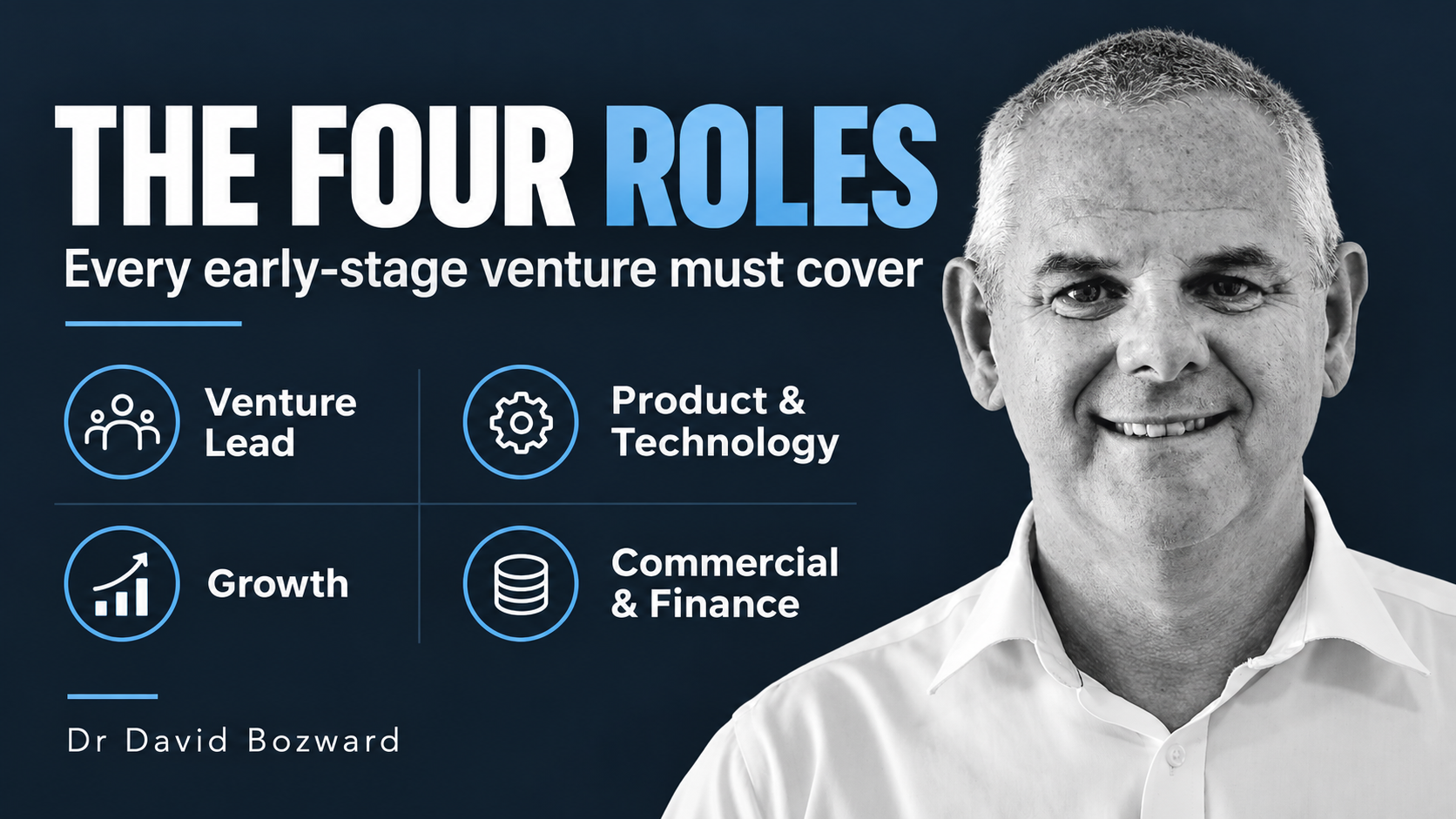
  • The Four Roles Every Early-Stage Venture Must Cover

    The Four Roles Every Early-Stage Venture Must Cover

    Early-stage ventures rarely fail because nobody is working hard. They fail because essential work is missing, duplicated or owned by the wrong person.

    One founder concentrates on the product. Another champions the vision. Everyone contributes to marketing when they have time, while cash flow and customer evidence receive intermittent attention. The team appears active, but important decisions remain unmade.

    A venture does not necessarily need four founders or four senior executives. It does, however, need four functions to be covered: venture leadership, product and technology, growth, and commercial and finance. These roles form a practical operating system for turning an idea into a credible business.

    1. Venture Lead: turning ambition into coordinated action

    The Venture Lead holds the whole business together. This role establishes direction, translates strategy into priorities and ensures that the team performs as one venture rather than as separate specialists.

    In a small company, the Venture Lead may resemble a chief executive, but the title is less important than the responsibility. Someone must decide what matters now, resolve competing priorities and maintain momentum. They must also build the culture and ensure that commitments are honoured.

    This is not simply the role of the person with the original idea. Ideas do not confer leadership capability. The Venture Lead must be able to listen, make difficult decisions and change direction when evidence challenges the founders’ assumptions.

    2. Product and Technology Lead: making the solution work

    The Product and Technology Lead owns the connection between the customer problem and the solution being built. Their task is not to develop the most sophisticated product possible. It is to create the simplest credible solution that delivers valuable outcomes and can develop over time.

    This role determines product priorities, technical architecture and delivery plans. It also manages risks involving security, data, integration and intellectual property.

    The most important discipline is resisting unnecessary development. Early ventures often build too much before confirming that customers care. Product decisions should therefore be grounded in user evidence, experiments and measurable acceptance criteria. A successful prototype is not the one with the most features; it is the one that answers the venture’s most important uncertainty.

    3. Growth Lead: creating a repeatable route to customers

    The Growth Lead ensures that the venture does not confuse interest with demand. Their responsibility covers customer discovery, positioning, marketing, partnerships, sales and retention.

    At the earliest stage, growth is less about running large campaigns and more about learning. Who experiences the problem most severely? Who controls the budget? What causes them to act? Which messages generate a response? What prevents a pilot from becoming a purchase?

    The Growth Lead turns these answers into a repeatable commercial process. They build the pipeline, test channels and bring the customer’s voice into product decisions. Without this role, teams can perfect a solution for an imaginary market.

    4. Commercial and Finance Lead: proving that value can become a viable business

    Revenue alone does not make a good business. The Commercial and Finance Lead establishes whether the venture can capture sufficient value to survive, invest and scale.

    This role owns the business model, pricing, cash flow, unit economics, investment readiness and commercial agreements. It brings discipline to equity, risk and reporting.

    The role should not be reduced to bookkeeping. Its central question is whether the venture’s economics work. How much does it cost to win and serve a customer? How quickly is cash collected? Does the gross margin support growth? What funding will be required before the business becomes sustainable?

    The roles must challenge one another

    These functions are deliberately different. Product may want more development time; Growth may need something customers can buy now. Finance may resist expenditure; the Venture Lead may support controlled investment. Constructive tension improves decisions when supported by shared evidence and clear authority.

    One person may cover two roles, and specialists can fill temporary gaps. What matters is that every function has a named owner, defined outcomes and sufficient capability.

    Founders should regularly ask four questions: Are we moving in a clear direction? Are we building something that works? Can we repeatedly reach and retain customers? Can the economics support a scalable company?

    If any answer is unclear, the venture has discovered an organisational risk. Addressing it early is far easier than repairing the consequences later. Strong ventures are not built by titles on an organisation chart. They are built when the essential work is visible, owned and integrated.


    Download the blog draft

  • The Missing Middle of Innovation: Why Promising Ideas Die Between TRL 2 and TRL 4

    The Missing Middle of Innovation: Why Promising Ideas Die Between TRL 2 and TRL 4

    Innovation rarely fails because people lack ideas. It fails because promising ideas struggle to cross the space between an interesting concept and credible evidence that it works.

    This is the missing middle of innovation: the journey from Technology Readiness Level 2, where a technological concept has been formulated, through TRL 3, where proof of concept is established, to TRL 4, where the technology has been validated under laboratory conditions.

    It sounds like a short step. In practice, it is where many potentially valuable innovations die.

    The evidence gap

    At TRL 2, an innovator may have a strong hypothesis, early research and a convincing description of the problem. What they lack is sufficient evidence. Customers cannot see a working solution. Investors cannot assess whether the principal technical risks have been reduced. Funders cannot distinguish between a bold proposition and an unsupported claim.

    The innovator therefore faces a paradox: they need resources to generate evidence, but they need evidence to secure resources.

    This is often described as a funding gap, but money is only part of the problem. There is also a capability gap. Moving towards TRL 4 requires experimental design, systems engineering, customer discovery, project governance and commercial judgement. The creator may not possess all those capabilities.

    Activity is not the same as progress

    Many early projects appear busy without becoming more investable. Teams build features before confirming the core technical hypothesis. They commission prototypes that demonstrate appearance rather than function. They speak to supportive contacts instead of prospective buyers. They report tasks completed rather than uncertainties reduced.

    This produces the illusion of progress.

    A credible TRL 3 project should be organised around explicit questions. What must be true for the technology to work? Which assumption presents the greatest risk? What experiment would test it? What counts as success or failure?

    TRL progression is not simply a matter of spending time on development. It is the disciplined reduction of uncertainty.

    Technology cannot progress alone

    Another mistake is treating readiness as purely technical. A proof of concept can work while the wider proposition remains unviable. The customer may not consider the problem important. Integration may be too complex. Data may be inaccessible. Security, regulation or operating costs may prevent adoption.

    Technical evidence must develop alongside market and delivery evidence. By TRL 4, a team should understand whether the technology can work, who might buy it, why they would act and what barriers stand in the way.

    Building a bridge across the missing middle

    Promising ideas need a structured evidence plan, not simply encouragement. This should define the critical hypotheses, experiments, acceptance criteria, responsibilities, costs and evidence needed for the next investment decision. Each activity should answer a material question or retire a significant risk.

    Universities, accelerators and innovation agencies also need to rethink their support. Too many programmes reward pitching, generic mentoring and participation. Innovators need technical facilities, product leadership, relevant customers, commercial expertise and patient funding tied to learning milestones.

    The objective should not be to protect every idea. Some should stop. A well-designed experiment that disproves a concept is more valuable than months spent sustaining false optimism.

    The real purpose of the missing middle is selection through evidence. Ideas that survive emerge stronger, more focused and more credible. Those that do not release their people, time and capital for better opportunities.

    Innovation policy often celebrates discovery and later-stage scale-up. Between them lies the less glamorous work of proving, testing and learning. Until we invest properly in that work, too many good ideas will continue to disappear before they are given a fair chance to succeed.

  • From MVP to MVD: The Minimum Valuable Difference

    From MVP to MVD: The Minimum Valuable Difference

    Why startups should focus on meaning, not just minimalism


    In today’s startup world, speed to market is everything. Entrepreneurs are taught to ship fast, break things, test quickly, and get feedback. Enter the Minimum Viable Product (MVP)—a core concept from lean startup methodology that encourages launching the simplest version of a product to validate assumptions.

    The MVP is practical. It’s efficient. But here’s the problem:

    🚨 Too many MVPs forget about value.

    They prove an idea can technically work, but say little about whether it actually matters to the user.

    That’s why I believe it’s time for a shift in thinking—from MVP to MVD: the Minimum Valuable Difference.


    What is the MVD?

    The Minimum Valuable Difference is the smallest possible change, feature, or action you can introduce that delivers real, meaningful value to your target customer.

    It answers questions like:

    • What pain am I truly relieving?
    • What task am I genuinely simplifying?
    • What desire am I directly fulfilling?

    It’s not about what’s viable for you—it’s about what’s valuable to them.


    MVP vs. MVD: What’s the Difference?

    MVPMVD
    Tests feasibilityCreates meaningful impact
    Focuses on minimum productFocuses on minimum transformation
    Often prioritises speedPrioritises significance
    Asks “Can we build this?”Asks “Should we build this?”
    Measures engagementMeasures improvement or outcomes

    Why MVD Matters More Than Ever

    In a saturated digital world, users are overwhelmed by options. The market is flooded with viable products—but few of them make a real difference.

    🧠 A basic to-do list app? Been there.
    🧠 Another newsletter tool? Yawn.
    🧠 A photo filter that changes eye colour? Cool… for 5 seconds.

    What people remember—and keep using—are the tools and services that improve their lives in noticeable ways.


    Real-World Examples of MVD Thinking

    1. Calendly

    Their MVD? Eliminating the pain of back-and-forth emails for scheduling. That single, clear difference made users immediately say, “This is better.”

    2. Slack

    Slack didn’t launch with a full suite of integrations and channels. Its initial MVD was centralised team messaging that actually reduced internal email. That alone got teams hooked.

    3. Duolingo

    Rather than launch with hundreds of languages, Duolingo focused on one: Spanish. Its MVD was making language learning fun, gamified, and mobile-friendly—solving a problem that textbook apps didn’t.


    How to Build with MVD in Mind

    1. Find the Critical Friction Point
      What’s the single most frustrating or inefficient part of your user’s day? Start there.
    2. Go Deep, Not Wide
      Don’t try to solve every problem. Focus on one, and do it better than anyone else.
    3. Prototype for Value, Not Just Function
      Ask: “Does this improve someone’s situation in a tangible way?” If not, keep refining.
    4. Measure Real Outcomes
      Instead of tracking clicks or installs, look at retention, referrals, or behaviour change.

    What the Research Says

    Academic literature is increasingly supporting a value-first mindset in entrepreneurial design.

    “Entrepreneurial success lies not in the novelty of an idea, but in the significance of the solution.”
    Fisher, 2012, Journal of Business Venturing

    And in the world of effectual entrepreneurship, co-creating value with early users—not just validating an MVP—is seen as the more sustainable approach.


    Final Thoughts: What Are You Really Offering?

    It’s easy to launch something. It’s harder to launch something that matters.

    So the next time you’re planning a product, prototype, or pitch—ask yourself:

    • Will this make someone’s life measurably better?
    • If it disappeared tomorrow, would anyone miss it?
    • Am I building for validation, or for value?

    Because in the end, traction doesn’t come from being viable
    It comes from being valuable.

    Case Study: Calendly – From Simple Scheduling to a Minimum Valuable Difference


    Overview: A Tool to End Email Ping-Pong

    Calendly, founded by Tope Awotona in 2013, didn’t enter the world with an elaborate suite of scheduling features. Its early product was stripped down—yet laser-focused. What it did do, it did exceptionally well: eliminated the back-and-forth of scheduling meetings.

    Rather than testing if users would click a scheduling link (MVP logic), Calendly focused on delivering an immediate, meaningful outcome—saving users time and frustration. This wasn’t just a minimal product—it was a minimum valuable difference.


    The Problem

    Scheduling meetings is a universal pain point. Most professionals were stuck in endless email threads:

    • “Are you free Tuesday at 3pm?”
    • “No, how about Wednesday?”
    • “That doesn’t work for me, maybe next week?”

    This inefficient dance cost time and often resulted in dropped opportunities. Tools like Outlook and Google Calendar helped manage time, but not coordinate it between people.


    The Insight

    Tope Awotona’s insight wasn’t technical—it was human. He asked:

    “What’s the smallest thing I could build that would truly remove this pain?”

    The answer?
    A link that lets others pick from your available time slots.

    Not a calendar app.
    Not a meeting manager.
    Not an all-in-one productivity suite.

    Just a solution to the one thing that hurts the most: scheduling friction.


    Execution as MVD: The First Version of Calendly

    Calendly’s early product had:

    • Integration with your existing calendar (Google, Outlook)
    • A link with your available times
    • Automatic timezone detection
    • Confirmation emails

    That’s it.

    But these features, though minimal, delivered maximum difference. Users who tried it once saw the value immediately: no more email ping-pong. It felt like magic.


    Customer Response and Growth

    Calendly didn’t need fancy marketing. The product spread virally:

    • Sales teams shared it with clients
    • Recruiters shared it with candidates
    • Coaches and consultants added it to their email signature

    “The true power of Calendly was in its shareability—it solved a problem so simply that people naturally wanted to pass it along.”
    TechCrunch, 2021


    Key Metrics That Reflect MVD Success

    • Over 20 million users by 2022
    • Used by 90% of Fortune 500 companies
    • $3 billion+ valuation (without raising early VC money)

    More telling than the numbers, however, was the retention. Users didn’t just try Calendly—they stuck with it. Why? Because it had created a daily improvement in their lives.


    Lessons for Entrepreneurs

    1. Focus on the Problem, Not the Product
      Calendly didn’t ask: “How do we build a scheduling app?”
      It asked: “How do we eliminate scheduling pain?”
    2. Make a Small But Clear Difference
      Instead of bloated features, aim for impact. What’s the one thing your user will thank you for?
    3. Deliver Emotional Relief
      The best products don’t just save time—they remove frustration. Calendly’s early adopters felt the difference immediately.
  • Creating Value-Driven Startups: Moving Beyond the MVP Hype

    Creating Value-Driven Startups: Moving Beyond the MVP Hype

    Why lean isn’t enough—and how value creation builds businesses that last


    In today’s startup culture, the Minimum Viable Product (MVP) has become something of a holy grail. Popularized by Eric Ries in The Lean Startup, the MVP is described as the simplest version of a product that can be released to test hypotheses and gain customer feedback. It’s fast, frugal, and focused.

    And yet, as someone who has worked with hundreds of startups and advised entrepreneurship programmes across sectors, I’m starting to ask:
    Have we gone too far with the MVP mindset?

    Too many founders are stuck shipping half-baked products, mistaking viability for value. They aim to “fail fast”—but often end up failing shallow.

    It’s time to move beyond MVP hype and refocus on something more enduring: creating real value.


    The MVP Trap: Fast But Fragile

    Don’t get me wrong—lean thinking has its place. It prevents founders from building in a vacuum and encourages rapid iteration. But over time, the MVP approach has been reduced to “launch anything quick and dirty” without a deeper reflection on long-term customer value.

    As academic research begins to show, this oversimplification has real consequences.

    “Lean startup methods can result in premature scaling if the learning process focuses on superficial feedback rather than deep value creation.”
    Blank & Dorf (2012), The Startup Owner’s Manual

    In other words, just because something is “viable” doesn’t mean it’s meaningful. Without understanding the core value you’re delivering—and to whom—there’s a risk of building a product that works but doesn’t matter.


    Value Creation: The Real Driver of Lasting Businesses

    In contrast, value-driven startups focus on solving real problems for real people in ways that are desirable, feasible, and sustainable. This isn’t just about functionality—it’s about impact.

    As strategy scholar Michael Porter argues:

    “Competitive advantage is created and sustained when firms deliver greater value to customers or create comparable value at lower cost.”
    Porter (1985), Competitive Advantage

    Value creation means understanding:

    • What your customer truly cares about
    • How your solution improves their life
    • Why your offer is better than alternatives

    This leads to stickier products, stronger word-of-mouth, and deeper emotional engagement—all of which support long-term growth.


    Examples of Value-Driven Startups That Went Beyond MVP

    1. Canva

    In my recent blog on Canva’s early days, we saw how co-founder Melanie Perkins identified a deep pain point: the complexity of design software for non-designers. Rather than simply launch a basic design tool, Canva focused on ease, speed, and beauty from day one.
    They delivered value—not just a viable product.

    2. Notion

    Notion didn’t release its first product until years after development. Why? Because it wasn’t just about launching an MVP—it was about creating a tool that people loved using every day. Their focus on elegance, simplicity, and modularity led to high retention and viral growth.

    3. Duolingo

    Instead of launching a barebones app to test assumptions, Duolingo obsessed over learning outcomes. They made language learning fun, gamified, and research-backed—leading to real user value and a product that has scaled globally with strong loyalty.


    Academic Perspectives on Value-First Innovation

    Value creation is increasingly seen as the central pillar of innovation in entrepreneurship literature. Sarasvathy’s concept of effectuation—a theory on how expert entrepreneurs operate—places strong emphasis on leveraging existing means to co-create value with stakeholders, rather than just validating hypotheses.

    “Entrepreneurs start with who they are, what they know, and whom they know… and interact with others to co-create opportunities.”
    Sarasvathy (2001), Effectual Reasoning in Entrepreneurial Decision Making

    Likewise, Osterwalder’s Value Proposition Canvas has emerged as a tool that shifts attention from the MVP to customer gains and pains, helping entrepreneurs design products that are deeply aligned with user needs.


    From MVP to MVD: The Minimum Valuable Difference

    What if, instead of focusing on the Minimum Viable Product, we focused on the Minimum Valuable Difference?

    What is the smallest thing you can offer that makes a real difference in someone’s life or work? That’s where true traction starts.

    Value-driven startups don’t just ask, Can we build this?
    They ask:
    Should we build this? And will it truly help someone?


    Final Thoughts: Redefining Startup Success

    MVPs can get you started—but only value creation keeps you going.

    In a world where users are drowning in “viable” but soulless products, it’s the businesses that focus on deep, relevant, and transformational value that will stand the test of time.

    If you’re a founder, ask yourself:

    • What is the real outcome I’m enabling for my customer?
    • Am I focused on features, or on transformation?
    • Would anyone care if my product disappeared tomorrow?

    Only when the answer is “yes”—because of the value you create—should you launch.


    Want to build a value-driven business from day one?
    Join our upcoming session on “From Ideas to Impact” at Albion Business School, where we’ll explore the tools and mindsets to make your startup matter.