Early-stage ventures rarely fail because nobody is working hard. They fail because essential work is missing, duplicated or owned by the wrong person.
One founder concentrates on the product. Another champions the vision. Everyone contributes to marketing when they have time, while cash flow and customer evidence receive intermittent attention. The team appears active, but important decisions remain unmade.
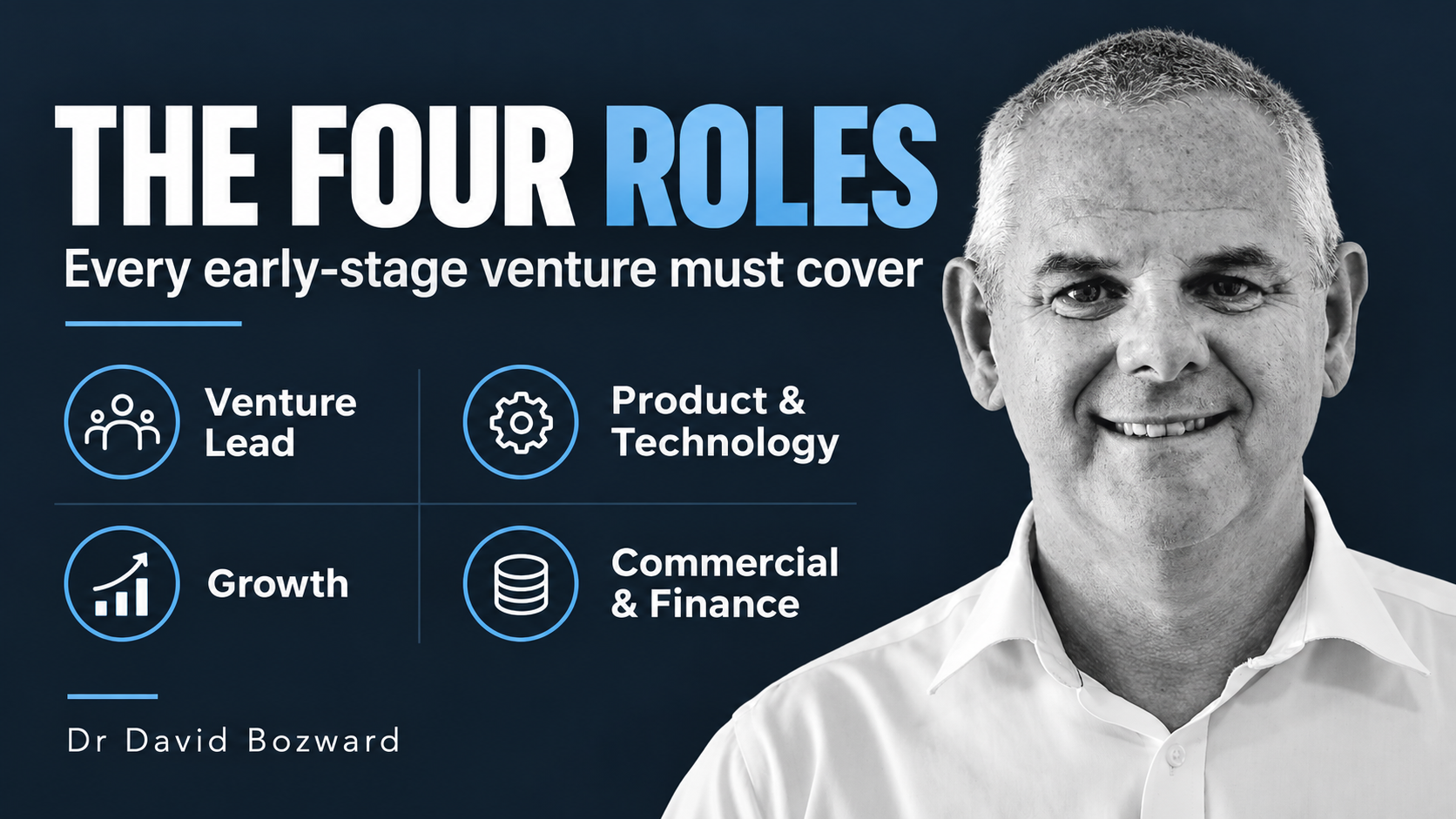
A venture does not necessarily need four founders or four senior executives. It does, however, need four functions to be covered: venture leadership, product and technology, growth, and commercial and finance. These roles form a practical operating system for turning an idea into a credible business.
1. Venture Lead: turning ambition into coordinated action
The Venture Lead holds the whole business together. This role establishes direction, translates strategy into priorities and ensures that the team performs as one venture rather than as separate specialists.
In a small company, the Venture Lead may resemble a chief executive, but the title is less important than the responsibility. Someone must decide what matters now, resolve competing priorities and maintain momentum. They must also build the culture and ensure that commitments are honoured.
This is not simply the role of the person with the original idea. Ideas do not confer leadership capability. The Venture Lead must be able to listen, make difficult decisions and change direction when evidence challenges the founders’ assumptions.
2. Product and Technology Lead: making the solution work
The Product and Technology Lead owns the connection between the customer problem and the solution being built. Their task is not to develop the most sophisticated product possible. It is to create the simplest credible solution that delivers valuable outcomes and can develop over time.
This role determines product priorities, technical architecture and delivery plans. It also manages risks involving security, data, integration and intellectual property.
The most important discipline is resisting unnecessary development. Early ventures often build too much before confirming that customers care. Product decisions should therefore be grounded in user evidence, experiments and measurable acceptance criteria. A successful prototype is not the one with the most features; it is the one that answers the venture’s most important uncertainty.
3. Growth Lead: creating a repeatable route to customers
The Growth Lead ensures that the venture does not confuse interest with demand. Their responsibility covers customer discovery, positioning, marketing, partnerships, sales and retention.
At the earliest stage, growth is less about running large campaigns and more about learning. Who experiences the problem most severely? Who controls the budget? What causes them to act? Which messages generate a response? What prevents a pilot from becoming a purchase?
The Growth Lead turns these answers into a repeatable commercial process. They build the pipeline, test channels and bring the customer’s voice into product decisions. Without this role, teams can perfect a solution for an imaginary market.
4. Commercial and Finance Lead: proving that value can become a viable business
Revenue alone does not make a good business. The Commercial and Finance Lead establishes whether the venture can capture sufficient value to survive, invest and scale.
This role owns the business model, pricing, cash flow, unit economics, investment readiness and commercial agreements. It brings discipline to equity, risk and reporting.
The role should not be reduced to bookkeeping. Its central question is whether the venture’s economics work. How much does it cost to win and serve a customer? How quickly is cash collected? Does the gross margin support growth? What funding will be required before the business becomes sustainable?
The roles must challenge one another
These functions are deliberately different. Product may want more development time; Growth may need something customers can buy now. Finance may resist expenditure; the Venture Lead may support controlled investment. Constructive tension improves decisions when supported by shared evidence and clear authority.
One person may cover two roles, and specialists can fill temporary gaps. What matters is that every function has a named owner, defined outcomes and sufficient capability.
Founders should regularly ask four questions: Are we moving in a clear direction? Are we building something that works? Can we repeatedly reach and retain customers? Can the economics support a scalable company?
If any answer is unclear, the venture has discovered an organisational risk. Addressing it early is far easier than repairing the consequences later. Strong ventures are not built by titles on an organisation chart. They are built when the essential work is visible, owned and integrated.