Tag: investment readiness

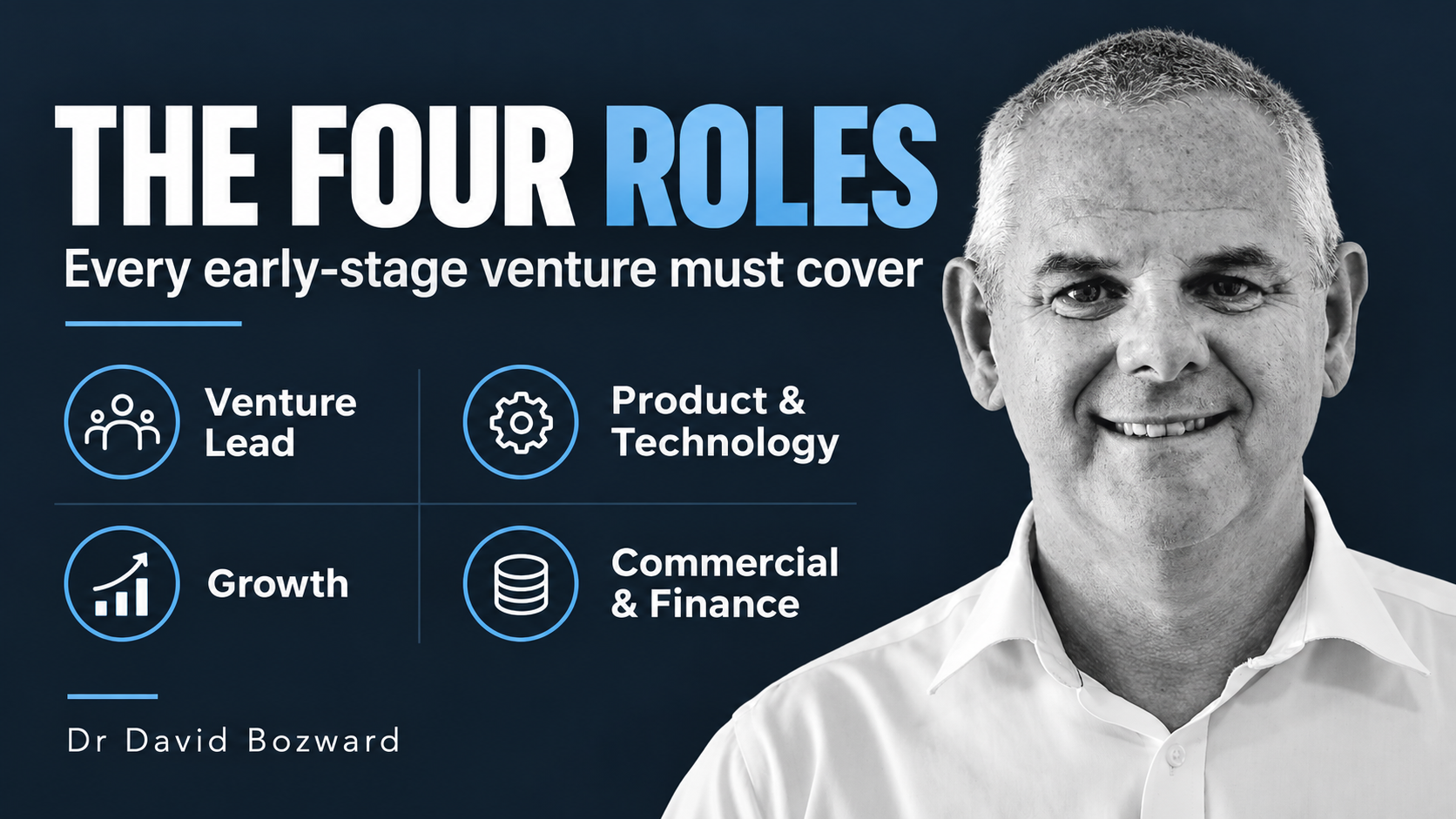
  • The Four Roles Every Early-Stage Venture Must Cover

    The Four Roles Every Early-Stage Venture Must Cover

    Early-stage ventures rarely fail because nobody is working hard. They fail because essential work is missing, duplicated or owned by the wrong person.

    One founder concentrates on the product. Another champions the vision. Everyone contributes to marketing when they have time, while cash flow and customer evidence receive intermittent attention. The team appears active, but important decisions remain unmade.

    A venture does not necessarily need four founders or four senior executives. It does, however, need four functions to be covered: venture leadership, product and technology, growth, and commercial and finance. These roles form a practical operating system for turning an idea into a credible business.

    1. Venture Lead: turning ambition into coordinated action

    The Venture Lead holds the whole business together. This role establishes direction, translates strategy into priorities and ensures that the team performs as one venture rather than as separate specialists.

    In a small company, the Venture Lead may resemble a chief executive, but the title is less important than the responsibility. Someone must decide what matters now, resolve competing priorities and maintain momentum. They must also build the culture and ensure that commitments are honoured.

    This is not simply the role of the person with the original idea. Ideas do not confer leadership capability. The Venture Lead must be able to listen, make difficult decisions and change direction when evidence challenges the founders’ assumptions.

    2. Product and Technology Lead: making the solution work

    The Product and Technology Lead owns the connection between the customer problem and the solution being built. Their task is not to develop the most sophisticated product possible. It is to create the simplest credible solution that delivers valuable outcomes and can develop over time.

    This role determines product priorities, technical architecture and delivery plans. It also manages risks involving security, data, integration and intellectual property.

    The most important discipline is resisting unnecessary development. Early ventures often build too much before confirming that customers care. Product decisions should therefore be grounded in user evidence, experiments and measurable acceptance criteria. A successful prototype is not the one with the most features; it is the one that answers the venture’s most important uncertainty.

    3. Growth Lead: creating a repeatable route to customers

    The Growth Lead ensures that the venture does not confuse interest with demand. Their responsibility covers customer discovery, positioning, marketing, partnerships, sales and retention.

    At the earliest stage, growth is less about running large campaigns and more about learning. Who experiences the problem most severely? Who controls the budget? What causes them to act? Which messages generate a response? What prevents a pilot from becoming a purchase?

    The Growth Lead turns these answers into a repeatable commercial process. They build the pipeline, test channels and bring the customer’s voice into product decisions. Without this role, teams can perfect a solution for an imaginary market.

    4. Commercial and Finance Lead: proving that value can become a viable business

    Revenue alone does not make a good business. The Commercial and Finance Lead establishes whether the venture can capture sufficient value to survive, invest and scale.

    This role owns the business model, pricing, cash flow, unit economics, investment readiness and commercial agreements. It brings discipline to equity, risk and reporting.

    The role should not be reduced to bookkeeping. Its central question is whether the venture’s economics work. How much does it cost to win and serve a customer? How quickly is cash collected? Does the gross margin support growth? What funding will be required before the business becomes sustainable?

    The roles must challenge one another

    These functions are deliberately different. Product may want more development time; Growth may need something customers can buy now. Finance may resist expenditure; the Venture Lead may support controlled investment. Constructive tension improves decisions when supported by shared evidence and clear authority.

    One person may cover two roles, and specialists can fill temporary gaps. What matters is that every function has a named owner, defined outcomes and sufficient capability.

    Founders should regularly ask four questions: Are we moving in a clear direction? Are we building something that works? Can we repeatedly reach and retain customers? Can the economics support a scalable company?

    If any answer is unclear, the venture has discovered an organisational risk. Addressing it early is far easier than repairing the consequences later. Strong ventures are not built by titles on an organisation chart. They are built when the essential work is visible, owned and integrated.


    Download the blog draft

  • Can a Student Venture Be Designed to Become a £100 Million Business?

    Can a Student Venture Be Designed to Become a £100 Million Business?

    Most student ventures are designed to pass an assessment, win a competition or generate a modest income. Very few are designed from the outset to become businesses worth £100 million.

    That is not because students lack ambition or creativity. It is because entrepreneurship education often starts with the resources immediately available to the student rather than the scale of the problem worth solving. The result is frequently a small, local and easily copied business. It may provide an excellent learning experience, but it is unlikely to become a significant venture.

    So, can a student venture genuinely be designed to reach a £100 million valuation? The answer is yes—but it cannot be guaranteed. The purpose of the ambition is not to predict the eventual valuation. It is to impose a more demanding standard on the opportunity, business model, technology, team and evidence from the beginning.

    Start with a problem large enough to matter

    A £100 million company must normally address a substantial market, solve an expensive problem or create value for a large number of customers. A venture selling a low-value service to a small local audience faces a mathematical limit, regardless of the founders’ enthusiasm.

    This does not mean every student must invent a global technology platform. It means they must understand the relationship between customer value, market size, revenue potential and enterprise value. A narrow starting market can be sensible, but it should provide an entry point into a much larger opportunity.

    The first question should therefore not be, “What business can we start?” It should be, “What important problem can we solve at scale?”

    That change in language matters. It moves students away from imitation and towards investigation. They must identify who experiences the problem, how frequently it occurs, what it costs, why current solutions are inadequate and whether customers will pay for a better outcome.

    Design for scale before growth begins

    Growth and scale are not the same. A business grows by adding resources as it adds customers. A scalable business can increase revenue much faster than its cost base.

    Students therefore need to examine the economic engine behind the idea. Can delivery be standardised? Can technology automate important processes? Can the product be distributed beyond the founders’ personal networks? Does each new customer improve the economics, data or usefulness of the venture? Can the model operate across regions or sectors without being rebuilt each time?

    A consultancy may grow into a successful firm, but a service dependent upon the founder’s time is inherently constrained. By contrast, a productised service, software platform, licensable system or repeatable marketplace may have a more credible path to scale.

    This is not an argument that technology automatically creates value. Many digital products fail because they automate something customers do not consider important. Scale must begin with demonstrated value, not technical possibility.

    Build evidence, not theatre

    Early-stage entrepreneurship can become dominated by pitch decks, slogans and optimistic financial projections. None of these proves that a venture works.

    A £100 million ambition requires stronger evidence at every stage. Have prospective customers confirmed the problem? Will they commit time, data, access or money to a trial? Can the team deliver a working solution? What does it cost to acquire and serve a customer? Do customers return, renew or recommend it? Is there a believable route from a small pilot to a repeatable commercial model?

    The venture should progress through evidence gates. At each point, the team must demonstrate that key uncertainties have been reduced before receiving further support or investment. This makes ambition more disciplined, because evidence can strengthen, reshape or stop the venture.

    Stopping is not failure. Continuing with an idea after the evidence has turned against it is the more serious failure.

    Create a team around the venture’s needs

    Large opportunities are rarely developed by one person. Student teams need complementary capabilities covering four essential functions: venture leadership and operations; product and technology; customer growth and partnerships; and commercial management and finance.

    These are functions, not necessarily four grand job titles. What matters is that the work is owned. A technically strong team without sales capability may build something nobody buys. A persuasive team without product discipline may sell a promise it cannot deliver. A creative team without financial control may grow activity while destroying value.

    The educational environment must also change. Students need access to experienced founders, sector specialists, technologists, customers, investors and professional advisers. Mentors should challenge assumptions and open relevant doors, not simply offer encouragement.

    Treat ownership as a responsibility

    Once students form a real company and allocate equity, entrepreneurship stops being a classroom simulation. Decisions about founders, intellectual property, vesting, governance and investment can have lasting consequences.

    Equity should reflect contribution, commitment and risk. Where participation develops over time, ownership can vest progressively against agreed milestones. This protects the venture if someone leaves early while recognising the value already created.

    Governance need not become bureaucratic, but it should establish clear decision rights, reporting expectations and standards of conduct. Investors are more likely to support ambitious founders who understand accountability as well as opportunity.

    Use £100 million as a design discipline

    The value of the £100 million question is not that every student business will achieve it. Most will not. The value lies in what the question forces founders to confront.

    Is the problem sufficiently important? Is the addressable market large enough? Can the model scale? Is there a defensible advantage? Does the team possess—or know how to acquire—the necessary capabilities? What evidence would justify the next investment of time and money?

    This is the philosophy behind programmes such as Sky High Ventures: students should not merely learn about entrepreneurship or operate temporary projects. They should experience the discipline of building a real company with genuine customers, ownership, milestones and consequences.

    Universities often encourage students to “think big” but then place them inside small, short and assessment-led projects. If we want students to create consequential ventures, we must give them a longer runway, multidisciplinary teams, external expertise, demanding evidence gates and meaningful exposure to markets and investment.

    A student venture cannot be guaranteed a £100 million future. It can, however, be designed so that such a future remains credible. That begins by replacing easy optimism with a serious problem, a scalable architecture and relentless evidence. Ambition then becomes more than a slogan. It becomes a method.

  • The Missing Middle of Innovation: Why Promising Ideas Die Between TRL 2 and TRL 4

    The Missing Middle of Innovation: Why Promising Ideas Die Between TRL 2 and TRL 4

    Innovation rarely fails because people lack ideas. It fails because promising ideas struggle to cross the space between an interesting concept and credible evidence that it works.

    This is the missing middle of innovation: the journey from Technology Readiness Level 2, where a technological concept has been formulated, through TRL 3, where proof of concept is established, to TRL 4, where the technology has been validated under laboratory conditions.

    It sounds like a short step. In practice, it is where many potentially valuable innovations die.

    The evidence gap

    At TRL 2, an innovator may have a strong hypothesis, early research and a convincing description of the problem. What they lack is sufficient evidence. Customers cannot see a working solution. Investors cannot assess whether the principal technical risks have been reduced. Funders cannot distinguish between a bold proposition and an unsupported claim.

    The innovator therefore faces a paradox: they need resources to generate evidence, but they need evidence to secure resources.

    This is often described as a funding gap, but money is only part of the problem. There is also a capability gap. Moving towards TRL 4 requires experimental design, systems engineering, customer discovery, project governance and commercial judgement. The creator may not possess all those capabilities.

    Activity is not the same as progress

    Many early projects appear busy without becoming more investable. Teams build features before confirming the core technical hypothesis. They commission prototypes that demonstrate appearance rather than function. They speak to supportive contacts instead of prospective buyers. They report tasks completed rather than uncertainties reduced.

    This produces the illusion of progress.

    A credible TRL 3 project should be organised around explicit questions. What must be true for the technology to work? Which assumption presents the greatest risk? What experiment would test it? What counts as success or failure?

    TRL progression is not simply a matter of spending time on development. It is the disciplined reduction of uncertainty.

    Technology cannot progress alone

    Another mistake is treating readiness as purely technical. A proof of concept can work while the wider proposition remains unviable. The customer may not consider the problem important. Integration may be too complex. Data may be inaccessible. Security, regulation or operating costs may prevent adoption.

    Technical evidence must develop alongside market and delivery evidence. By TRL 4, a team should understand whether the technology can work, who might buy it, why they would act and what barriers stand in the way.

    Building a bridge across the missing middle

    Promising ideas need a structured evidence plan, not simply encouragement. This should define the critical hypotheses, experiments, acceptance criteria, responsibilities, costs and evidence needed for the next investment decision. Each activity should answer a material question or retire a significant risk.

    Universities, accelerators and innovation agencies also need to rethink their support. Too many programmes reward pitching, generic mentoring and participation. Innovators need technical facilities, product leadership, relevant customers, commercial expertise and patient funding tied to learning milestones.

    The objective should not be to protect every idea. Some should stop. A well-designed experiment that disproves a concept is more valuable than months spent sustaining false optimism.

    The real purpose of the missing middle is selection through evidence. Ideas that survive emerge stronger, more focused and more credible. Those that do not release their people, time and capital for better opportunities.

    Innovation policy often celebrates discovery and later-stage scale-up. Between them lies the less glamorous work of proving, testing and learning. Until we invest properly in that work, too many good ideas will continue to disappear before they are given a fair chance to succeed.