Tag: Higher Education

  • From Degree to Work: The Broken Transition System

    From Degree to Work: The Broken Transition System

    For decades, higher education has been sold on a simple promise: earn a degree, and better career opportunities will follow. This narrative has shaped student expectations, institutional strategies, and government policy alike. Yet, for many graduates today, the transition from university to work is anything but smooth.

    Instead of a clear pathway, graduates encounter a fragmented, uncertain, and often frustrating journey into employment. The issue is not a lack of talent, ambition, or even opportunity. The problem is systemic.

    The transition from degree to work is broken—and it requires urgent redesign.


    The Myth of the Linear Pathway

    At the core of the problem is an outdated assumption: that education leads directly to employment in a linear, step by step, predictable way.

    This model assumes:

    • Students acquire knowledge
    • They graduate
    • They enter relevant employment

    In reality, graduate pathways are far more complex. Careers are increasingly:

    • Non-linear
    • Iterative
    • Influenced by networks, experience, and timing

    Graduates often move through multiple roles, sectors, and learning experiences before finding alignment. The expectation of a seamless transition is not only unrealistic—it sets students up for disappointment.


    A Structural Disconnect Between Education and Work

    One of the most significant issues is the disconnect between what universities deliver and what employers need.

    Universities excel at:

    • Delivering theoretical knowledge
    • Developing critical thinking
    • Advancing disciplinary expertise

    Employers, however, often prioritise:

    • Practical experience
    • Workplace behaviours
    • Adaptability and problem-solving
    • Commercial awareness

    This is not a failure of universities per se. It is a failure of alignment.

    The system operates in silos:

    • Universities design curricula independently
    • Employers articulate needs inconsistently
    • Policymakers attempt to bridge the gap through metrics and incentives

    The result is a misaligned ecosystem where graduates must navigate the space between education and employment largely on their own.


    Experience as the New Currency

    Increasingly, employers are not just asking, “What degree do you have?” but “What have you done?”

    Work experience has become a critical differentiator:

    • Internships
    • Placements
    • Part-time work
    • Projects and portfolios

    Yet access to these opportunities is uneven.

    Students from more advantaged backgrounds are more likely to:

    • Secure unpaid internships
    • Leverage personal networks
    • Gain early exposure to professional environments

    Those without these advantages face structural barriers, reinforcing inequality in graduate outcomes.

    In effect, the system rewards prior access to opportunity rather than potential.


    The Hidden Curriculum

    Much of what determines success in the transition to work is not formally taught.

    Graduates must learn to:

    • Navigate recruitment processes
    • Build professional networks
    • Communicate their value
    • Understand workplace norms

    This “hidden curriculum” is often acquired informally, through:

    • Family connections
    • Social capital
    • Prior exposure to professional environments

    Students who lack this background are at a disadvantage, regardless of their academic ability.

    Universities have made efforts to address this through employability programmes, but these are often:

    • Optional
    • Peripheral to core study
    • Insufficiently embedded

    Fragmented Support Systems

    Support for the transition from degree to work is often fragmented across institutions.

    Students may encounter:

    • Careers services
    • Academic advisors
    • External programmes
    • Employer initiatives

    However, these are rarely integrated into a coherent journey.

    Common issues include:

    • Late engagement (often in final year)
    • Lack of personalisation
    • Limited continuity

    As a result, students are expected to piece together their own pathway, often without the guidance or confidence to do so effectively.


    The Role of Metrics and Incentives

    Ironically, efforts to improve graduate outcomes have sometimes exacerbated the problem.

    Metrics that focus on short-term employment outcomes encourage universities to:

    • Prioritise immediate job placement
    • Focus on measurable outputs
    • Treat employability as a compliance issue

    This can lead to:

    • Superficial interventions
    • Reduced emphasis on long-term capability development
    • A narrow definition of success

    Instead of transforming the system, metrics often reinforce its limitations.


    Regional Inequality and Labour Market Realities

    The transition from degree to work is also shaped by geography.

    Graduates in regions with:

    • Strong labour markets
    • Diverse industries
    • High levels of investment

    have greater opportunities.

    Those in less economically dynamic areas face:

    • Fewer graduate-level roles
    • Lower wages
    • Limited career progression

    Universities cannot control regional economies, yet they are often judged as if they can.

    This creates a structural imbalance that disproportionately affects certain institutions and student groups.


    The Rise of Alternative Pathways

    At the same time, the nature of work itself is changing.

    Traditional career pathways are being complemented—or replaced—by:

    • Freelancing and gig work
    • Entrepreneurship
    • Portfolio careers
    • Remote and global opportunities

    These pathways offer flexibility and innovation but are poorly reflected in traditional transition systems.

    Graduates pursuing these routes may appear “unsuccessful” in conventional metrics, even when they are building viable and meaningful careers.


    Towards a Redesigned Transition System

    If the current system is broken, what would a better model look like?

    A redesigned transition system must move beyond the idea of a single handover point between education and employment. Instead, it should be understood as a continuous, integrated process.

    1. Early and Embedded Employability

    Employability should not be an add-on—it should be embedded from day one.

    This includes:

    • Real-world projects within courses
    • Industry engagement in curriculum design
    • Continuous reflection on skills and development

    2. Experience for All

    Access to meaningful experience must be universal, not selective.

    This could involve:

    • Guaranteed placements or project-based learning
    • Partnerships with employers
    • Simulation-based learning environments

    3. Integrated Support Systems

    Universities need to create coherent, personalised support journeys.

    This means:

    • Aligning academic, careers, and external support
    • Providing consistent guidance over time
    • Using data to tailor interventions

    4. Recognition of Diverse Pathways

    The system must recognise that success takes many forms.

    This requires:

    • Valuing entrepreneurship and self-employment
    • Supporting alternative career models
    • Expanding definitions of graduate success

    5. Stronger Ecosystem Collaboration

    The transition from degree to work cannot be solved by universities alone.

    It requires collaboration between:

    • Universities
    • Employers
    • Policymakers
    • Regional stakeholders

    This is fundamentally an ecosystem challenge.


    Reframing the Transition

    Perhaps the most important shift is conceptual.

    The transition from degree to work should not be seen as:

    • A single moment
    • A final outcome

    But as:

    • A developmental journey
    • A process of exploration and growth

    Graduates are not products moving through a pipeline. They are individuals navigating complex, evolving careers.


    Conclusion

    The promise of higher education remains powerful, but the pathway from degree to work no longer reflects the realities of the modern world.

    The system is not failing because graduates are unprepared or institutions are ineffective. It is failing because it is built on outdated assumptions, fragmented structures, and narrow definitions of success.

    Fixing this requires more than incremental change. It requires a fundamental redesign—one that recognises the complexity of careers, the diversity of pathways, and the importance of capability over short-term outcomes.

    Because the goal is not simply to help graduates get their first job.

    It is to equip them to build meaningful, sustainable careers in a world that is constantly changing.


  • Why Employability Metrics Are Failing Universities

    Why Employability Metrics Are Failing Universities

    Universities are under increasing pressure to demonstrate that their graduates secure meaningful employment. In response, governments and regulators have embedded employability metrics into performance frameworks, funding models, and league tables. In the UK, for example, graduate outcomes (B3) data has become a central feature of regulatory oversight and institutional strategy.

    On the surface, this seems entirely reasonable. Students invest significant time and money into higher education, and they expect a return in the form of improved career prospects. Policymakers, in turn, want assurance that universities are delivering value.

    Yet, despite this growing emphasis, a fundamental problem persists:

    Employability metrics, as currently designed, are failing universities—and more importantly, they are failing students.


    The Illusion of Measurement

    At the heart of the issue lies a simple but powerful question: what exactly are we measuring?

    Most employability metrics rely on narrow indicators such as:

    • Graduate employment rates
    • Salaries after 15 months
    • Job classification (e.g. “professional” roles)(Don’t ask me about Models)

    While these measures provide a snapshot, they do not capture the complexity of graduate outcomes.

    Employment is not a binary state. Nor is it a static endpoint. Careers evolve over time, often through nonlinear and unpredictable pathways. By reducing employability to short-term outcomes, metrics create an illusion of precision while obscuring the reality of graduate transitions.


    The Timing Problem

    One of the most widely used measures in the UK is based on graduate destinations approximately 15 months after completion. This timeframe is deeply problematic.

    Many graduates:

    • Pursue further study
    • Start businesses (which at 15 months is traveling through the valley of death)
    • Take interim roles while exploring career options
    • Enter industries with longer entry pathways

    For these individuals, early outcomes may appear weak, even though their long-term trajectories are strong.

    The result is a systematic distortion: universities are judged on when outcomes occur, rather than how meaningful those outcomes ultimately become.


    Penalising the Wrong Institutions

    Employability metrics often fail to account for differences in student demographics and institutional missions.

    Universities that:

    • Serve widening participation students
    • Operate in economically disadvantaged regions
    • Recruit non-traditional learners

    are frequently penalised.

    These institutions play a critical role in social mobility, yet their graduates may face structural barriers in the labour market. Lower short-term employment outcomes do not necessarily reflect poor educational quality—they often reflect inequality in opportunity.

    By ignoring context, current metrics risk reinforcing the very inequalities they are meant to address.


    The Narrow Definition of Success

    Another major limitation is the narrow definition of what constitutes “success.”

    Metrics typically prioritise:

    • Full-time employment
    • High salaries
    • Traditional career pathways (Occupation codes last changed on 4 April 2024)

    However, this excludes a wide range of valuable outcomes, including:

    • Entrepreneurship and self-employment
    • Portfolio careers
    • Social impact work
    • Creative and cultural industries

    In an economy increasingly characterised by flexibility and diversity, these pathways are not marginal—they are central.

    Yet, because they do not fit neatly into existing metrics, they are often undervalued or ignored.


    Behavioural Distortions

    Perhaps the most concerning consequence of current employability metrics is how they shape institutional behaviour.

    When universities are measured on specific indicators, they naturally optimise for those indicators.

    This can lead to:

    • Overemphasis on short-term job outcomes
    • Strategic steering of students towards “safe” careers
    • Reduced support for entrepreneurship or risk-taking
    • Gaming of data through selective reporting or classification

    In extreme cases, employability becomes less about empowering students and more about managing metrics.

    This is a classic example of Goodhart’s Law:
    When a measure becomes a target, it ceases to be a good measure.


    The Missing Middle: Capability Development

    One of the most significant gaps in current frameworks is the absence of capability-based measures.

    Employability is not just about outcomes; it is about:

    • Skills development
    • Confidence and agency
    • Networks and social capital
    • The ability to navigate uncertainty

    These capabilities are developed over time and are often invisible in traditional metrics.

    For example, a student who:

    • Builds strong professional networks
    • Develops entrepreneurial skills
    • Gains meaningful project experience

    may be highly employable, even if their first job is not immediately “high status.”

    By focusing only on outcomes, metrics ignore the underlying processes that drive long-term success.


    Regional and Structural Blind Spots

    Employability metrics also fail to account for regional economic conditions.

    Graduates in areas with:

    • Limited job opportunities
    • Lower average wages
    • Sectoral decline

    are inherently disadvantaged in outcome-based measures.

    Universities cannot control local labour markets, yet they are judged as if they can.

    This creates a disconnect between:

    • Institutional performance
    • Regional economic realities

    and further disadvantages institutions located outside major economic hubs.


    Data Without Insight

    Another challenge is the overreliance on quantitative data without sufficient qualitative insight.

    Large-scale surveys provide valuable information, but they often lack depth. They do not capture:

    • Graduate experiences
    • Career aspirations
    • Barriers faced
    • Non-linear pathways

    Without this context, data can be misleading.

    For example, a graduate in a “non-professional” role may be:

    • Building experience in a chosen field
    • Transitioning between careers
    • Prioritising personal circumstances

    Yet, the metric records this simply as a negative outcome.


    Towards Better Employability Measures

    If current metrics are failing, what should replace them?

    A more effective approach would involve a shift from outcomes-only measurement to a multi-dimensional framework.

    1. Longitudinal Tracking

    Instead of focusing on short-term outcomes, metrics should track graduates over time:

    • 3 years
    • 5 years
    • 10 years

    This would provide a more accurate picture of career development.

    2. Contextualisation

    Metrics must account for:

    • Student demographics
    • Regional economic conditions
    • Institutional mission

    This would create fairer comparisons and more meaningful insights.

    3. Inclusion of Diverse Pathways

    Entrepreneurship, self-employment, and portfolio careers should be fully recognised and valued.

    This requires:

    • New classification systems
    • Better data collection methods

    4. Capability-Based Indicators

    Universities should be assessed on their ability to develop:

    • Skills
    • Networks
    • Confidence
    • Career management capabilities

    These are the foundations of employability.

    5. Integration with Skills Frameworks

    Linking outcomes to frameworks such as ESCO (European Skills, Competences, Qualifications and Occupations) would enable:

    • Better alignment with labour market needs
    • More granular analysis of skills development

    Reframing the Purpose of Employability

    Ultimately, the issue is not just technical—it is philosophical.

    What is the purpose of higher education?

    If employability is reduced to:

    • Immediate job outcomes
    • Salary levels

    then universities become training providers for the labour market.

    But higher education has a broader role:

    • Developing critical thinkers
    • Enabling social mobility
    • Fostering innovation and entrepreneurship
    • Contributing to society

    Employability should be understood as the capacity to create value over a lifetime, not just secure a job in the short term.


    Conclusion

    Employability metrics were introduced with good intentions: to ensure accountability, improve outcomes, and provide transparency.

    However, in their current form, they fall short.

    They:

    • Oversimplify complex realities
    • Ignore context
    • Distort behaviour
    • Undervalue diverse pathways

    Most importantly, they fail to capture what truly matters: the long-term ability of graduates to navigate, contribute to, and shape an ever-changing world.

    If universities are to fulfil their role in society, we must move beyond narrow metrics and embrace a richer, more nuanced understanding of employability.

    Because the goal is not just to produce graduates who get jobs.

    It is to develop individuals who can build careers, create opportunities, and drive the future of our economies.

  • Beyond the Bake Sale: Reimagining University-Industry Partnerships for Genuine Impact

    Title: Reimagining the University-Industry Partnership: A New Model for Impact

    There’s a certain quaintness to the traditional image of university-industry partnerships. Think career fairs, bake sales to fund student projects, perhaps a guest lecture from an industry leader. These are valuable initiatives, certainly, but they often feel like peripheral activities – a polite nod towards the ‘real world’ rather than a fundamental shift in how universities operate.

    I’m not dismissing these efforts, mind you. I’ve participated in them myself, organizing career workshops and facilitating industry mentorship programmes. But after years of observing these interactions from both sides – as an academic deeply invested in research and a consultant advising businesses – I’m convinced that we need to fundamentally reimagine the university-industry partnership. We need a model that moves beyond simple transactional exchanges and embraces genuine collaboration, one that prioritizes shared value creation over short-term gains.

    I’m not suggesting a radical overhaul, but rather a subtle recalibration – a shift in mindset that recognizes the inherent strengths of both institutions and leverages them to address complex societal challenges. It’s a vision born from witnessing firsthand the frustrating disconnect between academic research and real-world application, and fueled by a deep conviction that universities have a crucial role to play in driving innovation, productivity and economic growth.

    The Current Landscape: A History of Missed Opportunities

    Let’s be honest, the current landscape is often characterized by a degree of mutual skepticism. Universities are perceived as ivory towers, disconnected from the practical needs of businesses. Businesses, in turn, view universities as slow-moving bureaucracies, resistant to change and unwilling to commercialize their research.

    This isn’t entirely unwarranted. The traditional model often prioritizes academic publications over practical impact, incentivizing researchers to publish in high-impact (don’t get me started on those) journals rather than seeking solutions to today’s real-world problems. The intellectual property landscape can be a minefield, with complex licensing agreements and conflicting interests hindering commercialization efforts. And let’s not forget the inherent cultural differences – the academic emphasis on rigorous peer review clashes with the business imperative for rapid iteration and market validation.

    I recall one particularly frustrating experience advising a medtech startup that was struggling to secure funding for a promising new intervention. The university’s technology transfer office, while well-intentioned, was bogged down in lengthy negotiations with potential investors, delaying the project and ultimately jeopardizing its future. It was a stark reminder that good intentions alone aren’t enough; we need streamlined processes, clear incentives, and a shared commitment to driving impact.

    A New Model: Shared Value Creation at the Core, Grounded in Experiential Learning

    My vision for a reimagined university-industry partnership centres on the concept of shared value creation (The central premise of enterprise creation). It’s about moving beyond transactional exchanges and fostering deep, collaborative relationships that benefit both institutions and society as a whole. Crucially, this requires embedding experiential learning at the heart of our approach. Tools like SimVenture, for instance, offer unparalleled opportunities for students to grapple with real-world business challenges in a safe and engaging environment. Imagine undergraduate teams developing strategic plans for simulated companies, making investment decisions, navigating market fluctuations – all while receiving mentorship from industry professionals. This isn’s just theoretical learning; it’s applied knowledge, forged in the crucible of simulated experience.

    Key Pillars of a Collaborative Future:

    Here are some concrete steps we can take to build this collaborative future:

    1. Embedded Industry Fellows: Imagine a programme where experienced industry professionals are embedded at the same level, within university departments, working alongside faculty and students on real-world projects. These fellows would bring valuable insights into market needs, provide mentorship to aspiring entrepreneurs, and help bridge the gap between academic research and commercial application.
    2. Challenge-Driven Research: Instead of pursuing research topics in isolation, universities should actively solicit challenges from businesses and policymakers. This would ensure that our research is aligned with real-world needs, increasing its relevance and impact.
    3. Flexible Intellectual Property Frameworks: We need to move away from rigid, one-size-fits-all intellectual property frameworks and embrace more flexible models that encourage collaboration and innovation.
    4. Cross-Disciplinary Innovation Hubs: Universities should establish cross-disciplinary innovation hubs that bring together faculty, students, and industry partners from diverse fields to tackle complex challenges.
    5. Data-Driven Impact Assessment: We need to develop robust data-driven impact assessment frameworks that measure the real-world benefits of our research.
    6. Robust Subcontractual Oversight: Recognizing that complex projects often involve subcontracting, universities must implement rigorous oversight mechanisms. As detailed in my work on this topic, clear contractual provisions, independent audits, and transparent reporting are essential to ensure accountability, mitigate risks, and safeguard the integrity of collaborative ventures. This includes establishing clear lines of responsibility for performance, quality control, and ethical conduct across all tiers of the project.

    The Role of Policy: Incentivizing Collaboration

    Government policy also has a crucial role to play in incentivizing collaboration between universities and businesses. This could involve providing tax breaks for companies that invest in university research, creating grant programmes that specifically target collaborative projects, and streamlining regulatory processes to facilitate commercialization.

    I remember advocating for a policy change in my own state that provided tax credits to companies that partnered with universities on research projects. The impact was immediate – we saw a surge in collaborative initiatives, leading to the creation of new businesses and high-paying jobs.

    Embracing Imperfection: A Journey, Not a Destination

    This isn’t about creating a utopian vision of perfect collaboration. It’s about acknowledging that the journey will be fraught with challenges, setbacks, and disagreements. There will be times when we stumble, make mistakes, and question our assumptions. But it’s through these experiences that we learn, adapt, and ultimately build a more effective partnership.

    As I reflect on my own experiences, I’m filled with a sense of optimism and hope. I believe that universities have a vital role to play in driving innovation, creating jobs, and addressing some of the world’s most pressing challenges. And I believe that by reimagining our partnerships with businesses, incorporating experiential learning tools like SimVentures and implementing robust subcontractual oversight, we can unlock a new era of shared value creation and lasting impact.

  • Bridging Academia and Consulting: My Journey in Entrepreneurial Impact

    Bridging Academia and Consulting: My Journey in Entrepreneurial Impact

    Introduction: The Dual Lens of Academia and Consulting

    As I sit at my desk in Worcester, England, surrounded by decades-old books on entrepreneurship and a whiteboard filled with frameworks for scaling startups, I can’t help but reflect on how my career has unfolded. Over the past 25 years, I’ve oscillated between academia and consulting—roles that at first glance might seem incompatible but, in reality, are deeply intertwined. My work spans university leadership, board governance, and advising governments on entrepreneurial ecosystems, all while publishing research that informs both sectors.

    This post is a candid exploration of my journey: how I built credibility as an academic while cultivating expertise as a consultant, and the lessons I’ve learned along the way. It’s also a guide to those navigating similar paths, blending scholarly rigor with the actionable insights that consultants thrive on.


    The Academic Foundation: Teaching, Research, and “Failing Forward”

    My academic roots began in engineering, a discipline that taught me to value precision and systems thinking—a mindset I’ve carried into entrepreneurship. In 2015, as Senior Lecturer and Course Leader for Entrepreneurship at the University of Worcester, I designed a BA in Entrepreneurship that combined theory with practice. (A paper reviewing this course is here) Students weren’t just learning about business models; they were building them, often in collaboration with local businesses.

    One pivotal moment came when I tried to integrate rural entrepreneurship into the curriculum at the Royal Agricultural University (RAU). I envisioned a programme where students could apply innovation to agricultural challenges, like sustainable food systems. But early attempts faltered—the disconnect between theoretical concepts and the practical needs of rural communities left me frustrated. I realized success required more than just syllabus design; it demanded partnerships with entreprenurial ecosystem: farmers, policymakers, and local startups.

    Tip #1: Build bridges between academia and industry early. My learning at the RAU led to a revised approach: co-creating curricula with stakeholders.


    The Consultant’s Edge: From Theory to Tangible Impact

    Consulting forced me to abandon the comfort of academic abstraction. When I became Director of Employability and Entrepreneurship at GBS in 2022, I faced a stark reality: over 15,000 students—many from disadvantaged backgrounds—needed support moving beyond academia into meaningful careers.

    The challenge was twofold: scaling services without diluting quality and addressing systemic barriers like poor English proficiency. My solution? A “staged competency approach,” rooted in my research, which tailored support to students’ readiness. We embedded employability into classroom curricula, paired struggling learners with language tutors, and built employer networks. The numbers? 2,639 new roles secured by students in one year—proof that frameworks matter when paired with execution.

    Tip #2: Turn research into action. My 9 Stages of Entrepreneurial Lifecycle model wasn’t born in a vacuum; it emerged from years watching startups succeed or fail. When consulting, use your research as a lens—but adapt it to the client’s reality.


    The Tension of Dual Roles: When Worlds Collide

    Balancing academia and consulting isn’t without friction. At Albion Business School, where I serve as a Board Trustee, I championed globalizing entrepreneurship education. Yet negotiating institutional bureaucracy to adopt innovative programmes tested my patience. Similarly, advising startups in mobile gaming (via dojit, a past venture) taught me that the academic rigor of “agile methodologies” must flex to suit corporate timelines.

    Emotional Insight: There were nights when I questioned whether my dual path was sustainable. My breakthrough? Embracing the dichotomy: academia lets me explore why entrepreneurship works; consulting forces me to answer how.


    Emerging Frontiers: Opportunities in EdTech, Policy, and Rural Innovation

    The future of entrepreneurial education is digital. While my work on open educational resources with Beijing Foreign Studies University showed promise, I’ve realized scalability requires more than just free content. Hybrid formats—like virtual incubators for African startups—could democratize access, especially in regions where universities are underfunded.

    As a Fellow of The Centre for Entrepreneurs, I’ve advised governments on startup programmes and rural innovation hubs. My takeaway? Policy should incentivize ecosystems, not just businesses—for example, tax breaks for universities collaborating with local SMEs.

    Tip #3: Advocate for systems change, not just individual success. My recent work in South Sudan reflects this philosophy: educating women isn’t about creating lone entrepreneurs but fostering an ecosystem where they can thrive.


    Practical Takeaways for Aspiring Academic/Consultants

    1. Leverage interdisciplinary expertise: My engineering background informs tech ventures, while my research on rural entrepreneurship shapes policy. Never dismiss a skill as irrelevant.
    2. Embrace “messy” collaboration: My EdTech projects with China and India succeeded because we allowed cultural nuances to shape outcomes—not the other way around.
    3. Measure what matters: When I assessed the impact of student startups, I shifted focus from mere business counts to metrics like job creation and community investment.

    Conclusion: The Power of Dual Vision

    Bridging academia and consulting isn’t just a career choice—it’s a lens. By wearing both hats, I’ve crafted frameworks that endure (my 9 Stages) and programmes that scale (at GBS). For newcomers, I urge you to resist silos: publish research and pitch it to boards; teach courses that align with industry trends.

    As I look toward the next chapter, I’m focused on expanding free education models in Africa and refining my digital toolkits. Will it be easy? No. But then again, neither was convincing a roomful of farmers in Cirencester that gaming startups could revolutionize agriculture.


    Final Thought: Your expertise has value in both ivory towers and boardrooms—use it to build bridges, not barriers.

  • Improving Quality Systems in University–Subcontractual Provider Relationships

    Improving Quality Systems in University–Subcontractual Provider Relationships

    Effective quality management in higher education is increasingly complex when universities work with subcontractual or partner providers. Ensuring consistency, compliance, and continuous improvement across multiple delivery sites requires robust systems that balance accountability with enhancement. Traditional quality control and assurance processes must evolve into dynamic frameworks that embed shared responsibility, data-driven oversight, and collaborative development. This review outlines practical strategies to strengthen institutional quality systems, drawing on UK QAA standards, the PDCA improvement model, and Total Quality Management principles. It highlights how universities can maintain academic integrity, enhance student outcomes, and build sustainable partnerships through structured subcontractual oversight.

    1. Strengthen Governance and Oversight Structures

    1.1. Establish a Unified Partnership Quality Framework

    Develop a Partnership Quality Framework that clearly defines:

    • Roles and responsibilities of both the university and subcontractual provider.
    • Reporting lines to central academic quality and registry functions.
    • Minimum academic, operational, and compliance standards aligned with the UK Quality Code.

    This framework should integrate QA (process assurance) and QE (continuous improvement) mechanisms to ensure all partners meet equivalent standards to on-campus delivery.

    1.2. Introduce a Partnership Oversight Board

    Create a Subcontractual Oversight Board reporting to the Academic Board or Senate, responsible for:

    • Reviewing academic performance metrics across providers.
    • Approving new partnerships and dynamically monitoring risks.
    • Overseeing annual self-evaluations, site visits, and re-approval cycles.

    The board should include representation from academic quality, registry, finance, compliance, and student experience, ensuring a holistic governance approach.


    2. Embed the PDCA (Plan–Do–Check–Act) Cycle in Partnership Management

    2.1. Plan

    • Co-develop Programme Delivery Plans with each provider, specifying staffing, learning resources, assessment timelines, and student support.
    • Ensure alignment with Subject Benchmark Statements and the Framework for Higher Education Qualifications (FHEQ).

    2.2. Do

    • Deliver teaching and learning using approved teaching staff and validated module specifications, which detail session learning outcomes.
    • Require staff induction into the university’s academic policies, assessment regulations, and pedagogic philosophy.

    2.3. Check

    • Conduct joint moderation of assessments and external examiner reviews.
    • Implement mid-academic year quality reviews using student session attendance, module performance, retention, and satisfaction data.
    • Use risk-based audits for providers showing volatility in outcomes.

    2.4. Act

    • Require Corrective Action Plans (CAPs) for underperforming areas.
    • Integrate lessons learned into the Annual Programme Monitoring (APM) process.
    • Share improvement outcomes across the provider network for collective learning.

    3. Enhance Data-Driven Quality Control and Benchmarking

    3.1. Develop a Partnership Data Dashboard

    Create a real-time data dashboard tracking:

    • Student enrolment and retention rates.
    • Session Attendance and Engagement.
    • Assessment completion and grade distribution.
    • Module feedback from Students.
    • External examiner feedback and academic misconduct cases.
    • Continuation and Completion rates.
    • NSS-equivalent satisfaction scores.

    This evidence-based approach supports proactive quality interventions and transparent accountability.

    3.2. Implement Cross-Provider Benchmarking

    Benchmark subcontractual providers against:

    • Internal university programmes.
    • External sector norms (using data such as HESA, TEF outcomes, or Graduate Outcomes Survey).
    • Comparable franchise or validation partners.

    Use this benchmarking to drive competitive quality improvement and share best practice across providers and sites.


    4. Reinforce Quality Assurance through Continuous Professional Development (CPD)

    4.1. Standardise Staff Development

    Mandate joint staff development programmes for university and subcontractual teaching staff:

    • Annual Teaching and Assessment Symposium to share best practices.
    • Digital pedagogy and student engagement workshops.
    • Support for HEA Fellowship or equivalent professional recognition.

    4.2. Peer Review and Mentoring

    Implement peer observation schemes that cross partner boundaries:

    • University academics mentor subcontractual teaching staff.
    • Reciprocal classroom visits and reflection sessions.

    This approach transforms quality assurance from a compliance mechanism into a shared culture of learning, reflection, and continuous improvement, fostering trust, capability, and consistency across the entire partnership network.


    5. Strengthen Quality Enhancement through Student Partnership

    5.1. Student Voice Integration

    Ensure student representation from each subcontractual provider within the university’s:

    • Academic Board or Learning & Teaching Committee.
    • Programme review and revalidation panels.
    • Student experience forums.

    Establish consistent mechanisms for module feedback, focus groups, and student–staff liaison committees across all partners and sites, with standardised templates and analysis which drive the data dashboard.

    5.2. Feedback-to-Action Transparency

    Create a monthly Student Feedback Impact Report for each provider that shows:

    • Key issues raised.
    • Actions taken and responsible parties.
    • Timelines and measurable outcomes.

    This demonstrates responsiveness and supports a culture of continuous enhancement.


    6. Institutionalise Total Quality Management (TQM) Principles

    6.1. Develop a Culture of Shared Responsibility

    Move beyond compliance by embedding TQM principles:

    • Leadership commitment to shared goals.
    • Stakeholder-driven quality (students, employers, staff).
    • Continuous improvement mindset.

    Encourage providers to see quality as everyone’s responsibility, not merely the QA office’s function.

    6.2. Establish Continuous Improvement Reviews

    Introduce biannual Continuous Improvement Reviews (CIRs) where each provider:

    • Presents progress on academic and operational KPIs.
    • Shares innovations in pedagogy and student support.
    • Reflects on improvement actions implemented since the last review.

    This shifts the focus from inspection to collaboration and learning.


    7. Manage Risk and Compliance Proactively

    7.1. Adopt a Risk-Based Quality Oversight Model

    Categorise providers as Low, Medium, or High Risk based on:

    • Past performance.
    • Staff turnover.
    • Student outcomes.
    • Financial stability.

    Tailor monitoring intensity accordingly:

    • Low risk: light-touch annual review.
    • Medium risk: mid-year check plus full annual review.
    • High risk: enhanced scrutiny, extra visits, and conditional continuation.

    7.2. Maintain Clear Contractual Quality Clauses

    Contracts should specify:

    • Quality expectations linked to QAA and OfS standards.
    • Sanctions for non-compliance or misrepresentation.
    • Obligations for real-time data reporting, assessment moderation, and staff approval.

    Contracts should integrate quality indicators and improvement triggers—making QE a contractual expectation, not an optional enhancement.


    8. Foster Transparency and External Credibility

    8.1. External Examiner Network

    Create a shared pool of external examiners across subcontractual sites to ensure consistency in:

    • Marking and assessment standards.
    • Feedback quality and moderation.
    • Award recommendations.

    8.2. Public Reporting and Communication

    Publish a Partnership Quality Annual Report summarising:

    • Provider performance.
    • Enhancements achieved.
    • Future improvement goals.

    This reinforces institutional transparency and strengthens trust with stakeholders and regulators.


    9. Promote Innovation and Digital Oversight

    9.1. Digital Monitoring Systems

    Use secure digital platforms for:

    • Engagement throughout module teaching.
    • Continuously track student learning development.
    • Online moderation and assessment tracking.
    • Automated alerts for underperformance.

    9.2. AI-Driven Quality Insights

    Apply learning analytics and AI tools to identify early warning signals such as:

    • Declining attendance or engagement.
    • Assessment bottlenecks.
    • Variance in feedback turnaround times.

    Such data-driven intelligence enhances preventive quality management rather than reactive response. All digital platforms should be linked through a central data warehouse or dashboard, enabling the quality team to conduct integrated analyses that combine academic results, engagement data, and feedback insights. This holistic approach strengthens both accountability (through Quality Assurance) and innovation (through Quality Enhancement).


    10. Align Subcontractual Oversight with Institutional Enhancement Strategy

    Finally, integrate subcontractual quality oversight into the university’s broader enhancement agenda, ensuring it supports institutional ambitions in:

    • Teaching excellence (TEF alignment).
    • Graduate employability.
    • International reputation.
    • Inclusive student success.

    When partners are embedded within a shared mission of continuous enhancement, the subcontractual relationship becomes not just a compliance requirement but a collaborative driver of educational excellence.


    Summary: Key Recommendations

    AreaKey ActionModel Applied
    GovernanceCreate unified Partnership Quality Framework & Oversight BoardQA
    Continuous ImprovementApply PDCA cycle and CAPsQC → QE
    Data & AnalyticsBuild live dashboards and benchmarking systemsData-driven QA
    Staff CapabilityJoint CPD, peer mentoringQE
    Student PartnershipStandardised feedback + representationTQM / Transformational
    Risk ManagementRisk-based oversight modelQA / Compliance
    TransparencyAnnual partnership quality reportsQE

    Summary

    This article explores how universities can strengthen quality management when working with subcontractual or partner providers. It argues that traditional quality control and assurance models must evolve into integrated systems combining accountability, collaboration, and continuous enhancement.

    A robust governance structure—anchored by a unified Partnership Quality Framework and Oversight Board—ensures consistent academic standards and transparent reporting. The PDCA (Plan–Do–Check–Act) cycle supports iterative improvement across all providers, while data-driven dashboards enable real-time monitoring of student outcomes, attendance, and satisfaction.

    Staff capability is reinforced through joint CPD, cross-partnership peer review, and mentoring, creating a shared academic culture that values reflection and improvement. Students play a central role through standardised feedback mechanisms and representation on key committees.

    The article promotes Total Quality Management (TQM) principles and risk-based oversight, balancing trust with accountability. Digital systems—including learning analytics, AI-driven dashboards, and experiential tools such as SimVenture—enhance transparency and consistency across teaching and assessment.

    Ultimately, aligning subcontractual oversight with the university’s wider enhancement strategy ensures that all partners contribute to teaching excellence, employability, and inclusive student success. Quality thus becomes a collective, data-informed, and enhancement-led endeavour that unites the entire university network.

    Other blogs in this series:

    OfS Subcontractual Oversight: Helping Universities Strengthen Assurance

    Bridging Subcontracting Oversight and Business Simulation: How Can Universities Meet OfS Expectations?

    Call to Action:

    If you are interested in learning more or discussing the points in this blog, then please either:
    Connect on Linkedin: https://www.linkedin.com/in/bozward/
    Book an Appointment: https://calendar.app.google/hCA49pWHJ2TtteL76

  • The Role of UK Universities in Increasing Productivity: A Lost Opportunity?

    The Role of UK Universities in Increasing Productivity: A Lost Opportunity?

    Over the past two decades, the United Kingdom has experienced a notable stagnation in productivity growth, often referred to as the “productivity puzzle.” This phenomenon has been a focal point for economists and policymakers alike, as productivity is a critical determinant of economic prosperity. Concurrently, universities have traditionally played a pivotal role in fostering innovation, research, and skills development, thereby contributing to national productivity. However, the persistent productivity slowdown has raised concerns about the evolving role and effectiveness of UK universities in this context.​mckinsey.com+1cep.lse.ac.uk+1

    The Role of Universities in Enhancing Productivity

    Universities serve as engines of economic growth through several key functions:​thetimes.co.uk

    1. Research and Development (R&D): Universities conduct a significant portion of the UK’s research activities, driving technological advancements and innovation. Publicly funded R&D, predominantly undertaken within universities, has been shown to generate substantial productivity gains that far exceed the initial investment costs. ​committees.parliament.uk
    2. Human Capital Development: By providing higher education and specialized training, universities equip individuals with advanced skills and knowledge, enhancing the workforce’s overall productivity. Graduates typically experience better employment outcomes and contribute more effectively to economic activities. ​lordslibrary.parliament.uk
    3. Knowledge Exchange and Innovation: Through partnerships with industries and the commercialization of research, universities facilitate the transfer of knowledge, leading to new products, services, and processes that bolster productivity. Initiatives such as University Enterprise Zones exemplify efforts to stimulate economic growth by fostering collaboration between academia and industry. ​en.wikipedia.org

    The Productivity Slowdown: 2005–2025

    Despite the inherent potential of universities to drive productivity, the UK has faced a marked slowdown in productivity growth since the mid-2000s. Several factors have been identified as contributors to this stagnation:​

    • Investment Shortfalls: Both public and private sectors have exhibited underinvestment in critical areas such as infrastructure, technology, and R&D. This underinvestment has impeded the adoption of innovations and the scaling of productive capacities. ​
    • Skills Mismatch: There exists a growing disparity between the skills imparted by educational institutions and those demanded by the labor market. This mismatch has led to underemployment and inefficient utilization of human resources. ​
    • Regional Disparities: Economic activities and productivity levels vary significantly across different regions of the UK, with some areas lagging due to inadequate access to educational resources and economic opportunities. ​lordslibrary.parliament.uk

    Impact on the Role of Universities

    The prolonged period of sluggish productivity has had implications for universities:​

    • Funding Constraints: Economic stagnation has led to tighter government budgets, resulting in reduced funding for higher education and research initiatives. This financial pressure has constrained universities’ capacities to undertake expansive research projects and invest in cutting-edge facilities. ​ft.com
    • Shift in Focus: In response to funding challenges, some universities have shifted focus towards revenue-generating activities, such as increasing international student enrollment, potentially at the expense of domestic research priorities. ​
    • Erosion of Influence: As universities grapple with internal challenges, their ability to act as catalysts for regional economic development and innovation may diminish, leading to a perceived loss of their traditional role in driving productivity. ​thetimes.co.uk

    Reasserting the Role of Universities

    To revitalize their contribution to national productivity, universities could the same old strategies which over the last 25 have done very little, these being:​

    • Enhanced Collaboration: Strengthening partnerships with industries, government agencies, and other educational institutions can amplify the impact of research and ensure alignment with national productivity goals. ​

    With over 400 institutions in England all doing very similar. Businesses can address the global best universities. 95% are small businesses who need process innovation, not blue sky research. Government agencies being pulled from one strategy to the next and being told by big business their needs….

    • Curriculum Alignment: Regularly updating academic programs to reflect evolving industry needs can mitigate skills mismatches and enhance graduate employability. ​

    The basic skills needed are the same this year as they were last and 25 years ago. The curriculum needs to be made harder and have greater depth and breadth to challenge students, yes even if students don’t want it. As those that do these courses should be provided amazing jobs (and hopefully from the poorest backgrounds).

    Every region in England has the same UK driven regional development agenda. 100 years ago each region had unique identities, resources and opportunity. Today, as they are all using the same consultants, guess what they all get the same strategy and guess what they don’t work and the context is lost (yes I know the consultant said they will take this into consideration).

    In conclusion, productivity in the UK is everyone’s problem. Universities have a central role in pushing this forward, but we need collaboration between local/regional government, SME businesses and universities. Its a grass route thing from the smallest business working in the smallest council and the university department no one knows about. Then we have a movement!

  • Why Higher Education in Universities Must Change: Adapting to a New Era

    Why Higher Education in Universities Must Change: Adapting to a New Era

    Higher Education is highly politically. Left Right, Up, Down, everyone has view. So in this article I wanted to look at the widest range of changes which people are calling for. This is not about my views, its about looking at as many options as possible with a view to understanding them. The list below generally goes from left to right in the thoughts.

    1. Education as a Public Good, Not a Commodity The capitalist model treats universities like businesses, turning students into customers and education into a commodity. This approach prioritizes profit over learning, driving up tuition costs and burdening students with massive debt. Education becomes a privilege for the wealthy, while marginalized groups are stuck in underfunded institutions. A socialist perspective calls for education to be a public good, accessible to all, not a product bought and sold.

    2. Ending Educational Inequality and Privilege Higher education perpetuates inequality by favouring wealthy students, who gain access to elite institutions and better opportunities. Meanwhile, those from lower-income backgrounds struggle to afford tuition or even gain admission. This system of privilege needs to be dismantled to create a truly equal education landscape.

    3. Decolonizing the Curriculum Universities often promote colonial and Eurocentric perspectives, sidelining non-Western knowledge and reinforcing oppressive systems. Decolonizing the curriculum is essential for creating a fair, inclusive education system that conveys the best knowledge to all.

    4. Rejecting the Corporate University Universities increasingly align with corporate interests, focusing on profit-driven fields like business and technology, while underfunding critical areas such as the humanities and social sciences. Education should prioritize social good over corporate profits, fostering critical thinking and awareness.

    5. Abolishing Student Debt Student debt entrenches inequality, especially for marginalized groups. The crippling burden of debt limits their ability to fully participate in society. Abolishing student debt is a necessary step toward making education accessible and equitable.

    6. Lifelong Education for All Education shouldn’t be confined to youth but should be a lifelong right, especially in a world where industries evolve rapidly. Access to higher education must be expanded for working adults and those seeking retraining, creating opportunities for continuous learning.

    7. Research for the Public Good University research is often commercialized, driven by corporate interests. This skews priorities, leaving critical issues like climate change and social justice underfunded. Research must serve society’s needs, not corporate profits.

    8. Worker Control and Academic Democracy Universities are run by administrators and trustees with little input from the educators and students who drive learning. This hierarchical structure is undemocratic and needs reform. Faculty, staff, and students should have greater say in how universities are run.

    9. Radical Redistribution of Resources Resources in higher education are unequally distributed, with elite universities enjoying vast wealth while public institutions and community colleges struggle. Redistributing resources can create a fairer education system that benefits all.

    10. Smashing the Hierarchies Within Academia Academic hierarchies mirror capitalist oppression, privileging full-time professors while overworking and underpaying adjuncts and contingent faculty. Academia must become more equitable, valuing all contributors and dismantling elitist knowledge systems.

    11. Education as a Tool for Collective Liberation Higher education often reinforces existing class structures, producing elites who perpetuate the status quo. Universities should instead foster collective liberation, challenging power structures and empowering students to fight for social justice and equality.

    12. Rejecting the Politicization of Education Universities have become overly politicized, pushing left-wing ideologies around race, gender, and identity politics. This narrative undermines national unity and fosters victimhood. Universities should focus on objective, fact-based knowledge, prioritizing national values over divisive political agendas.

    13. Restoring Meritocracy and Excellence The current focus on diversity and inclusion undermines meritocracy, weakening educational standards. Admission should be based on academic achievement rather than identity politics, encouraging competition and rewarding individual excellence.

    14. Defending National Sovereignty in Education Globalization has shifted universities away from serving national interests. Restoring national sovereignty in education, ensuring universities prioritize domestic needs and defend national identity and security.

    15. Reasserting Traditional Values Universities must return to traditional values, rejecting progressive ideas around gender, family, and societal roles that have led to moral decline. Education should reinforce cultural norms that promote stability, responsibility, and social cohesion.

    16. Ending the Culture of Victimhood The far-right perspective also argues that universities have fostered a culture of victimhood, encouraging students to see themselves as oppressed rather than capable individuals. Education should promote self-reliance, personal responsibility, and resilience.

    17. Reforming the Role of Government in Education Government interference, particularly through mandates on diversity and inclusion, has eroded academic freedom. Universities should have more autonomy, free from political pressures that distort academic priorities.

    18. Promoting Free Speech and Intellectual Diversity Free speech in universities is under threat, with conservative voices often marginalized. Intellectual diversity must be protected to ensure that all perspectives, especially right-wing ones, have a platform in academic discourse.

    19. Cutting Waste and Restoring Fiscal Responsibility The cost of higher education has surged due to administrative bloat and unnecessary programs. Universities should cut waste, reduce bureaucracy, and focus on delivering high-quality education efficiently to benefit both students and taxpayers.

    Conclusion

    Higher education is critical to shaping a fair, equitable, and progressive society, but the current system is plagued by inequality, market-driven interests, and rising student debt.

    Whilst coming up with this list, its clear the left and the right have different viewpoints, but in some of their points its just looking at the same problem from a different perspective. For example, if we cut waste and restore fiscal responsibility, then we should be able to reduce fees or provide better access to those in greater need.

    I also come to this problem having worked in Universities, so don’t believe every university should be the same, e.g. address the same market and provide the same service. Supermarkets don’t, Airlines don’t and therefore we should design a higher education market place which services all the customers we would like to access it. This may mean Oxford and Cambridge charge £50,000 per year for undergraduates and receive no public funding, whilst another institution provide undergraduate degrees for £2,500 year or using a subscription model based on £300 per year with a student taking from one year to up to 50 years to complete a degree.

    Then the options are endless, the possibilities to solve these problems can become real. Its just making sure we innovate this business model which has been in place for just over one thousand years.

  • What is a PhD?

    What is a PhD?

    A Doctor of Philosophy, or PhD, is the highest academic degree awarded by universities. It represents a significant and unique contribution to knowledge in a specific field through original research. Here’s a closer look at what a PhD entails:

    The Nature of a PhD

    A PhD is fundamentally a research degree. Unlike undergraduate or master’s degrees, which often involve a combination of coursework and exams, a PhD is focused on conducting original research. This research is usually presented in the form of a dissertation or thesis, which must be defended before a panel of experts in the field.

    Purpose of a PhD

    The main goal of a PhD is to develop advanced research skills and contribute new knowledge to the chosen field. It involves identifying a gap in existing research, formulating research questions, designing and conducting experiments or studies, and analyzing and interpreting data. The outcomes should provide new insights, theories, or applications that advance the field.

    PhD Structure

    1. Coursework: In some programs, especially in the initial stages, students might undertake coursework to build foundational knowledge and research skills.
    2. Research Proposal: Students must often submit a detailed research proposal outlining their intended research, methodology, and expected contributions.
    3. Dissertation: The dissertation is the core of the PhD, showcasing the student’s research findings and their significance.
    4. Defense: The dissertation defense involves presenting the research to a panel of experts and answering their questions to demonstrate the validity and rigor of the work. This aural exam is called a viva.

    Duration

    The duration of a PhD can vary widely depending on the country, field of study, and specific program requirements. Generally, it takes between 3 to 7 years to complete a PhD. This time frame includes the period needed to complete coursework, research, and writing the dissertation.

    Admission Requirements

    Admission to a PhD program typically requires:

    • A Master’s Degree: Most programs require applicants to hold a master’s degree in a related field, although some programs accept students directly from undergraduate studies.
    • Research Proposal: A clear and compelling research proposal is often a critical component of the application.
    • Letters of Recommendation: These should be from academic or professional references who can attest to the applicant’s suitability for advanced research.
    • Relevant Experience: Previous research experience, such as a master’s thesis or research assistantship, is highly advantageous.

    Career Opportunities

    A PhD opens doors to a variety of career paths, including:

    • Academia: Many PhD graduates pursue careers as university professors or researchers.
    • Industry: PhD holders are often sought after in industries that value high-level research and analytical skills, such as pharmaceuticals, technology, and finance.
    • Government and Non-profits: PhD graduates may work in policy development, research institutions, or international organizations.

    Challenges and Rewards

    Completing a PhD is a challenging endeavor that requires dedication, resilience, and a passion for the subject. The process can be intellectually demanding and sometimes isolating. However, the rewards include a deep sense of accomplishment, the opportunity to become an expert in your field, and the potential to make significant contributions to knowledge and society.

    In conclusion, a PhD is a prestigious and demanding academic journey that culminates in the creation of original research. It equips individuals with advanced skills and knowledge, opening up diverse career opportunities and enabling them to contribute meaningfully to their chosen fields.

    👉 Ready to strengthen your PhD application? Explore how I can help here: https://david.bozward.com/phd-application-support/

  • Entrepreneurship Education in the UK: Impact and Future Research Directions

    Entrepreneurship Education in the UK: Impact and Future Research Directions

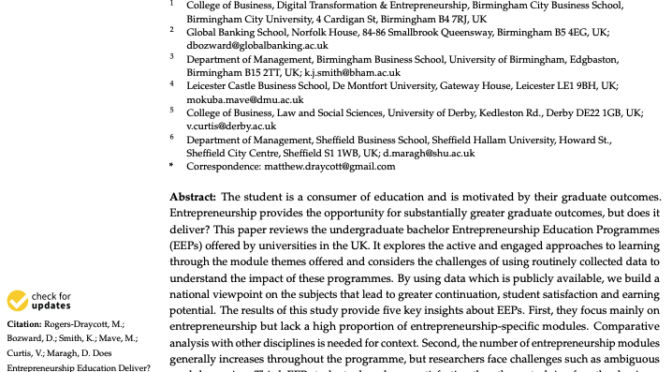
    Dive into the world of entrepreneurship education in the UK. This blog post unpacks the key findings from a recent study, analyzing the real impact nationally of Entrepreneurship Education Programmes (EEP) on students and identifying future research areas.

    Entrepreneurship education has become a cornerstone in shaping the business leaders of tomorrow. But, how effective is it, really? This recent study I conducted with colleagues delved into this question, examining UK’s undergraduate entrepreneurship programmes. Let’s uncover what they found and what it means for the future.

    The research article is titled “Does Entrepreneurship Education Deliver? A Review of Entrepreneurship Education University Programmes in the UK” and explores the impact of undergraduate entrepreneurship education programs (EEPs) in the UK. It examines the structure, student satisfaction, and outcomes of these programmes. The study is conducted using publicly available data and aims to offer insights on the effectiveness of EEPs in terms of student continuation, satisfaction, and employability. The paper contributes new findings to the field, particularly relevant for researchers, educators, and policymakers involved in entrepreneurship education. For more details, you can view the full article here.

    The article concludes that while Entrepreneurship Education Programmes (EEPs) in UK universities are generally well-received by students, their effectiveness in enhancing employability and entrepreneurial skills varies. The study highlights the need for a more standardized approach in evaluating these programmes and suggests a greater emphasis on practical, experiential learning to improve outcomes. It also points out the potential for these programmes to better align with industry requirements and entrepreneurial ecosystems.

    For a comprehensive understanding, don’t forget to check out the full study here.