Tag: Experiential Learning

  • The Igbo Apprenticeship Model (IAS) and its benefits for entrepreneurship and business creation

    The Igbo Apprenticeship Model (IAS) and its benefits for entrepreneurship and business creation

    As we try and secure Skills England to agree that an Entrepreneur is a valid occupation, lets look around the world for use cases.

    This blog uses recent empirical and conceptual literature (2010–2025) on the Igbo Apprenticeship System (IAS, also called Igba-Boyi/Igba-Boi, Imu-Oru, etc.) in southeastern Nigeria, with emphasis on how the model develops entrepreneurship skills and fuels business creation. Sources include peer-reviewed articles, theses, working papers, and reputable journalistic and policy accounts. Key themes extracted: historical structure, mechanisms of learning and finance, skills outcomes, firm-creation impacts, constraints and reforms, and research gaps. Erasmus University Thesis Repository


    1. What the IAS is — structure and origins

    The IAS is a predominantly informal, community-based system in which young people (apprentices, often called boyi or odibo) live with and work for established traders/entrepreneurs (masters, oga/madam) to learn a trade, gain market access, and (crucially) receive start-up capital when they “graduate.” The arrangement is contractual but socially enforced: families mediate placements; mentors provide training, credit and networks; apprentices provide labour, loyalty and skill acquisition over a fixed period. Several contemporary studies stress that IAS is both vocational training and an indigenous small-business incubation model embedded in kin and ethnic networks. Wikipedia


    2. Core mechanisms that generate entrepreneurial capacity

    Through our literature review we have identified three mutually reinforcing mechanisms through which IAS builds entrepreneurship capacity:

    1. Practice-based skill transfer. Apprentices learn technical trade skills on-the-job (from tailoring, carpentry to more complex commerce practices), acquiring tacit knowledge rarely conveyed in formal classrooms. This learning takes place via long-term observation, imitation, and scaffolded responsibility. Irene B
    2. Embedded finance and graduated capital transfer. Many masters accumulate savings and then supply a pool of working capital — in cash, goods or credit facilities — to apprentices when they “cycle out.” This capital infusion is often the decisive enabler that converts acquired skills into an independent business. Several empirical studies highlight that this guaranteed capital distinguishes IAS from many other apprenticeship traditions. Ernest Jebolise Chukwuka
    3. Networks and market access. Apprentices inherit supplier links, customer lists, and social reputation from their masters and from ethnic trading networks. These relational assets substantially lower market entry barriers and reduce transaction costs for new enterprises. African Business

    3. Skills and capacities developed

    Researchers group the IAS outcomes into skill clusters:

    • Technical and operational skills: sector-specific craft and trade abilities (e.g., accounting for small traders, inventory handling, pricing). Chukwuma-Nwuba
    • Business and managerial skills: informal training in bookkeeping basics, stock rotation, supplier negotiation, customer relations, and simple business planning learned through practice. ResearchGate
    • Entrepreneurial mindsets and soft skills: risk tolerance, resourcefulness, independence, time discipline, and opportunistic problem solving are repeatedly documented as cultural products of the IAS. Several qualitative studies argue that the IAS socialises entrepreneurial identity. Chukwuma-Nwuba
    • Social capital and reputation management: apprentices learn how to mobilise family and ethnic networks, important for scaling beyond micro-ventures. African Business

    These capabilities together create readiness to found and run micro and small enterprises — often with higher survival probabilities because of the mentoring and capital aspects of the model. Chukwuma-Nwuba


    4. Evidence on business creation, livelihoods and economic effects

    A growing body of quantitative and qualitative work links the IAS to concrete entrepreneurial outcomes:

    • Start-up incidence: Studies and field reports show high rates of business formation among IAS alumni — many graduates immediately open shops, workshops or trading stalls using the capital/support from mentors. Kenneth Nduka Omede
    • SME growth and resilience: IAS-founded firms often evolve into stable micro and small enterprises; some scale to larger trading firms through network reinvestment and apprenticeship cycles (masters who were once apprentices themselves). Chukwuma-Nwuba
    • Poverty alleviation and employment: Research in southeastern Nigeria attributes significant livelihood creation and poverty reduction to the IAS by creating self-employment pathways where formal wage jobs are scarce. Kenneth Nduka Omede

    While many studies are context-specific and observational, convergence across sources supports the claim that IAS is an effective grassroots engine for entrepreneurship and local economic development. African Business


    5. Strengths — why IAS works where formal systems struggle

    Literature highlights several comparative strengths:

    • Cost-effective human capital formation: IAS requires little public expenditure and is demand-driven (market signals determine what is learned). IIARD Journals
    • Integrated finance and training: The built-in post-training capital transfer solves a common gap—trained youth lacking start-up funds. Chukwuma-Nwuba
    • Cultural fit and trust: Embeddedness in family/ethnic networks provides enforcement and reduces moral hazard, a major advantage where formal contract enforcement is weak. African Business

    6. Limitations, challenges and critiques

    Scholars and policy commentators also document important limitations:

    • Informality and regulatory gaps: Lack of formal recognition can limit access to broader finance, formal certification, and scalable support from government or donors. epubs.ac.za
    • Variable quality and exploitation risk: Apprenticeship quality depends on the master; some apprentices face long hours, low pay, or exploitative conditions, and not all receive adequate business mentoring. Chukwu Udoka Helen
    • Gender and inclusion issues: Historically male-dominated in many trades; women and marginalized groups may have less access to the most profitable networks and capital transfers. Research calls for more gender-sensitive analyses. Nigerian Journals Online
    • Scaling and modernisation pressures: Integrating IAS with contemporary financial services, digital markets and formal vocational qualifications remains a policy and practical challenge. Vanguard News

    7. Conclusion — synthesis

    The Igbo Apprenticeship System (IAS) offers valuable lessons for strengthening the UK apprenticeship system, particularly in promoting entrepreneurship, business creation, and social mobility. At its core, the IAS combines practical, immersive learning with structured mentorship and a guaranteed transition into self-employment through start-up capital and access to markets. Integrating these principles into the UK context could address long-standing gaps in enterprise education and the progression of apprentices beyond employment into business ownership.

    First, UK apprenticeship pathways could embed entrepreneurial apprenticeships that mirror the IAS model—pairing young people with experienced small business owners who provide hands-on coaching while developing commercial, financial, and customer-facing competencies. This would extend apprenticeships beyond technical skill acquisition to include core business capabilities such as sales, budgeting, supplier relations, and opportunity recognition.

    Second, adopting the IAS principle of graduation support—through micro-grants, matched savings, or guaranteed access to start-up advice—would help apprentices transition into independent trading or micro-enterprise. Partnerships with local authorities, community lenders, and chambers of commerce could replicate the IAS’s capital and network transfer.

    Finally, IAS-inspired models would strengthen place-based regeneration. By empowering apprentices to start local businesses, the UK could stimulate high-street renewal, build community wealth, and create a pipeline of resilient, locally rooted entrepreneurs.


  • Improving Quality Systems in University–Subcontractual Provider Relationships

    Improving Quality Systems in University–Subcontractual Provider Relationships

    Effective quality management in higher education is increasingly complex when universities work with subcontractual or partner providers. Ensuring consistency, compliance, and continuous improvement across multiple delivery sites requires robust systems that balance accountability with enhancement. Traditional quality control and assurance processes must evolve into dynamic frameworks that embed shared responsibility, data-driven oversight, and collaborative development. This review outlines practical strategies to strengthen institutional quality systems, drawing on UK QAA standards, the PDCA improvement model, and Total Quality Management principles. It highlights how universities can maintain academic integrity, enhance student outcomes, and build sustainable partnerships through structured subcontractual oversight.

    1. Strengthen Governance and Oversight Structures

    1.1. Establish a Unified Partnership Quality Framework

    Develop a Partnership Quality Framework that clearly defines:

    • Roles and responsibilities of both the university and subcontractual provider.
    • Reporting lines to central academic quality and registry functions.
    • Minimum academic, operational, and compliance standards aligned with the UK Quality Code.

    This framework should integrate QA (process assurance) and QE (continuous improvement) mechanisms to ensure all partners meet equivalent standards to on-campus delivery.

    1.2. Introduce a Partnership Oversight Board

    Create a Subcontractual Oversight Board reporting to the Academic Board or Senate, responsible for:

    • Reviewing academic performance metrics across providers.
    • Approving new partnerships and dynamically monitoring risks.
    • Overseeing annual self-evaluations, site visits, and re-approval cycles.

    The board should include representation from academic quality, registry, finance, compliance, and student experience, ensuring a holistic governance approach.


    2. Embed the PDCA (Plan–Do–Check–Act) Cycle in Partnership Management

    2.1. Plan

    • Co-develop Programme Delivery Plans with each provider, specifying staffing, learning resources, assessment timelines, and student support.
    • Ensure alignment with Subject Benchmark Statements and the Framework for Higher Education Qualifications (FHEQ).

    2.2. Do

    • Deliver teaching and learning using approved teaching staff and validated module specifications, which detail session learning outcomes.
    • Require staff induction into the university’s academic policies, assessment regulations, and pedagogic philosophy.

    2.3. Check

    • Conduct joint moderation of assessments and external examiner reviews.
    • Implement mid-academic year quality reviews using student session attendance, module performance, retention, and satisfaction data.
    • Use risk-based audits for providers showing volatility in outcomes.

    2.4. Act

    • Require Corrective Action Plans (CAPs) for underperforming areas.
    • Integrate lessons learned into the Annual Programme Monitoring (APM) process.
    • Share improvement outcomes across the provider network for collective learning.

    3. Enhance Data-Driven Quality Control and Benchmarking

    3.1. Develop a Partnership Data Dashboard

    Create a real-time data dashboard tracking:

    • Student enrolment and retention rates.
    • Session Attendance and Engagement.
    • Assessment completion and grade distribution.
    • Module feedback from Students.
    • External examiner feedback and academic misconduct cases.
    • Continuation and Completion rates.
    • NSS-equivalent satisfaction scores.

    This evidence-based approach supports proactive quality interventions and transparent accountability.

    3.2. Implement Cross-Provider Benchmarking

    Benchmark subcontractual providers against:

    • Internal university programmes.
    • External sector norms (using data such as HESA, TEF outcomes, or Graduate Outcomes Survey).
    • Comparable franchise or validation partners.

    Use this benchmarking to drive competitive quality improvement and share best practice across providers and sites.


    4. Reinforce Quality Assurance through Continuous Professional Development (CPD)

    4.1. Standardise Staff Development

    Mandate joint staff development programmes for university and subcontractual teaching staff:

    • Annual Teaching and Assessment Symposium to share best practices.
    • Digital pedagogy and student engagement workshops.
    • Support for HEA Fellowship or equivalent professional recognition.

    4.2. Peer Review and Mentoring

    Implement peer observation schemes that cross partner boundaries:

    • University academics mentor subcontractual teaching staff.
    • Reciprocal classroom visits and reflection sessions.

    This approach transforms quality assurance from a compliance mechanism into a shared culture of learning, reflection, and continuous improvement, fostering trust, capability, and consistency across the entire partnership network.


    5. Strengthen Quality Enhancement through Student Partnership

    5.1. Student Voice Integration

    Ensure student representation from each subcontractual provider within the university’s:

    • Academic Board or Learning & Teaching Committee.
    • Programme review and revalidation panels.
    • Student experience forums.

    Establish consistent mechanisms for module feedback, focus groups, and student–staff liaison committees across all partners and sites, with standardised templates and analysis which drive the data dashboard.

    5.2. Feedback-to-Action Transparency

    Create a monthly Student Feedback Impact Report for each provider that shows:

    • Key issues raised.
    • Actions taken and responsible parties.
    • Timelines and measurable outcomes.

    This demonstrates responsiveness and supports a culture of continuous enhancement.


    6. Institutionalise Total Quality Management (TQM) Principles

    6.1. Develop a Culture of Shared Responsibility

    Move beyond compliance by embedding TQM principles:

    • Leadership commitment to shared goals.
    • Stakeholder-driven quality (students, employers, staff).
    • Continuous improvement mindset.

    Encourage providers to see quality as everyone’s responsibility, not merely the QA office’s function.

    6.2. Establish Continuous Improvement Reviews

    Introduce biannual Continuous Improvement Reviews (CIRs) where each provider:

    • Presents progress on academic and operational KPIs.
    • Shares innovations in pedagogy and student support.
    • Reflects on improvement actions implemented since the last review.

    This shifts the focus from inspection to collaboration and learning.


    7. Manage Risk and Compliance Proactively

    7.1. Adopt a Risk-Based Quality Oversight Model

    Categorise providers as Low, Medium, or High Risk based on:

    • Past performance.
    • Staff turnover.
    • Student outcomes.
    • Financial stability.

    Tailor monitoring intensity accordingly:

    • Low risk: light-touch annual review.
    • Medium risk: mid-year check plus full annual review.
    • High risk: enhanced scrutiny, extra visits, and conditional continuation.

    7.2. Maintain Clear Contractual Quality Clauses

    Contracts should specify:

    • Quality expectations linked to QAA and OfS standards.
    • Sanctions for non-compliance or misrepresentation.
    • Obligations for real-time data reporting, assessment moderation, and staff approval.

    Contracts should integrate quality indicators and improvement triggers—making QE a contractual expectation, not an optional enhancement.


    8. Foster Transparency and External Credibility

    8.1. External Examiner Network

    Create a shared pool of external examiners across subcontractual sites to ensure consistency in:

    • Marking and assessment standards.
    • Feedback quality and moderation.
    • Award recommendations.

    8.2. Public Reporting and Communication

    Publish a Partnership Quality Annual Report summarising:

    • Provider performance.
    • Enhancements achieved.
    • Future improvement goals.

    This reinforces institutional transparency and strengthens trust with stakeholders and regulators.


    9. Promote Innovation and Digital Oversight

    9.1. Digital Monitoring Systems

    Use secure digital platforms for:

    • Engagement throughout module teaching.
    • Continuously track student learning development.
    • Online moderation and assessment tracking.
    • Automated alerts for underperformance.

    9.2. AI-Driven Quality Insights

    Apply learning analytics and AI tools to identify early warning signals such as:

    • Declining attendance or engagement.
    • Assessment bottlenecks.
    • Variance in feedback turnaround times.

    Such data-driven intelligence enhances preventive quality management rather than reactive response. All digital platforms should be linked through a central data warehouse or dashboard, enabling the quality team to conduct integrated analyses that combine academic results, engagement data, and feedback insights. This holistic approach strengthens both accountability (through Quality Assurance) and innovation (through Quality Enhancement).


    10. Align Subcontractual Oversight with Institutional Enhancement Strategy

    Finally, integrate subcontractual quality oversight into the university’s broader enhancement agenda, ensuring it supports institutional ambitions in:

    • Teaching excellence (TEF alignment).
    • Graduate employability.
    • International reputation.
    • Inclusive student success.

    When partners are embedded within a shared mission of continuous enhancement, the subcontractual relationship becomes not just a compliance requirement but a collaborative driver of educational excellence.


    Summary: Key Recommendations

    AreaKey ActionModel Applied
    GovernanceCreate unified Partnership Quality Framework & Oversight BoardQA
    Continuous ImprovementApply PDCA cycle and CAPsQC → QE
    Data & AnalyticsBuild live dashboards and benchmarking systemsData-driven QA
    Staff CapabilityJoint CPD, peer mentoringQE
    Student PartnershipStandardised feedback + representationTQM / Transformational
    Risk ManagementRisk-based oversight modelQA / Compliance
    TransparencyAnnual partnership quality reportsQE

    Summary

    This article explores how universities can strengthen quality management when working with subcontractual or partner providers. It argues that traditional quality control and assurance models must evolve into integrated systems combining accountability, collaboration, and continuous enhancement.

    A robust governance structure—anchored by a unified Partnership Quality Framework and Oversight Board—ensures consistent academic standards and transparent reporting. The PDCA (Plan–Do–Check–Act) cycle supports iterative improvement across all providers, while data-driven dashboards enable real-time monitoring of student outcomes, attendance, and satisfaction.

    Staff capability is reinforced through joint CPD, cross-partnership peer review, and mentoring, creating a shared academic culture that values reflection and improvement. Students play a central role through standardised feedback mechanisms and representation on key committees.

    The article promotes Total Quality Management (TQM) principles and risk-based oversight, balancing trust with accountability. Digital systems—including learning analytics, AI-driven dashboards, and experiential tools such as SimVenture—enhance transparency and consistency across teaching and assessment.

    Ultimately, aligning subcontractual oversight with the university’s wider enhancement strategy ensures that all partners contribute to teaching excellence, employability, and inclusive student success. Quality thus becomes a collective, data-informed, and enhancement-led endeavour that unites the entire university network.

    Other blogs in this series:

    OfS Subcontractual Oversight: Helping Universities Strengthen Assurance

    Bridging Subcontracting Oversight and Business Simulation: How Can Universities Meet OfS Expectations?

    Call to Action:

    If you are interested in learning more or discussing the points in this blog, then please either:
    Connect on Linkedin: https://www.linkedin.com/in/bozward/
    Book an Appointment: https://calendar.app.google/hCA49pWHJ2TtteL76

  • The Power of Entrepreneurship Education in Developing Businesses and Resilient Citizens

    The Power of Entrepreneurship Education in Developing Businesses and Resilient Citizens

    Introduction

    Entrepreneurship education has become a crucial element in today’s rapidly evolving economic landscape. By equipping individuals with the necessary skills, knowledge, and mindset, entrepreneurship education fosters innovation, resilience, and sustainable economic growth. This article delves into the transformative power of entrepreneurship education, examining its role in developing successful businesses and resilient citizens.

    The Importance of Entrepreneurship Education

    Entrepreneurship education is more than just learning how to start a business. It encompasses a comprehensive skill set that includes problem-solving, critical thinking, leadership, and financial literacy. These skills are essential not only for entrepreneurs but also for anyone looking to navigate the complexities of the modern workforce .

    The Role of Entrepreneurship in Economic Development

    Entrepreneurship drives economic development by creating jobs, fostering innovation, and stimulating competition. By encouraging entrepreneurial thinking, economies can adapt more quickly to changes, leading to more robust and dynamic markets .

    Fostering Innovation through Entrepreneurship Education

    Innovation is at the heart of entrepreneurship. Through structured programs and practical experiences, entrepreneurship education encourages creative thinking and problem-solving. This innovation mindset is crucial for developing new products, services, and processes that drive business success .

    Building Resilience in Individuals

    Entrepreneurship education teaches resilience by exposing individuals to real-world challenges and encouraging them to learn from failures. This resilience is not only vital for business success but also for personal growth and adaptability in the face of adversity .

    Key Components of Effective Entrepreneurship Education

    Curriculum Design

    An effective entrepreneurship education curriculum integrates theoretical knowledge with practical applications. This includes case studies, business simulations, and hands-on projects that provide students with real-world experience .

    Mentorship and Networking

    Access to mentors and a robust network of industry professionals is crucial. Mentorship provides guidance, support, and valuable insights, while networking opportunities can lead to partnerships and business opportunities .

    Experiential Learning

    Experiential learning involves direct engagement in entrepreneurial activities. This could include internships, startup incubators, and participation in business competitions, providing students with practical skills and confidence .

    Case Studies of Successful Entrepreneurial Education Programs

    Babson College

    Babson College is renowned for its entrepreneurship education programs. Its curriculum emphasizes experiential learning, with students working on real-world projects and startups from the outset .

    Stanford University

    Stanford University integrates entrepreneurship across various disciplines. Its proximity to Silicon Valley provides students with unparalleled access to industry leaders and innovative startups .

    Developing Soft Skills through Entrepreneurship Education

    Leadership and Teamwork

    Entrepreneurship education cultivates leadership skills and the ability to work effectively in teams. These skills are essential for managing a business and collaborating with others .

    Communication Skills

    Effective communication is vital for entrepreneurs. Entrepreneurship education programs focus on developing strong written and verbal communication skills, essential for pitching ideas and negotiating deals .

    Financial Literacy and Management

    Understanding financial principles is crucial for any business venture. Entrepreneurship education includes training in budgeting, financial planning, and investment strategies, ensuring that entrepreneurs can manage their resources effectively .

    The Global Impact of Entrepreneurship Education

    Economic Empowerment

    Entrepreneurship education empowers individuals by providing them with the skills to create their own economic opportunities. This empowerment leads to increased economic participation and reduced inequality .

    Social Impact

    Entrepreneurial ventures often address social and environmental challenges. By fostering a sense of social responsibility, entrepreneurship education contributes to sustainable development and positive social change .

    The Future of Entrepreneurship Education

    Integrating Technology

    The integration of technology in entrepreneurship education enhances learning experiences and provides students with the tools needed to succeed in a digital economy .

    Adapting to Changing Markets

    Entrepreneurship education must continuously evolve to keep pace with changing market dynamics. This involves updating curricula to include emerging trends and technologies .

    Challenges and Opportunities in Entrepreneurship Education

    Accessibility and Inclusivity

    Ensuring that entrepreneurship education is accessible to all, regardless of background or socioeconomic status, is a significant challenge. However, it also presents an opportunity to tap into diverse perspectives and ideas .

    Measuring Impact

    Quantifying the impact of entrepreneurship education can be challenging. Developing metrics to assess outcomes and continuously improve programs is essential for long-term success .

    Conclusion

    Entrepreneurship education is a powerful catalyst for developing thriving businesses and resilient citizens. By equipping individuals with essential skills, fostering innovation, and promoting economic empowerment, entrepreneurship education plays a crucial role in shaping a prosperous and dynamic future.


    FAQs

    What is entrepreneurship education?

    Entrepreneurship education involves teaching skills, knowledge, and mindsets necessary for starting and managing businesses. It includes subjects like leadership, financial literacy, and innovation.

    How does entrepreneurship education benefit individuals?

    It helps individuals develop critical thinking, problem-solving skills, and resilience, preparing them for various challenges in the business world and beyond.

    Why is entrepreneurship education important for economic development?

    It fosters job creation, stimulates innovation, and drives competition, leading to a more dynamic and adaptable economy.

    What are some examples of successful entrepreneurship education programs?

    Programs at institutions like Babson College and Stanford University are renowned for their effective integration of theoretical and practical learning in entrepreneurship.

    How does entrepreneurship education build resilience?

    By exposing individuals to real-world challenges and failures, it teaches them to adapt, persevere, and learn from their experiences.

    What role does mentorship play in entrepreneurship education?

    Mentorship provides guidance, support, and industry insights, helping aspiring entrepreneurs navigate their business journeys and make informed decisions.


    References

    1. Kuratko, D. F. (2005). The emergence of entrepreneurship education: Development, trends, and challenges. Entrepreneurship Theory and Practice, 29(5), 577-597.
    2. Audretsch, D. B., & Thurik, R. (2001). What’s new about the new economy? Sources of growth in the managed and entrepreneurial economies. Industrial and Corporate Change, 10(1), 267-315.
    3. Neck, H. M., Greene, P. G., & Brush, C. G. (2014). Teaching entrepreneurship: A practice-based approach. Edward Elgar Publishing.
    4. Cope, J. (2005). Toward a dynamic learning perspective of entrepreneurship. Entrepreneurship Theory and Practice, 29(4), 373-397.
    5. Fayolle, A., & Gailly, B. (2008). From craft to science: Teaching models and learning processes in entrepreneurship education. Journal of European Industrial Training, 32(7), 569-593.
    6. St-Jean, E., & Audet, J. (2012). The role of mentoring in the learning development of the novice entrepreneur. International Entrepreneurship and Management Journal, 8, 119-140.
    7. Pittaway, L., & Cope, J. (2007). Simulating entrepreneurial learning: Integrating experiential and collaborative approaches to learning. Management Learning, 38(2), 211-233.
    8. Babson College. (2021). Entrepreneurship education. Retrieved from Babson College.
    9. Stanford University. (2021). Stanford Entrepreneurship Network. Retrieved from Stanford University.
    10. Katz, J. A. (2003). The chronology and intellectual trajectory of American entrepreneurship education. Journal of Business Venturing, 18(2), 283-300.
    11. Brush, C. G., & Greene, P. G. (1996). Teaching entrepreneurship: A practice-based approach. Journal of Business Venturing, 11(5), 399-416.
    12. Klapper, R., & Tegtmeier, S. (2010). Innovating entrepreneurial pedagogy: Examples from France and Germany. Journal of Small Business and Enterprise Development, 17(4), 552-568.
    13. Volkmann, C. (2004). Entrepreneurial studies in higher education. Higher Education in Europe, 29(2), 177-185.
    14. Mair, J., & Marti, I. (2006). Social entrepreneurship research: A source of explanation, prediction, and delight. Journal of World Business, 41(1), 36-44.
    15. Rae, D. (2007). Connecting enterprise and graduate employability: Challenges to the higher education culture and curriculum? Education + Training, 49(8/9), 605-619.
    16. Kirby, D. A. (2004). Entrepreneurship education: Can business schools meet the challenge? Education + Training, 46(8/9), 510-519.
    17. Jones, C., & Iredale, N. (2010). Enterprise education as pedagogy. Education + Training, 52(1), 7-19.
    18. Matlay, H. (2005). Researching entrepreneurship and education: Part 1: What is entrepreneurship and does it matter? Education + Training, 47(8/9), 665-677.
  • Entrepreneurship Education in the UK: Impact and Future Research Directions

    Entrepreneurship Education in the UK: Impact and Future Research Directions

    Dive into the world of entrepreneurship education in the UK. This blog post unpacks the key findings from a recent study, analyzing the real impact nationally of Entrepreneurship Education Programmes (EEP) on students and identifying future research areas.

    Entrepreneurship education has become a cornerstone in shaping the business leaders of tomorrow. But, how effective is it, really? This recent study I conducted with colleagues delved into this question, examining UK’s undergraduate entrepreneurship programmes. Let’s uncover what they found and what it means for the future.

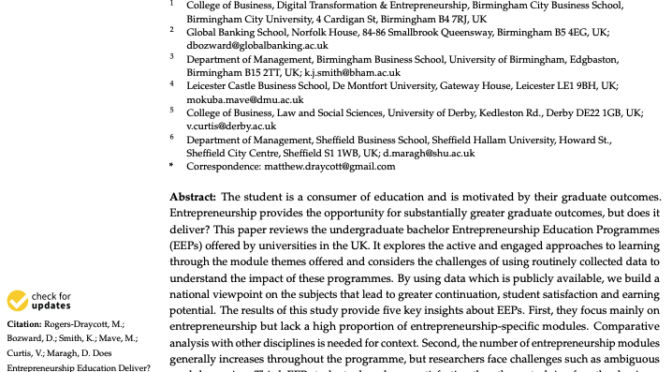
    The research article is titled “Does Entrepreneurship Education Deliver? A Review of Entrepreneurship Education University Programmes in the UK” and explores the impact of undergraduate entrepreneurship education programs (EEPs) in the UK. It examines the structure, student satisfaction, and outcomes of these programmes. The study is conducted using publicly available data and aims to offer insights on the effectiveness of EEPs in terms of student continuation, satisfaction, and employability. The paper contributes new findings to the field, particularly relevant for researchers, educators, and policymakers involved in entrepreneurship education. For more details, you can view the full article here.

    The article concludes that while Entrepreneurship Education Programmes (EEPs) in UK universities are generally well-received by students, their effectiveness in enhancing employability and entrepreneurial skills varies. The study highlights the need for a more standardized approach in evaluating these programmes and suggests a greater emphasis on practical, experiential learning to improve outcomes. It also points out the potential for these programmes to better align with industry requirements and entrepreneurial ecosystems.

    For a comprehensive understanding, don’t forget to check out the full study here.