Universities have spent the last two decades talking about entrepreneurship. They have launched incubators, created enterprise hubs, introduced optional modules, and invited guest speakers from industry. Yet, despite this activity, entrepreneurship remains marginal to the core student experience. It is something extra—an add-on for the interested few—rather than a foundational capability for the many.
This is a structural failure.
In an economy defined by uncertainty, technological disruption, and shifting labour markets, entrepreneurial capability is no longer optional. It is central to employability, innovation, and economic resilience. The question, therefore, is not whether universities should teach entrepreneurship—but how they embed it meaningfully across every degree.
This blog sets out a practical model for doing exactly that.
The Problem: Entrepreneurship as an Add-On
Most institutions approach entrepreneurship in one of three ways:
Standalone modules (often optional)
Enterprise centres or incubators
Extra-curricular competitions and events
While valuable, these approaches suffer from three critical limitations:
Low reach: Only a small percentage of students engage
Late intervention: Often introduced in final year, when habits are already formed
Weak integration: Disconnected from disciplinary learning
The result is predictable. Entrepreneurship becomes associated with business schools and start-up culture, rather than a broader way of thinking and acting.
This is a fundamental misunderstanding.
Entrepreneurship is not just about starting businesses. It is about creating value under conditions of uncertainty. That applies as much to a nurse redesigning patient care pathways as it does to a founder launching a tech venture.
Reframing Entrepreneurship: From Activity to Capability
To embed entrepreneurship effectively, universities must shift from teaching entrepreneurship as an activity to developing entrepreneurship as a capability.
This capability includes:
Opportunity recognition
Resource mobilisation
Value creation
Risk navigation
Adaptation and learning
These are not discipline-specific skills. They are transferable, developmental, and essential across all professions.
This reframing aligns closely with your broader work on entrepreneurial capital and value creation. Students are not simply learning to “start businesses”; they are learning to deploy different forms of capital—human, social, intellectual, and beyond—to create value in diverse contexts.
A Practical Model: Embedding Entrepreneurship Across the Curriculum
A meaningful approach requires a system-level design. The model below integrates three dimensions:
1. Curriculum Integration (Where it is taught)
2. Developmental Staging (When it is taught)
3. Experiential Application (How it is taught)
Together, these create a coherent, scalable framework.
1. Curriculum Integration: The “Thin Layer” Model
Rather than isolating entrepreneurship in single modules, the most effective approach is to embed a “thin layer” of entrepreneurial thinking across all modules.
This does not require rewriting entire programmes. Instead, it involves introducing targeted interventions within existing teaching.
Example by discipline:
Engineering: Design projects include commercial feasibility and user validation
Healthcare: Case studies include service innovation and system improvement
Arts: Creative work includes audience development and monetisation strategies
Social Sciences: Policy analysis includes implementation and impact creation
The key is consistency. Every student encounters entrepreneurial thinking repeatedly, in different contexts, across their degree.
This approach solves the reach problem. Entrepreneurship is no longer optional—it is embedded.
2. Developmental Staging: A Longitudinal Model
Embedding entrepreneurship requires more than repetition. It requires progression.
Here, your 9 Stages of the Entrepreneurial Lifecycle provide a powerful foundation. These stages can be translated into a student development journey.
Year 1: Discovery
Students learn to identify opportunities and understand problems.
Activities: Problem identification, curiosity exercises, industry exploration
Outcome: Awareness of opportunity spaces
Year 2: Modelling
Students develop ideas into structured concepts.
Activities: Business models, design thinking, prototyping
Outcome: Ability to shape and test ideas
Year 3: Application
Students apply entrepreneurial thinking in real-world contexts.
Activities: Live projects, placements, consultancy challenges
The UK apprenticeship system, while effective in achieving high sustained employment rates for its graduates, is structurally inhibited from cultivating entrepreneurs and self-employed individuals. This failure is a systemic consequence of a policy framework designed to prioritize the immediate, demand-led needs of established employers, fostering intrapreneurship (internal innovation) rather than independent market creation. The literature review identifies three primary, interconnected impediments:
Regulatory Exclusion: Statutory funding rules explicitly mandate a contract of employment and categorically exclude self-employed sole traders from eligibility, effectively penalizing apprentices who attempt to transition to independent work during or immediately after their training.
Structural Bias from the Levy: The Apprenticeship Levy has caused a market shift away from foundational skilled trades towards higher-level corporate training. This policy has marginalized Small and Medium Enterprises (SMEs)—the traditional incubators of entrepreneurial talent—which now account for only 37% of apprenticeship starts , limiting apprentice exposure to holistic small business operations.
Curricular Deficit: Apprenticeship Standards (KSBs) focus narrowly on technical and sector-specific competencies, resulting in a critical lack of mandatory, comprehensive commercial training essential for sole traders, such as tax compliance, invoicing, financial management, and small business law.
In contrast to successful international models, such as the German Dual System and its Meister qualification, the UK lacks a formal, quality-assured progression path that links technical mastery with validated business competence. Overcoming this deficit requires fundamental reform, including the establishment of a Dual-Track Apprenticeship Pathway to permit funded self-employment, mandatory integration of commercial training modules, and the introduction of a national Master Technician status to provide a recognized, structured route to independent business ownership. The current framework risks creating a cohort of highly skilled employees who remain commercially dependent on established organizations.
Executive Summary and Conceptual Foundation
The UK apprenticeship system, while successfully achieving its core mandate of improving employment rates and sustaining positive destinations for learners 1, demonstrates a systemic and structural failure to cultivate self-employed individuals and entrepreneurs. This deficiency is not an accidental oversight but the direct consequence of a policy framework fundamentally designed to serve the immediate needs of established employers, prioritizing the creation of a stable, productive workforce over the incubation of new economic entities. The analysis concludes that three primary, interconnected factors restrict the pathway to self-employment: explicit regulatory prohibition, structural biases embedded by the Apprenticeship Levy, and a significant deficit in mandatory commercial and managerial training within the curriculum.
Defining Entrepreneurship vs. Intrapreneurship in the Skills Economy
To accurately assess the failure of the system, it is necessary to establish a conceptual distinction between entrepreneurship and intrapreneurship. Entrepreneurship refers to the activity of creating and running an independent business, often operating as a sole trader, being responsible for success or failure, managing multiple clients, and handling taxation through mechanisms like HMRC Self Assessment.2 Conversely, intrapreneurship describes the cultivation of an entrepreneurial mindset—exhibiting initiative, problem-solving, and adaptability within the confines of an existing organizational structure.4
The current UK apprenticeship mandate is clearly structured to generate intrapreneurs. Academic providers explicitly frame entrepreneurship to apprentices as personal development, teaching them to innovate and add value while remaining employees within established companies.4 While this produces high-value employees who can adapt to change and solve problems on the job, it strategically avoids providing the essential legal and commercial knowledge required for independent business formation.4 This fundamental design choice—to create internal innovators rather than independent market entrants—sets the stage for the limited self-employment outcomes observed in the UK system.
The Evolution of UK Apprenticeship Policy: From Craft to Corporate Needs
The evolution of the UK vocational training landscape has shaped its current employment-centric focus. Apprenticeships have historically provided a crucial route into work for young people, combining on-the-job training with formal qualifications.6 However, the framework in England has been historically criticised for ignoring general and civic educational elements, often discounting the longer-term interests of the apprentices themselves.6
The policy shift in the early 21st century, influenced by reports like Leitch (2006), argued for a significant expansion in structured training to boost economic competitiveness.7 This led to considerable government investment and the establishment of the National Apprenticeships Service, designed to boost the supply of opportunities and make apprenticeships a mainstream option.7 Crucially, the literature review found that contemporary evidence on apprenticeships relates strongly to employers, reflecting the government’s explicit ambition to create a system where skills provision is demand-led.7 This structural decision, prioritizing the immediate skill needs defined by employers, inherently limits the curriculum and funding structure to favour the continuity of employment over the establishment of new, independent commercial ventures, thereby structurally constraining entrepreneurial preparation.6
Furthermore, the statistical measurement framework reinforces this non-prioritization. Government data focuses on ‘sustained positive destinations’ and ‘sustained employment’ rates.1 The proportion of apprenticeship learners in 2021/22 moving into sustained positive destinations was 94%, with 93% achieving a sustained employment rate.1 The absence of self-employment as a distinct, tracked Key Performance Indicator (KPI) within official government statistics 8 indicates that successful transition to independent business ownership is not considered a primary success metric for the Education and Skills Funding Agency (ESFA), confirming that the failure to foster entrepreneurial destinations is rooted in policy design that neglects this outcome from the outset.
Outline of the Failure Thesis: Regulatory, Curricular, and Structural Disconnects
The systematic failure to foster self-employment pathways is attributable to three systemic disconnects:
Regulatory Exclusion: The mandatory contract of employment and the explicit regulatory exclusion of sole traders from funding eligibility.9
Structural Bias: The impact of the Apprenticeship Levy, which has marginalized Small and Medium Enterprises (SMEs) 11—the traditional incubators of entrepreneurial talent—in favour of large corporate entities.
Curricular Deficit: The lack of mandatory, comprehensive business management, compliance, and financial training within Apprenticeship Standards.4
The Primary Regulatory Impediment: The Employment Contract Mandate
The most definitive and uncompromising barrier preventing apprentices from pursuing self-employment is the statutory framework governing apprenticeship eligibility and funding. This framework enforces a rigid model of employment that actively disqualifies self-starters.
Statutory Eligibility Requirements: The Exclusion of Self-Employed Sole Traders
The apprenticeship system requires, as a prerequisite for funding, that the apprentice must have a contract of employment from day one.9 This mandate firmly establishes the apprentice as an employee, necessitating payment via Pay As You Earn (PAYE).9
Analysis of the Apprenticeship Funding Rules reveals an explicit and categorical prohibition against funding individuals who operate as sole traders.10 The rules state clearly that a provider must not claim funding for individuals who are self-employed as a sole trader.10 This requirement establishes a strict condition for eligibility that binds the apprentice to the traditional employer-employee structure, effectively excluding those who wish to pursue a funded apprenticeship while simultaneously operating or developing an independent income stream.
Consequences of the Mandate: Deterring Self-Starters
The regulatory structure views a change in employment status to self-employment not as a positive career progression, but as a breach of funding requirements. If an apprentice becomes self-employed (as a sole trader) during their training period, they lose eligibility for funding, and the training provider is required to report them as having withdrawn from the programme.9 This consequence is highly detrimental, as it acts as a direct financial and educational penalty against entrepreneurial ambition, framing self-employment as a risk to compliance rather than a measure of success.
This regulatory ‘Compliance Trap’ disproportionately harms workers in skilled trades, such as construction 12, where self-employment is a highly desirable and natural progression route post-qualification. The framework forces skilled workers to choose between completing their funded qualification within a structured employment setting and applying their newly acquired skills immediately in an independent commercial environment. By enforcing this strict choice, the system discourages the immediate application of skills in an independent setting, potentially leading to dependency on employment and slowing down the rate of new business formation within key sectors.
Furthermore, the rule prevents experienced sole traders or freelancers from formalising their training relationships. A sole trader or subcontractor cannot legally hire someone and call them an “apprentice” if they pay them as a subcontractor; the apprentice must be a PAYE employee.9 This prevents the traditional, practical training model where an experienced independent tradesperson takes on a junior trainee, further limiting the potential pipeline for future self-employment.
The Ambiguity of Employment Status in the UK
The rigid regulatory stance taken by the Department for Education (DfE) in the apprenticeship funding rules contrasts sharply with the broader definitions of work used by HM Revenue and Customs (HMRC). HMRC acknowledges that a person can run a business and be employed simultaneously, representing the modern ‘portfolio worker’.2 Self-employed status is defined by factors such as being responsible for success/failure, invoicing for pay, providing equipment, and being able to hire others.2
By strictly adhering to the employee (PAYE) model, the apprenticeship framework fails to accommodate the commercial realities of dynamic, gig-heavy sectors. The regulatory model bypasses the flexibility inherent in the UK labour market, excluding highly motivated individuals who may seek training to formalize a business they already operate or plan to launch concurrently with their studies. This regulatory gap represents a fundamental failure to integrate vocational training with the rapidly evolving nature of modern work and business formation.
Structural Misalignment: The Apprenticeship Levy and SME Marginalisation
The introduction of the Apprenticeship Levy in 2017 caused a significant structural shift in the UK skills market, altering the profile of apprentices and the types of employers involved. This policy unintentionally created a bias that disadvantages small and medium-sized enterprises (SMEs), which are traditionally the most fertile ground for entrepreneurial incubation.
Impact of the Apprenticeship Levy on Start Composition
The Levy’s primary consequence was a market distortion characterized by a move away from foundational and trade-based training towards higher-level corporate training. Overall apprenticeship starts fell by 33% between 2014/15 and 2022/23.13 The decline was most pronounced at the entry levels: Intermediate (Level 2) apprenticeships fell by two-thirds, and Advanced (Level 3) starts declined by a quarter.14 Specifically, participation in Intermediate apprenticeships decreased by 28.3% between 2020/21 and 2024/25.8
Conversely, Higher Apprenticeship participation (L4-7) surged by 46.1% over the same period, leading to a tenfold growth in starts since 2013.8 This policy-driven shift created a ‘missing middle’ in UK skills provision, diverting funding and focus towards management and corporate training for existing large-scale employees. Evidence shows that 54% of organizations paying the Levy converted existing training into apprenticeships to claim back their allowance.15 This strategic ‘rebadging’ focuses resources on fulfilling internal skills needs (intrapreneurship) rather than expanding the pipeline for new skilled tradespeople who traditionally transition into self-employment. This financial segmentation systematically limits the resources flowing to the foundational training levels that underpin most independent commercial ventures.
The Critical Role of SMEs and Their Marginalisation
Small and medium-sized enterprises (SMEs) are essential incubators for entrepreneurs because they typically expose apprentices to the holistic operational context of a business—including commercial decision-making, finance, and client management—critical skills for eventual self-employment.
However, the UK apprenticeship market is structurally biased against them. SMEs (defined as 0-249 employees) accounted for only 37% of apprenticeship starts in 2022/23, a decrease from 40% in the previous year.11 This low figure is dramatically contrasted by successful international models, such as Germany, where approximately 98% of apprenticeships are offered through SMEs.14 The limited exposure of UK apprentices to the small business operational context due to this marginalisation reduces their likelihood of developing the necessary commercial awareness to transition effectively to self-employment.
Barriers to SME Participation
The barriers preventing SMEs from engaging are primarily administrative and structural. Research from the Social Market Foundation (SMF) found that small trades firms frequently lack the engagement necessary to navigate the complex recruitment and training process.16 A significant majority of businesses surveyed reported little to no interaction with local colleges (52% lack interaction) or independent providers (60% lack interaction).16 This lack of a “go-to” intermediary service forces SMEs to tackle the complexity alone, often resulting in them being unable to take on apprentices, thereby exacerbating skills shortages in skilled trades.16
While financial incentives exist—small, non-levy-paying businesses pay only 5% of training costs, and £1,000 incentives are paid for hiring younger apprentices 17—the financial burden remains a deterrent. Research indicates that 73% of small employers who already employ apprentices stated that the reintroduction of higher incentives (e.g., the previous £3,000 incentive) would encourage them to expand their capacity.18
Future Policy Instability: The Growth and Skills Levy
The UK government has acknowledged the failures of the current system, describing the existing Levy as “failing” and proposing its replacement with a Growth and Skills Levy.19 This proposed reform intends to allow employers up to 50% flexibility to spend Levy funding on non-apprenticeship training, such as short courses in critical areas like digital and engineering.19
While the intent is to drive investment in skills and address falling starts 20, this flexibility introduces a significant systemic risk. The inherent weakness of the previous Levy—its tendency to convert existing internal training 15—combined with this new flexibility, creates a potential scenario where large corporations may divert funds entirely away from structured apprenticeships and into short-term, internal skills development. This risks a further decline in overall apprenticeship starts, particularly at the foundational L2/L3 levels 21, further eroding the base of young entrants who might otherwise pursue trades and later transition to self-employment. The financial security of the existing pipeline, already strained, is therefore threatened by future instability.
Table 1: The Shift in UK Apprenticeship Start Composition (Pre- vs. Post-Levy)
Metric
Pre-Levy Context
Post-Levy (2022/23 Data)
Change (Interpretation)
Source
Total Apprenticeship Starts
High (500k+ annually pre-2017)
Declined by 33% (from 2014/15 to 2022/23)
Overall reduction in talent pipeline
13
Intermediate (L2) Starts
High Volume
Declined by two-thirds
Loss of foundational trade skills base
14
Higher (L4-7) Starts
Low (e.g., 9,800 in 2013)
High (e.g., 106,360 in 2022)
Tenfold growth, skewing focus to large employers/intrapreneurship
14
SME Share of Starts (0-249 Employees)
Higher (Pre-Levy)
37% (2022/23)
Decreased role of primary entrepreneurial incubators
11
Curricular and Pedagogical Deficits in Entrepreneurial Development
Even if the regulatory barriers to self-employment were removed, the current apprenticeship curriculum suffers from a pedagogical deficit, failing to equip apprentices with the critical commercial knowledge needed to operate a business successfully.
The Limited Scope of Knowledge, Skills, and Behaviours (KSBs)
Apprenticeship Standards are defined by the required Knowledge, Skills, and Behaviours (KSBs) necessary to undertake a specific occupation.22 These standards focus on sector-specific duties and competencies, ensuring technical proficiency.22 This prescriptive focus on job duties reinforces the employee-centric model, continuing the historical criticism that the framework often ignores broader, general educational elements that would serve the long-term career interests of the apprentice, such as advanced business management or civic education.6
The curriculum creates highly skilled technicians but leaves them commercially underprepared. For a sole trader, proficiency requires not just technical mastery but essential commercial skills, including tax compliance (HMRC requirements 2), quoting, invoicing, and financial management.24 These elements are often absent as mandatory components.
Critique of Off-the-Job Training Delivery (OTJT)
Apprentices must dedicate a minimum of 20% of their working hours to off-the-job training, typically delivered by the training provider.25 This OTJT time is where abstract, theoretical knowledge should be imparted.5 However, training providers are primarily incentivized by compliance and the achievement of core technical qualifications required by the employers who fund the placements.11
Consequently, the pedagogical environment often lacks robust commercial training. The required curriculum ensures technical compliance but fails to construct modules covering crucial business elements like registration, financial planning, marketing, and small business law.5 This structural reality means that training providers focus on achieving technical compliance, neglecting the niche business development training that is vital for future self-employment but not required by their dominant corporate clients. To overcome this, educators require targeted support to embed entrepreneurial projects and assessments into all disciplines.4
Fostering ‘Intrapreneurship’ as a Substitute
The pedagogical shortfall is mitigated, but not solved, by the deliberate framing of entrepreneurship as ‘intrapreneurship’. Providers recognize that many apprentices initially view themselves solely as employees.4 Therefore, they teach core entrepreneurial competencies—such as taking initiative, adapting to change, and solving problems on the job—which successfully creates individuals who drive innovation within established organizations.4
However, by stopping short of teaching the necessary legal and financial skills for independent operation, this approach reinforces the employee-centric model. Graduates leave with a valuable entrepreneurial mindset but often without the validated commercial and regulatory capability to launch and sustain their own business, forcing them into continued reliance on established companies.
Social Mobility and the Progression Cliff
The curricular limitations intersect with social mobility concerns. While intermediate apprenticeships (L2) can act as a stepping stone toward higher educational attainment for non-disadvantaged learners, this progression is significantly less applicable for disadvantaged learners.26 Furthermore, starts by apprentices from disadvantaged backgrounds declined up to 10 percentage points more than non-disadvantaged apprenticeships at L2/L3 levels, and up to 23 percentage points more at the higher level.26
If the foundational apprenticeships (L2/L3) utilized by these demographics fail to provide a viable self-employment exit route (due to the curricular deficit and regulatory exclusion), and if progression to higher educational levels is constrained, the apprenticeship risks limiting subsequent career flexibility. This creates a progression cliff, where highly skilled individuals from deprived areas may not be able to leverage their technical competence to achieve independent economic self-sufficiency through business ownership.
International Benchmarking: Integrated Pathways to Mastery and Self-Employment
To grasp the full extent of the UK’s structural failure, it is instructive to compare the system against international vocational models that successfully integrate technical training with a structured pathway to business ownership and mastery.
Case Study: The German Dual System and the Meister Qualification
The German Dual System provides a powerful counter-example to the UK’s employee-only focus. This model covers approximately 330 state-recognized occupations, with training heavily weighted toward the foundational EQF levels 3-4 (comparable to UK L2 and L3).14 A key differentiator is the high involvement of SMEs, which host 98% of German apprenticeships.14 This integration ensures apprentices are exposed to the full spectrum of business operations from the start, a fundamental prerequisite for becoming an entrepreneur.
The core structure enabling self-employment is the Meister (Master craftsperson) qualification. This is a formal, post-apprenticeship progression that combines extensive theoretical and practical knowledge.27 The Meister qualification serves four main aims: formal recognition of skill, capacity to assume management responsibilities, development of skills to train apprentices, and, critically, the equipping of individuals with the business knowledge required to set up or take over an existing business.27
The Regulatory and Commercial Functions of the Meisterbrief
The Meisterbrief (Master craftsperson’s certificate) acts as a powerful quality assurance mechanism and a regulatory prerequisite. In many German skilled trades, the Meister qualification is a legal requirement for independent work and business ownership.24 To achieve this status, individuals must pass comprehensive modules on commercial knowledge, which cover essential aspects of running a business, including financial calculation, expense management, tax preparation, and legal requirements.24
This systematic approach links high technical competence directly to validated commercial capability. Moreover, a Meister is formally required to train new apprentices.27 This creates a virtuous cycle where experienced, highly qualified entrepreneurs replenish the skills pipeline, ensuring quality and pedagogical continuity within the self-employed sector. This integration confirms that mandatory quality assurance standards are not just about training employees but are essential tools for guaranteeing the competence of the self-employed sector.
The Swiss VET Model and Integrated Ecosystems
The Swiss Vocational Education and Training (VET) model further highlights the importance of collaboration and ecosystem management. In Switzerland, VET is often determined by industry sectors in partnership with the State Secretariat for Education, Research, and Innovation (SERI), ensuring curriculum relevance.28
The successful development of regional Centres of Vocational Excellence (CoVEs) through initiatives like Erasmus+ 29 demonstrates how strong regional partnerships between educational institutions and SMEs can stimulate local business development and innovation. These publicly co-funded training alliances pool resources and facilitate knowledge exchange, providing a crucial and cost-effective method to tackle the scale and complexity challenges that prevent UK SMEs from engaging with the apprenticeship system.16
The Absence of a UK ‘Master Technician’ or ‘Master Craftsperson’ Status
The most significant structural deficit revealed by this international comparison is the absence of a formalized, recognized UK standard equivalent to the Meisterbrief.3 While the UK system offers progression to higher education (L4-7) 14 or informal professional body certification (e.g., chartered status in construction 12), there is no mandatory, comprehensive certification that links technical mastery, the pedagogical capacity to train others, and validated business competence.
The lack of this structured progression means that the transition from a technically competent employee to a self-employed business owner in the UK is largely unregulated and informal. This denies the market a clear quality signal for independent contractors and removes a powerful incentive for skilled tradespeople to complete essential business management training before launching their own ventures, thereby increasing the risk of business failure. This is compounded by the system’s fragmented oversight, which spreads regulatory responsibility across DfE, Ofqual, and OfS 30, hindering the integration of commercial requirements across all training pathways, unlike the coordinated industry self-regulation seen in Switzerland.31
Table 2: Comparative Analysis of Entrepreneurial Integration in Vocational Models
Feature
UK Apprenticeship System (England)
German Dual System (Meister Qualification)
Impact on Entrepreneurship Pathway
Source(s)
Eligibility for Sole Traders
Explicitly excluded from funded programmes. Must remain an employee (PAYE).
Apprentices are employees, but certification leads directly to authorized self-employment.
Regulatory barrier forces reliance on employment, delaying or preventing start-ups.
9
Business/Commercial Training
Optional or generalized (focus on ‘Intrapreneurship’).
Mandatory components (Part III/IV of Meisterprüfung) covering finance, legal, and management.
UK graduates lack validated business acumen for independent operation.
4
Post-Qualification Status
Sustained employment or higher academic qualification. No mandatory, recognized master status.
Formal Meisterbrief required for business ownership and training new apprentices.
Absence of quality assurance for self-employment; no structured progression to business leadership.
1
SME Engagement
Low (37-41% of starts).
High (approx. 98% of starts).
Low exposure to holistic business operational models critical for future founders.
11
Conclusions and Policy Recommendations
The failure of UK apprenticeships to develop entrepreneurs is a direct result of the system being structurally optimized for the corporate employee model, codified through regulation and reinforced by funding mechanisms. Overcoming this failure requires a concerted, multi-faceted reform effort that integrates international best practices and explicitly mandates entrepreneurial capability as a legitimate and tracked outcome.
Regulatory Reform: Implementing a Funded Dual-Track
To dismantle the primary barrier to self-employment, the Apprenticeship Funding Rules must be fundamentally revised.
The explicit exclusion of self-employed sole traders from funding eligibility 10 should be addressed by introducing a specialized, Dual-Track Apprenticeship Pathway. This pathway would operate in high self-employment sectors (e.g., construction, creative trades) and would legally permit individuals operating as self-employed sole traders to access funding, provided they meet strict compliance and training oversight rules. Furthermore, for Advanced (L3) and Higher (L4+) apprenticeships, particularly in dynamic sectors, the system should explore models that recognize a ‘learner-contractor’ status during the final stages of the programme, allowing for a managed transition to independent work while completing necessary End-Point Assessment (EPA).
Curriculum Mandates: Integrating Business Planning and Compliance
The current curricular focus on technical skills must be balanced by a mandatory inclusion of commercial acumen.
All Advanced (L3) and Higher (L4+) Apprenticeship Standards should mandate the integration of specific, compulsory training modules on essential business knowledge.4 This training must cover practical skills necessary for independent operators, including financial management, tax compliance (HMRC requirements 2), invoicing, pricing strategies, and small business law. This should be delivered through mandatory entrepreneurial projects and assessments 4, requiring apprentices to develop and cost a viable business plan relevant to their occupation, ensuring they graduate as commercially capable professionals. Furthermore, academic staff responsible for delivering these programmes require targeted support and recognition, potentially leveraging successful entrepreneurs and industry leaders as in-residence professionals or guest speakers.4
Structural Interventions: Establishing SME Intermediaries and Local Ecosystems
Addressing the marginalisation of SMEs is paramount, as they provide the natural training environment for future entrepreneurs.
The government must establish a dedicated, comprehensive SME Intermediary Service. This “go-to” brokerage service would significantly reduce the administrative complexity cited by small businesses 16 by actively strengthening local connections between SMEs and training providers, facilitating recruitment and managing administrative overhead. This service would complement broader employment reforms and ensure the necessary support is channelled effectively.16 Simultaneously, there must be sustained investment in developing regional Centres of Vocational Excellence (CoVEs), modelled after successful international public-private collaborations.29 These local ecosystems are essential for pooling resources and knowledge, thereby stimulating local business development and innovation by directly servicing the needs of SMEs.29
Developing a UK ‘Master’ Qualification
To provide a structured, quality-assured progression path to business ownership, the UK must develop a formal National Master Technician or Master Craftsperson Qualification.
This post-qualification certification, analogous to the German Meisterbrief27, should be nationally recognized and legally mandated for independent business ownership in key skilled trades. The attainment of Master status should require three mandatory components: demonstrated technical mastery, proven pedagogical capacity (the ability to train new apprentices), and mandatory completion of advanced commercial and managerial modules.24 This would not only provide a recognized, high-status progression route for skilled professionals but would also establish a vital public quality assurance mechanism for the self-employed sector, increasing consumer confidence and reinforcing the value of the apprenticeship pathway.
Post-Programme Mentorship and Incubation
The final stage of transition from employee to business owner must be supported by formalized incubation. Policy should acknowledge the need for post-apprenticeship mentorship and guidance, specifically for those seeking to launch businesses. This can be achieved by integrating formal support mechanisms, leveraging the expertise of third-sector organisations dedicated to empowering young entrepreneurs, such as The King’s Trust 32 and specialised mentorship programmes like EPIC, which targets young people from care backgrounds and disadvantaged communities.33 Continued access to business development resources and subsidized guidance must bridge the critical gap between qualification achievement and successful business launch.
A tripartite understanding of experiences of young apprentices: A case study of the London Borough of Hounslow – PubMed Central, accessed on December 1, 2025, https://pmc.ncbi.nlm.nih.gov/articles/PMC10175057/
Entrepreneurship has long been recognised as a vital driver of economic growth, innovation, and job creation. Yet, one of the challenges in building an entrepreneurial nation is ensuring that entrepreneurs are not just inspired, but also supported with structured learning pathways that help them to grow sustainable ventures. This is where the UK’s National Occupational Standards (NOS) for enterprise provide a valuable foundation.
Although originally developed nearly a decade ago, these NOS documents remain highly relevant today. They set out the core skills and behaviours entrepreneurs need – from scanning the business environment for opportunities, to engaging customers, managing ventures, and sustaining networks.
By mapping these NOS to the three proposed entrepreneurial apprenticeships – Level 4 (Starting a Business), Level 6 (Growing a Business), and Level 7 (Scaling a Business) – we can translate a set of legacy standards into a modern, practical framework for entrepreneurial development. This approach ensures that apprenticeship pathways are not only aligned with employer and learner needs, but also embedded in a recognised skills infrastructure that government and industry can support.
In this blog, I’ll show how each NOS element fits naturally into the journey of an entrepreneur, and how this mapping creates a clear, progressive route from startup through to scaleup success.
Here’s a draft mapping of the NOS titles to the stages of entrepreneurial apprenticeship:
Level 3 – Starting a Business (Foundation / early-stage venture skills)
Focus: discovery, opportunity recognition, validation, and establishing a viable startup.
Scan the business environment for enterprise opportunities (CFAENTI&TA1)
Make sense of enterprise opportunities and their compatibility with organisational priorities (CFAENTI&TA2)
Identify stakeholders for an enterprise venture and evaluate their needs (CFAENTI&TA4)
Develop a vision and goals for an enterprise venture (CFAENTI&TA5)
Identify customers and how to engage them in an enterprise venture (CFAENTP&DB2)
Level 5 – Growing a Business (Building operations, managing growth, developing resilience)
Focus: customer traction, managing operations, proving business models, and developing organisational capacity.
Manage an enterprise venture (CFAENTP&DB4)
Plan to deal with uncertainties, ambiguities and contingencies relating to an enterprise venture (CFAENTP&DB1)
Review and sustain networks to support an enterprise venture (CFAENTP&DB5)
Demonstrate the difference created by an enterprise venture (CFAENTM&RC2)
Level 6 – Scaling a Business (Strategic leadership, productivity, and impact)
Focus: innovation, impact measurement, leadership, and preparing for independence or exit.
Monitor and evaluate the difference created by an enterprise venture (CFAENTM&RC3)
Demonstrate the difference created by an enterprise venture (CFAENTM&RC2)(relevant here too at a deeper, strategic level)
Plan to deal with uncertainties, ambiguities and contingencies(applies at scaling stage in terms of strategic risk and resilience)
The UK economy thrives on entrepreneurship. Small businesses account for 99.9% of all enterprises and employ 16.7 million people, or 61% of private sector jobs (FSB, 2024). Yet the challenge is clear: while the UK is excellent at creating startups, too many fail too soon, and too few scale into productive, sustainable firms.
In 2023 alone, 841,000 new businesses were registered. But the reality is stark—20% fail within the first year, and 60% within three years (ONS, 2023). This churn represents a huge loss of potential jobs, innovation, and tax revenue.
A Coaching-Based Apprenticeship for Entrepreneurs could change this picture—transforming startups into scaleups, widening access to entrepreneurship, and delivering measurable returns for the UK economy.
The Case for Action
1. From Startups to Scaleups – Closing the Growth Gap
Research consistently shows that it is scaleups, not startups, that drive growth. Just 6% of firms that scale rapidly create over half of new jobs (ScaleUp Institute, 2023).
The UK’s productivity gap with G7 peers—around 16% lower (OECD, 2024)—is partly due to a “long tail” of low-productivity SMEs that never professionalise. By embedding structured coaching, mentoring, and skills development into the apprenticeship system, entrepreneurs can be supported not only to start but to grow and scale sustainably.
This approach directly addresses wasted effort, increases survival rates, and generates long-term tax revenues.
2. Widening Access – Entrepreneurship as a Driver of Social Mobility
Entrepreneurship is not just about economics—it’s about inclusion.
1 in 4 students is already running or planning to run a business during university (Santander Universities, 2023).
Yet only 5% of equity investment goes to all-female founding teams.
Black entrepreneurs face over 60% lower median turnover than White counterparts (British Business Bank, 2022).
For many groups—young people, carers, older workers, those excluded from traditional employment—entrepreneurship is a vital pathway to independence.
A coaching-based apprenticeship would level the playing field, offering funded access to mentoring, peer networks, and structured learning. It ensures that opportunity is not limited by background, geography, or personal circumstance.
3. Building Future Skills – Productivity and Innovation
Apprenticeships traditionally focus on technical or trade skills. But the modern economy demands more:
Strategic thinking
Resilience
Digital literacy
Innovation management
Poor management and leadership remain major contributors to the UK’s productivity lag (OECD). By formalising entrepreneurial development as a national standard, the government ensures founders are building not just businesses, but productive firms that innovate and compete globally.
The Economic Impact – A High-Return Investment
A recent economic impact assessment of the Apprenticeship for Entrepreneurs programme shows the scale of what’s possible.
3-Year Pilot Projection (1,000 apprentices recruited annually):
8,100 – 9,180 net new jobs created
£505m – £572m in annual Gross Value Added (GVA) by Year 5
ROI of £8.43 – £11.93 for every £1 of public investment
Wider Systemic Benefits:
Regional growth: Each cohort could inject hundreds of millions in GVA into regions outside London.
Innovation diffusion: Firms supported through coaching are more likely to adopt and spread new technologies.
Investor confidence: A pipeline of trained, mentored entrepreneurs de-risks early-stage investment.
Reduced economic drag: Higher survival rates mean less wasted capital, debt, and unemployment.
This is not a marginal policy—it is a game-changing intervention.
Why Government Support is Essential
Without government backing, the Apprenticeship for Entrepreneurs risks being an underutilised idea. With support, it can:
Maximise levy utilisation: Billions in unspent apprenticeship levy funds currently flow back to the Treasury unused.
Support levelling up: Creating viable businesses in every region, not just London.
Reduce welfare dependency: Making self-employment a supported, credible career path.
Boost competitiveness: Ensuring UK startups survive, scale, and thrive globally.
A Call to Action
The case is clear: this programme is more than an education policy—it is an economic growth strategy, a social mobility enabler, and a productivity booster.
For a relatively small investment, the UK government can unlock: ✔️ More jobs ✔️ Higher productivity ✔️ Stronger regions ✔️ Greater inclusion
It’s time to make entrepreneurship a recognised, funded career pathway. A Coaching-Based Apprenticeship for Entrepreneurs is the way to do it.
Dive into the world of entrepreneurship education in the UK. This blog post unpacks the key findings from a recent study, analyzing the real impact nationally of Entrepreneurship Education Programmes (EEP) on students and identifying future research areas.
Entrepreneurship education has become a cornerstone in shaping the business leaders of tomorrow. But, how effective is it, really? This recent study I conducted with colleagues delved into this question, examining UK’s undergraduate entrepreneurship programmes. Let’s uncover what they found and what it means for the future.
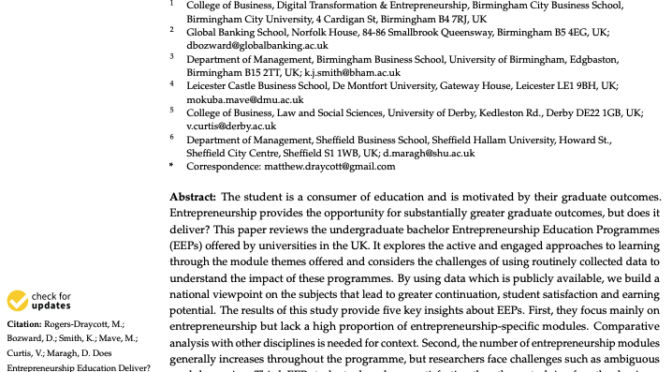
The research article is titled “Does Entrepreneurship Education Deliver? A Review of Entrepreneurship Education University Programmes in the UK” and explores the impact of undergraduate entrepreneurship education programs (EEPs) in the UK. It examines the structure, student satisfaction, and outcomes of these programmes. The study is conducted using publicly available data and aims to offer insights on the effectiveness of EEPs in terms of student continuation, satisfaction, and employability. The paper contributes new findings to the field, particularly relevant for researchers, educators, and policymakers involved in entrepreneurship education. For more details, you can view the full article here.
The article concludes that while Entrepreneurship Education Programmes (EEPs) in UK universities are generally well-received by students, their effectiveness in enhancing employability and entrepreneurial skills varies. The study highlights the need for a more standardized approach in evaluating these programmes and suggests a greater emphasis on practical, experiential learning to improve outcomes. It also points out the potential for these programmes to better align with industry requirements and entrepreneurial ecosystems.
For a comprehensive understanding, don’t forget to check out the full study here.