Tag: entrepreneurial ecosystems

  • The 8 Forms of Capital Every Entrepreneur Actually Uses (Beyond Finance)

    The 8 Forms of Capital Every Entrepreneur Actually Uses (Beyond Finance)

    Entrepreneurship is still too often reduced to a single question: how much money do you have?

    This narrow framing is not just incomplete—it is actively misleading. It privileges those with access to financial resources while obscuring the deeper, more complex reality of how ventures are actually built, sustained, and scaled.

    In practice, entrepreneurs draw upon a far richer portfolio of resources. These resources are not interchangeable, nor are they evenly distributed. Some are visible and measurable; others are intangible but decisive. Together, they form what can be understood as entrepreneurial capital—a multi-dimensional system of inputs that shapes opportunity recognition, venture creation, and long-term value.

    Based on my research and applied work across entrepreneurship, education, and economic development, I propose eight forms of capital that every entrepreneur uses—whether consciously or not. Financial capital is just one of them. The real story lies in the interplay between all eight.


    1. Financial Capital: Necessary but Not Sufficient

    Let’s begin with the obvious.

    Financial capital includes cash, credit, investment, and any form of monetary resource used to start or grow a business. It determines runway, enables hiring, supports marketing, and allows for experimentation.

    But here is the uncomfortable truth: financial capital rarely creates entrepreneurial success on its own.

    We have countless examples of well-funded ventures failing, and equally compelling examples of underfunded ventures thriving. Financial capital amplifies what already exists—it does not substitute for it.

    Entrepreneurs who rely solely on funding often mistake liquidity for capability. In reality, financial capital is best understood as a multiplier, not a foundation.


    2. Human (Experiential) Capital: What You Know and What You Can Do

    Human capital refers to skills, knowledge, experience, and capabilities. But in entrepreneurship, this is not just about formal qualifications—it is about applied competence under uncertainty.

    This includes:

    • Industry expertise
    • Technical skills
    • Problem-solving ability
    • Learning agility
    • Resilience under pressure

    Experienced entrepreneurs often outperform novices not because they have more ideas, but because they can execute, adapt, and recover.

    Crucially, human capital is cumulative. Every failure, every pivot, every difficult decision compounds into future advantage.

    From an employability perspective, this is where entrepreneurship education often falls short. It focuses on knowledge transfer rather than capability development. Yet in practice, ventures are built on what people can do, not what they know in theory.


    3. Social Capital: Who You Know—and Who Trusts You

    Entrepreneurship is a relational activity.

    Social capital includes networks, relationships, and the ability to mobilise others. It determines access to:

    • Customers
    • Partners
    • Investors
    • Mentors
    • Talent

    But more importantly, it determines trust.

    Two entrepreneurs with identical ideas and resources can achieve radically different outcomes depending on the strength of their networks. Introductions accelerate deals. Reputation reduces friction. Relationships unlock opportunities that are otherwise invisible.

    In early-stage ventures especially, social capital often substitutes for financial capital. A trusted founder can secure credit, attract collaborators, and open doors without large upfront investment.

    For policymakers, this raises a critical issue: entrepreneurial ecosystems are not built through funding alone—they are built through connection density and trust networks.


    4. Cultural Capital: How You Understand the Game

    Cultural capital is often overlooked, yet it shapes how entrepreneurs interpret and navigate their environment.

    It includes:

    • Norms and values
    • Language and communication styles
    • Understanding of institutional expectations
    • Awareness of “how things are done” in specific contexts

    For example, an entrepreneur operating in Silicon Valley understands pitching norms, risk tolerance, and growth expectations differently from someone operating in a rural economy or a traditional sector.

    Cultural capital influences:

    • How opportunities are recognised
    • How ventures are positioned
    • How credibility is established

    It also explains why entrepreneurship is unevenly distributed across regions and social groups. Those who “speak the language” of entrepreneurship are more likely to succeed—not necessarily because they are more capable, but because they are better aligned with the system.


    5. Intellectual Capital: What You Can Codify and Scale

    Intellectual capital refers to knowledge that can be formalised, protected, and leveraged.

    This includes:

    • Intellectual property (patents, trademarks, copyrights)
    • Proprietary processes
    • Data and analytics
    • Brand positioning
    • Business models

    Unlike human capital, which resides in individuals, intellectual capital can be embedded within the organisation. It enables scalability.

    A business with strong intellectual capital can replicate its value proposition across markets without relying entirely on individual expertise.

    In today’s economy, intellectual capital is increasingly dominant. Digital platforms, AI systems, and data-driven businesses are built on the ability to codify and scale knowledge.

    However, many entrepreneurs fail to recognise this early. They operate informally, without documenting processes or protecting assets, limiting their long-term growth potential.


    6. Manufactured Capital: The Tools and Infrastructure You Control

    Manufactured capital includes physical assets and infrastructure:

    • Equipment
    • Facilities
    • Technology systems
    • Supply chains
    • Logistics networks

    In traditional sectors—manufacturing, agriculture, construction—this form of capital is highly visible and often capital-intensive.

    But even in digital ventures, manufactured capital still matters. Cloud infrastructure, software platforms, and operational systems all fall into this category.

    The key question is not just what you own, but how efficiently you use it.

    Entrepreneurs who optimise their use of manufactured capital—through lean operations, outsourcing, or platform-based models—can compete effectively with far larger organisations.


    7. Natural Capital: The Environmental Context of Opportunity

    Natural capital refers to environmental resources and conditions:

    • Land
    • Water
    • Energy
    • Biodiversity
    • Climate conditions

    For many ventures, particularly in rural and resource-based industries, natural capital is foundational.

    But its importance is expanding. Sustainability pressures, ESG requirements, and climate risks are reshaping markets across all sectors.

    Entrepreneurs who understand and leverage natural capital can:

    • Develop sustainable business models
    • Access new funding streams
    • Align with regulatory trends
    • Create long-term resilience

    Conversely, those who ignore it face increasing constraints.

    Natural capital is not just a resource—it is becoming a strategic variable in competitive advantage.


    8. Spiritual Capital: Purpose, Meaning, and Direction

    The final form of capital is the least tangible, but often the most powerful.

    Spiritual capital refers to:

    • Purpose
    • Values
    • Ethical frameworks
    • Sense of meaning

    It answers the question: why does this venture exist?

    Entrepreneurs operate in uncertain, high-pressure environments. Decisions are rarely clear-cut. Trade-offs are constant.

    Spiritual capital provides direction under ambiguity.

    It influences:

    • Strategic choices
    • Organisational culture
    • Leadership behaviour
    • Long-term vision

    In practice, ventures with strong purpose often outperform those driven purely by financial metrics. They attract talent, build loyalty, and sustain momentum through difficult periods.

    This is not about idealism—it is about alignment.


    The Real Insight: It’s Not the Capitals, It’s the Combination

    Understanding these eight forms of capital is useful. But the real value lies in recognising how they interact.

    Entrepreneurial success is not determined by any single form of capital. It emerges from the configuration.

    Consider a few examples:

    • A founder with limited financial capital but strong social and human capital can bootstrap effectively.
    • A well-funded venture with weak cultural and social capital may struggle to gain traction.
    • A purpose-driven business with strong spiritual and intellectual capital can build powerful brand loyalty.

    This leads to a critical shift in thinking:

    Entrepreneurship is not about resource scarcity—it is about resource orchestration.

    The most effective entrepreneurs are not those with the most capital, but those who can combine, convert, and leverage different forms of capital over time.


    Implications for Entrepreneurs

    If you are building or growing a venture, this framework offers a more practical way to assess your position.

    Ask yourself:

    • Where am I strong?
    • Where am I constrained?
    • Which forms of capital can I build quickly?
    • Which require long-term investment?

    More importantly:

    • How can I convert one form of capital into another?

    For example:

    • Social capital can attract financial capital
    • Human capital can generate intellectual capital
    • Cultural capital can unlock new markets

    Entrepreneurship becomes a process of dynamic capital transformation.


    Implications for Education and Policy

    This perspective also challenges how we design entrepreneurship education and policy.

    Too often, interventions focus narrowly on:

    • Access to finance
    • Business plan development
    • Start-up rates

    But if entrepreneurship is multi-capital, then support systems must be as well.

    This means:

    • Building networks, not just funding schemes
    • Developing capabilities, not just knowledge
    • Embedding cultural understanding, not just technical skills
    • Supporting purpose-driven ventures, not just profit-driven ones

    For universities, this has direct implications for employability. Graduates need to develop multi-capital awareness and capability, not just disciplinary knowledge.

    For policymakers, it means shifting from funding-led models to ecosystem-led models.


    A More Honest Definition of Entrepreneurship

    Ultimately, this framework points to a more accurate definition:

    Entrepreneurship is the process of mobilising and transforming multiple forms of capital to create value under conditions of uncertainty.

    This moves us beyond the simplistic idea of “starting a business.”

    It recognises entrepreneurship as:

    • A capability
    • A system
    • A process
    • A form of value creation

    And crucially, it opens the door to more inclusive and effective approaches—because it acknowledges that people start with different capital endowments, not just different ideas.


    Final Thought

    If we continue to define entrepreneurship in financial terms, we will continue to exclude those who do not start with capital.

    But if we recognise the full spectrum of entrepreneurial capital, we begin to see opportunity differently.

    We see that:

    • Capability can substitute for capital
    • Networks can unlock resources
    • Purpose can drive performance
    • Context shapes outcomes

    And most importantly:

    Every entrepreneur already has capital. The question is whether they know how to use it.


  • Entrepreneurship Is Not Start-Up: A New Framework for Value Creation, Education, and Economic Growth

    Entrepreneurship Is Not Start-Up: A New Framework for Value Creation, Education, and Economic Growth

    Entrepreneurship has been reduced to a narrow and ultimately unhelpful idea: starting a business.

    Across universities, policy frameworks, and media narratives, entrepreneurship is framed through start-up activity—pitch decks, venture capital, and the pursuit of rapid scale. This interpretation is not simply incomplete; it is distorting how we educate students, design economic policy, and evaluate success.

    The consequence is a system that rewards activity over impact, formation over function, and visibility over value.

    If we are serious about improving productivity, employability, and long-term economic resilience, we need to move beyond the start-up myth and return to a more fundamental question:

    What is entrepreneurship actually for?


    The Problem: We Are Measuring the Wrong Thing

    Entrepreneurship policy and education are dominated by simplistic metrics:

    • Number of start-ups created
    • Amount of funding raised
    • Survival rates over three to five years

    These measures are easy to quantify, but they are poor proxies for what really matters: value creation.

    A business can be launched, funded, and sustained without creating meaningful economic or social value. Equally, significant value can be created within existing organisations, communities, or informal economies without ever appearing in start-up statistics.

    This misalignment has three critical consequences.

    First, it leads to policy inefficiency. Governments invest heavily in start-up ecosystems without understanding whether those ventures contribute to productivity, innovation, or regional development.

    Second, it creates educational distortion. Universities design entrepreneurship programmes around venture creation rather than capability development, leaving graduates underprepared for complex, non-linear careers.

    Third, it results in entrepreneurial failure. Founders are encouraged to pursue ideas without understanding the resources, processes, and conditions required to create sustainable value.

    In short, we are optimising for the wrong outcome.


    Reframing Entrepreneurship: From Activity to Value

    To correct this, entrepreneurship must be redefined.

    Entrepreneurship is not the act of starting a business. It is:

    The process of creating, capturing, and sustaining value through the effective orchestration of resources over time.

    This definition shifts the focus in three important ways.

    First, it places value at the centre, not activity. The purpose of entrepreneurship is not formation but transformation.

    Second, it emphasises process, recognising that entrepreneurship unfolds over time rather than occurring at a single moment of creation.

    Third, it highlights resource orchestration, acknowledging that entrepreneurs do not simply use resources—they combine, adapt, and transform them.

    This reframing aligns more closely with established economic theory. Joseph Schumpeter, for example, positioned the entrepreneur as an agent of “creative destruction,” reshaping markets through innovation rather than merely creating firms (Schumpeter, 1934). Similarly, Peter Drucker emphasised entrepreneurship as a systematic practice of innovation and value creation (Drucker, 1985).

    Yet despite this intellectual foundation, contemporary systems have drifted toward a far narrower interpretation.


    The Missing Mechanism: Understanding Entrepreneurial Capital

    If entrepreneurship is about value creation, the next question is straightforward:

    How is value actually created?

    The answer lies in capital—not just financial capital, but a broader set of resources that entrepreneurs draw upon and combine.

    The Eight Capitals Model provides a more complete view:

    • Financial Capital (money and funding)
    • Human/Experiential Capital (skills, knowledge, experience)
    • Social Capital (networks and relationships)
    • Intellectual Capital (ideas, IP, systems)
    • Cultural Capital (norms, behaviours, identity)
    • Natural Capital (environmental and physical resources)
    • Manufactured Capital (infrastructure, tools, technology)
    • Spiritual Capital (purpose, values, motivation)

    Traditional approaches overemphasise financial capital, yet evidence consistently shows that access to networks, knowledge, and institutional support often matters more in determining entrepreneurial outcomes (Acs et al., 2014).

    Entrepreneurs do not simply deploy these capitals independently. They orchestrate them—combining different forms of capital to create new forms of value.

    A founder launching a digital platform, for example, may rely heavily on intellectual and social capital in early stages, while scaling requires increasing levels of financial and manufactured capital.

    Understanding this dynamic is critical. Without it, both education and policy remain fundamentally incomplete.


    The Process Layer: The 9 Stages of Enterprise Development

    While capital explains what resources are used, it does not explain how entrepreneurship unfolds.

    Entrepreneurship is not a single act but a staged process. The 9 Stages of Enterprise Development provide a structured way to understand this progression:

    1. Discovery
    2. Modeling
    3. Startup
    4. Existence
    5. Survival
    6. Success
    7. Adaptation
    8. Independence
    9. Exit

    Each stage represents a different configuration of challenges, decisions, and resource requirements.

    Crucially, value is created differently at each stage.

    • In Discovery, value lies in identifying opportunities
    • In Startup, it lies in mobilising resources
    • In Survival, it lies in achieving cash flow stability
    • In Adaptation, it lies in responding to environmental change

    This staged perspective aligns with broader economic development theories, such as Walt Rostow’s model of economic growth, which highlights the importance of sequential development phases (Rostow, 1960). However, unlike linear economic models, entrepreneurship is iterative and adaptive.

    The key insight is this:

    Entrepreneurship is the dynamic interaction between capital and stages, producing value over time.


    An Integrated Framework for Entrepreneurship

    To move beyond fragmented thinking, these elements must be brought together into a single model.

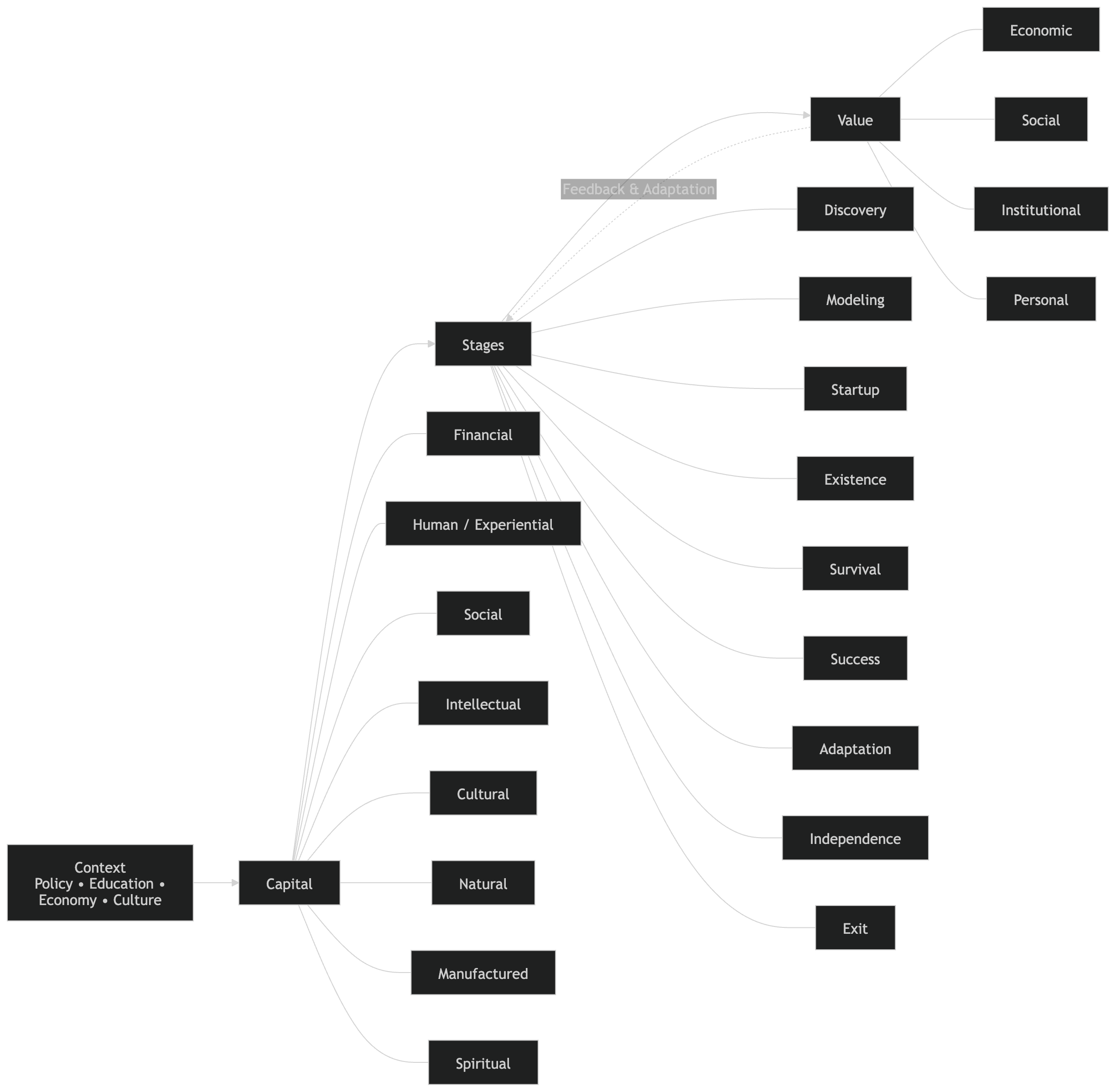
    Integrated Entrepreneurship Framework

    This framework is deliberately simple but conceptually powerful.

    • Capital represents the resources available
    • Stages represent the process through which entrepreneurship unfolds
    • Value represents the outcome
    • Context shapes and constrains the system

    Most existing approaches focus on only one of these elements. Effective entrepreneurship requires understanding all four—and, critically, how they interact.


    Implications for Universities: From Knowledge to Capability

    This framework exposes a fundamental weakness in higher education.

    Universities largely focus on knowledge transfer, while entrepreneurship requires capability development.

    Students are taught:

    • Business planning
    • Marketing theory
    • Financial modelling

    But they are rarely taught:

    • How to mobilise different forms of capital
    • How to navigate different stages of development
    • How to create and measure value in real contexts

    As a result, graduates leave with theoretical understanding but limited practical capability.

    To address this, universities must:

    1. Embed capital awareness into curricula
      Students should understand the different forms of capital and how to access them.
    2. Align learning with stages
      Programmes should simulate the progression from discovery to growth, not just start-up.
    3. Measure value creation capability
      Assessment should focus on outcomes, not outputs.

    This is not a marginal adjustment. It is a structural shift in how education is designed.


    Implications for Policy: From Start-Ups to Systems

    The same issue applies at the policy level.

    Entrepreneurship policy has become overly focused on:

    • Start-up grants
    • Incubators and accelerators
    • Venture capital ecosystems

    While these have value, they represent only a small part of the system.

    A more effective approach would focus on capital ecosystems:

    • Strengthening networks (social capital)
    • Investing in skills and education (human capital)
    • Supporting infrastructure (manufactured capital)
    • Enabling knowledge transfer (intellectual capital)

    This is particularly important in regional and rural contexts, where traditional start-up models often fail to translate.

    You cannot build entrepreneurial economies by funding businesses alone. You must build the systems that enable value creation.


    Implications for Entrepreneurs: Better Decisions, Better Outcomes

    For practitioners, this framework provides a more realistic lens.

    Instead of asking:

    • “Is this a good idea?”

    Entrepreneurs should ask:

    • “What value am I creating?”
    • “What capital do I need—and what am I missing?”
    • “What stage am I in—and what does that require?”

    This shift leads to better decision-making.

    It reduces overconfidence in early stages, improves resource allocation, and increases the likelihood of sustainable growth.


    Conclusion: A Necessary Shift

    Entrepreneurship matters—not because it creates businesses, but because it creates value.

    If we continue to define entrepreneurship as start-up activity, we will continue to miseducate students, misallocate resources, and misunderstand economic growth.

    The alternative is clear.

    We must move toward a model that recognises:

    • The role of capital
    • The importance of process
    • The centrality of value
    • The influence of context

    This is not simply an academic exercise. It is a practical necessity.

    The future of entrepreneurship lies not in more businesses—but in better value creation.


    References (APA Style)

    Acs, Z. J., Autio, E., & Szerb, L. (2014). National systems of entrepreneurship: Measurement issues and policy implications. Research Policy, 43(3), 476–494.

    Drucker, P. F. (1985). Innovation and entrepreneurship: Practice and principles. Harper & Row.

    Schumpeter, J. A. (1934). The theory of economic development. Harvard University Press.

    Rostow, W. W. (1960). The stages of economic growth: A non-communist manifesto. Cambridge University Press.

    Neck, H. M., Greene, P. G., & Brush, C. G. (2014). Teaching entrepreneurship: A practice-based approach. Edward Elgar.

    World Bank. (2020). Doing business 2020: Comparing business regulation in 190 economies. World Bank Publications.

    OECD. (2021). Entrepreneurship at a glance 2021. OECD Publishing.

  • Why Most Entrepreneurship Policy Fails Rural Economies

    Why Most Entrepreneurship Policy Fails Rural Economies

    Rural economies are often positioned as fertile ground for entrepreneurship. They are rich in natural resources, community cohesion, and untapped opportunity. Yet, despite decades of policy interventions—from grants and incubators to training programmes—entrepreneurial outcomes in rural regions frequently lag behind urban counterparts. Business creation rates are lower, survival rates are fragile, and scale remains elusive.

    The uncomfortable truth is this: most entrepreneurship policy fails rural economies not because of a lack of investment, but because of a misunderstanding of how rural entrepreneurship actually works.


    The Urban Bias Problem

    Much of modern entrepreneurship policy is designed with an implicit urban bias. Policymakers often assume that what works in cities—dense networks, access to finance, and rapid market validation—can simply be replicated in rural areas.

    This assumption is flawed.

    Urban ecosystems benefit from:

    • High population density
    • Access to venture capital
    • Proximity to universities and innovation hubs
    • Established infrastructure and supply chains

    Rural economies, by contrast, operate under entirely different conditions:

    • Sparse populations and dispersed markets
    • Limited access to finance and talent
    • Infrastructure gaps (digital, transport, logistics)
    • Strong reliance on local identity and informal networks

    When policy frameworks fail to recognise these structural differences, they impose solutions that are misaligned from the outset.


    Misunderstanding Opportunity in Rural Contexts

    Entrepreneurship policy often emphasises high-growth, innovation-led ventures, typically in sectors such as technology. While this is important, it overlooks the nature of opportunity in rural economies.

    Rural entrepreneurship is frequently:

    • Place-based – rooted in local resources (agriculture, tourism, crafts)
    • Incremental – focused on steady income rather than rapid scaling
    • Diversified – combining multiple income streams (e.g. farming + hospitality + digital services)

    Policies that prioritise “unicorns” over sustainable, diversified enterprises risk overlooking the real drivers of rural economic resilience.

    The result is a mismatch between:

    • What policymakers fund
    • What rural entrepreneurs actually need

    Fragmented Support Systems

    Another major failure lies in the fragmentation of support systems. Rural entrepreneurs often face a complex and disjointed landscape of agencies, funding streams, and advisory services.

    Typical challenges include:

    • Multiple organisations offering overlapping support
    • Lack of coordination between local, regional, and national bodies
    • Short-term funding cycles that disrupt continuity

    For entrepreneurs, this creates confusion and inefficiency. Instead of enabling progress, the system becomes a barrier to navigation.

    In urban environments, density compensates for fragmentation—networks fill the gaps. In rural areas, fragmentation is amplified by distance and isolation.


    Access to Capital: A Structural Barrier

    Access to finance remains one of the most persistent challenges in rural entrepreneurship.

    Traditional policy responses—grants, loans, and subsidies—often fail because they do not address underlying structural issues:

    • Lower perceived investment attractiveness
    • Higher transaction costs for lenders
    • Limited local financial ecosystems

    Moreover, many rural entrepreneurs do not seek venture capital. They require:

    • Patient capital
    • Microfinance
    • Community-based investment models

    Policies designed around conventional finance mechanisms fail to recognise these needs, leaving a critical gap between supply and demand.


    The Infrastructure Deficit

    Entrepreneurship does not occur in a vacuum. It depends on enabling infrastructure.

    In rural economies, this is often lacking:

    • Digital connectivity may be unreliable
    • Transport links are limited
    • Access to markets is constrained

    While governments frequently invest in entrepreneurship programmes, they underinvest in the foundational infrastructure required for those programmes to succeed.

    The consequence is predictable: businesses are created, but they struggle to grow.


    Human Capital and Skills Mismatch

    A further issue lies in the development of human capital. Entrepreneurship policies often focus on generic training programmes, assuming that skills are transferable across contexts.

    However, rural entrepreneurship requires a distinct skill set:

    • Resourcefulness and bricolage (making do with limited resources)
    • Multi-skilling across sectors
    • Deep understanding of local markets and communities

    Additionally, rural areas often experience:

    • Outmigration of young talent
    • Ageing populations
    • Limited access to higher education and training

    Without addressing these structural dynamics, skills programmes alone cannot deliver meaningful change.


    Ignoring Social and Cultural Capital

    One of the most overlooked dimensions of rural entrepreneurship is social and cultural capital.

    Rural communities are characterised by:

    • Strong social networks
    • High levels of trust
    • Deep-rooted cultural identities

    These are powerful assets. They shape:

    • Opportunity recognition
    • Resource mobilisation
    • Market access

    Yet, most entrepreneurship policies focus almost exclusively on financial and human capital, neglecting these relational and cultural dimensions.

    This represents a significant missed opportunity.


    The Scale Obsession

    Policy success is often measured through metrics such as:

    • Number of startups
    • Growth rates
    • Investment raised

    While these are important, they reinforce a narrow view of success.

    In rural economies, success may look different:

    • Sustaining local employment
    • Supporting community resilience
    • Enhancing quality of life

    By prioritising scale over sustainability, policymakers risk undervaluing the types of enterprises that are most relevant to rural contexts.


    Towards a New Model of Rural Entrepreneurship Policy

    If current approaches are failing, what should replace them?

    A more effective model of rural entrepreneurship policy should be built on the following principles:

    1. Contextualisation

    Policies must be tailored to the specific characteristics of rural economies. This requires:

    • Place-based strategies
    • Local stakeholder engagement
    • Flexibility in design and implementation

    2. Systems Thinking

    Entrepreneurship should be viewed as part of a broader system, including:

    • Infrastructure
    • Education
    • Finance
    • Community networks

    Interventions must be coordinated rather than fragmented.

    3. Multi-Capital Approach

    Drawing on emerging frameworks such as the Entrepreneurial Capital Model, policy should recognise multiple forms of capital:

    • Financial
    • Human
    • Social
    • Cultural
    • Natural

    Rural economies, in particular, are rich in non-financial capital that can be leveraged for development.

    4. Long-Term Investment

    Short-term programmes are insufficient. Rural entrepreneurship requires:

    • Sustained investment
    • Long-term capacity building
    • Institutional continuity

    5. Redefining Success

    Metrics must evolve to reflect:

    • Resilience
    • Inclusivity
    • Sustainability

    Rather than focusing solely on high-growth ventures, policy should support a diverse portfolio of enterprises.


    Conclusion

    Rural entrepreneurship holds enormous potential—not just for economic growth, but for addressing some of the most pressing challenges of our time, including inequality, sustainability, and community resilience.

    However, unlocking this potential requires a fundamental shift in how we design and implement policy.

    The failure of current approaches is not inevitable. It is the result of misaligned assumptions, fragmented systems, and narrow definitions of success.

    By embracing a more nuanced, context-sensitive, and system-oriented approach, policymakers can move beyond failure and begin to build rural economies that are not only entrepreneurial, but truly thriving.


    If you’re working in government, higher education, or regional development and want to rethink your approach to entrepreneurship policy, this is the moment to act. Rural economies do not need more of the same—they need something fundamentally better.