Tag: entrepreneurial capital

  • Why Most Business Models Fail Before They Start

    Most business failures are not the result of poor execution. They are the consequence of flawed thinking at the very beginning — before a product is built, before a customer is acquired, before a pound is spent on marketing.

    In other words, most business models fail before they even start.

    This is an uncomfortable truth. It challenges the popular narrative that entrepreneurship is primarily about resilience, hustle, or scaling tactics. Those matter — but only after a viable model exists. The deeper issue is that many ventures are built on assumptions that are never tested, value that is never validated, and structures that were never fit for purpose.

    If we want to improve entrepreneurial outcomes — whether in startups, corporate innovation, or policy — we need to shift our attention upstream, to the design of the business model itself.


    The Illusion of the “Good Idea”

    The starting point for most ventures is an idea. But ideas are cheap — and often misleading.

    Entrepreneurs frequently confuse:

    • Personal interest with market demand
    • Technical feasibility with economic viability
    • Innovation with value creation

    A good idea is not a business model. It is, at best, a hypothesis.

    The failure begins when this hypothesis is treated as fact.

    This is particularly evident in early-stage ventures where founders build products based on internal conviction rather than external validation. They design revenue models based on what they hope customers will pay, rather than what customers demonstrably will pay. They assume distribution channels will work because they exist, not because they are accessible.

    At this stage, failure is already embedded — not because the idea is inherently bad, but because the assumptions surrounding it are untested.


    Misunderstanding Value Creation

    At the heart of every business model is a simple question:

    What value is being created, for whom, and why does it matter?

    Yet this is where most models collapse.

    Entrepreneurs often define value in terms of features, technology, or novelty. But markets do not reward novelty — they reward relevance.

    Value is contextual. It is shaped by:

    • Customer needs and constraints
    • Timing and environment
    • Alternatives available in the market
    • Perceived risk and trust

    A technically superior product can fail if it does not align with these realities. Conversely, a relatively simple offering can succeed if it solves a clear and immediate problem.

    This is why many models fail early — they are built around supply-driven logic rather than demand-driven insight.

    From a strategic perspective, this reflects a deeper misunderstanding: value is not created in isolation. It emerges from the interaction between the entrepreneur, the customer, and the environment.


    The Over-Reliance on Financial Capital

    Another common failure point is the assumption that access to funding equates to viability.

    In reality, financial capital is only one component of what makes a business model work. Your own research into the Eight Forms of Capital highlights this clearly:

    • Human (skills, experience)
    • Social (networks, relationships)
    • Cultural (understanding of context)
    • Intellectual (knowledge, IP)
    • Manufactured (assets, infrastructure)
    • Natural (resources)
    • Spiritual (purpose, values)
    • Financial (funding)

    Many business models are designed as if financial capital can compensate for deficiencies in the others.

    It cannot.

    A well-funded venture with weak social capital will struggle to access customers. One with limited cultural capital may misread its market. A model lacking human capital will fail in execution regardless of funding.

    When these gaps are not recognised early, the business model is structurally weak from the outset.


    The Problem of Static Thinking

    Business models are often presented as static frameworks — a canvas to be filled in, a plan to be executed.

    But in reality, a business model is a dynamic system.

    It evolves in response to:

    • Market feedback
    • Competitive pressures
    • Resource constraints
    • Regulatory environments

    Most early-stage models fail because they are designed as if the environment will remain stable.

    They assume:

    • Customer behaviour will not change
    • Competitors will not respond
    • Costs will remain predictable
    • Channels will remain accessible

    This is rarely the case.

    The result is a model that looks coherent on paper but collapses under real-world complexity.

    The issue is not that the model is wrong — it is that it is incomplete.


    Weak Problem–Solution Fit

    Before product–market fit comes something more fundamental: problem–solution fit.

    Many ventures skip this step.

    They begin with a solution and then search for a problem to justify it. This leads to:

    • Over-engineered products
    • Unclear value propositions
    • Weak customer engagement

    A strong business model starts with a clearly defined problem that is:

    • Specific (not abstract)
    • Urgent (not hypothetical)
    • Costly (financially or emotionally)

    Without this, the model lacks a foundation.

    This is particularly visible in technology-led ventures, where innovation drives development but not necessarily adoption. The result is a product in search of a market — a classic failure mode.


    Misaligned Revenue Logic

    Revenue models are often an afterthought — or worse, an assumption.

    Entrepreneurs frequently rely on:

    • Benchmarking competitors (“they charge X, so we will too”)
    • Simplistic pricing models
    • Over-optimistic projections

    But revenue logic is not just about pricing. It is about:

    • Who pays
    • When they pay
    • Why they pay
    • How often they pay

    Misalignment here is fatal.

    For example:

    • A model targeting price-sensitive customers with a premium pricing strategy
    • A subscription model for a low-frequency use case
    • A freemium model without a clear conversion pathway

    These issues are rarely corrected later. They are embedded in the model from the start.


    Ignoring Distribution Realities

    One of the most underestimated aspects of a business model is distribution.

    How does the product reach the customer?

    Many ventures assume:

    • Digital channels are easily accessible
    • Customers will discover the product organically
    • Marketing costs will be manageable

    In reality, distribution is often the most expensive and complex part of the model.

    A strong product with weak distribution will fail.

    This is particularly relevant in saturated markets, where attention is scarce and customer acquisition costs are high. If the model does not account for this — if it assumes frictionless access to customers — it is already flawed.


    The Capability Gap

    Even when the model itself is sound, there is often a gap between what the model requires and what the entrepreneur can deliver.

    This includes:

    • Operational capability
    • Strategic decision-making
    • Execution discipline

    A business model is not just a design — it is a set of capabilities.

    If the founder or team cannot deliver those capabilities, the model will fail in practice.

    This is where many early-stage ventures struggle. They design models that assume:

    • Scalable operations
    • Efficient processes
    • Strong partnerships

    But they lack the experience or resources to implement them.

    The model is theoretically viable — but practically unattainable.


    The Absence of Iteration

    Perhaps the most critical failure is the absence of structured iteration.

    Entrepreneurs often treat the business model as something to be “launched” rather than tested.

    This leads to:

    • Large upfront investments
    • Slow feedback cycles
    • Resistance to change

    In contrast, successful ventures treat the model as a series of experiments.

    They test:

    • Value propositions
    • Pricing strategies
    • Channels
    • Customer segments

    They learn quickly and adapt.

    Most failed models never go through this process. They are built, not tested. Assumed, not validated.


    Reframing the Business Model

    If most business models fail before they start, what does a better approach look like?

    It requires a shift in mindset.

    1. From Ideas to Hypotheses

    Treat every element of the model as something to be tested:

    • Customer need
    • Value proposition
    • Revenue model
    • Distribution strategy

    2. From Products to Problems

    Start with the problem, not the solution. Define it clearly, validate it rigorously, and ensure it matters.

    3. From Capital to Capability

    Assess not just what resources are available, but what capabilities exist — and what is missing.

    4. From Plans to Experiments

    Design the model as a series of experiments, not a fixed plan.

    5. From Static to Dynamic Thinking

    Recognise that the model will evolve. Build flexibility into its design.


    Implications for Education and Policy

    This issue is not just relevant for entrepreneurs. It has broader implications.

    In higher education, business models are often taught as frameworks rather than as dynamic systems. Students learn how to fill in a canvas, but not how to test and adapt it.

    In policy, support is frequently focused on:

    • Funding
    • Scaling
    • Growth

    But less attention is given to the early-stage design of viable models.

    If we want to improve outcomes, we need to invest more in:

    • Opportunity recognition
    • Model validation
    • Capability development

    This aligns with a broader shift in entrepreneurship education — moving beyond startup creation towards value creation and system thinking.


    Final Reflection

    The uncomfortable reality is that most business failures are predictable.

    They are not random. They are the result of decisions made at the very beginning — decisions about value, customers, revenue, and capability.

    By the time the business “fails,” the failure has often already happened.

    The opportunity, then, is not just to build better businesses — but to design better business models from the start.

    Because in entrepreneurship, success is not just about execution.

    It is about getting the model right before execution begins.

  • The 8 Forms of Capital Every Entrepreneur Actually Uses (Beyond Finance)

    The 8 Forms of Capital Every Entrepreneur Actually Uses (Beyond Finance)

    Entrepreneurship is still too often reduced to a single question: how much money do you have?

    This narrow framing is not just incomplete—it is actively misleading. It privileges those with access to financial resources while obscuring the deeper, more complex reality of how ventures are actually built, sustained, and scaled.

    In practice, entrepreneurs draw upon a far richer portfolio of resources. These resources are not interchangeable, nor are they evenly distributed. Some are visible and measurable; others are intangible but decisive. Together, they form what can be understood as entrepreneurial capital—a multi-dimensional system of inputs that shapes opportunity recognition, venture creation, and long-term value.

    Based on my research and applied work across entrepreneurship, education, and economic development, I propose eight forms of capital that every entrepreneur uses—whether consciously or not. Financial capital is just one of them. The real story lies in the interplay between all eight.


    1. Financial Capital: Necessary but Not Sufficient

    Let’s begin with the obvious.

    Financial capital includes cash, credit, investment, and any form of monetary resource used to start or grow a business. It determines runway, enables hiring, supports marketing, and allows for experimentation.

    But here is the uncomfortable truth: financial capital rarely creates entrepreneurial success on its own.

    We have countless examples of well-funded ventures failing, and equally compelling examples of underfunded ventures thriving. Financial capital amplifies what already exists—it does not substitute for it.

    Entrepreneurs who rely solely on funding often mistake liquidity for capability. In reality, financial capital is best understood as a multiplier, not a foundation.


    2. Human (Experiential) Capital: What You Know and What You Can Do

    Human capital refers to skills, knowledge, experience, and capabilities. But in entrepreneurship, this is not just about formal qualifications—it is about applied competence under uncertainty.

    This includes:

    • Industry expertise
    • Technical skills
    • Problem-solving ability
    • Learning agility
    • Resilience under pressure

    Experienced entrepreneurs often outperform novices not because they have more ideas, but because they can execute, adapt, and recover.

    Crucially, human capital is cumulative. Every failure, every pivot, every difficult decision compounds into future advantage.

    From an employability perspective, this is where entrepreneurship education often falls short. It focuses on knowledge transfer rather than capability development. Yet in practice, ventures are built on what people can do, not what they know in theory.


    3. Social Capital: Who You Know—and Who Trusts You

    Entrepreneurship is a relational activity.

    Social capital includes networks, relationships, and the ability to mobilise others. It determines access to:

    • Customers
    • Partners
    • Investors
    • Mentors
    • Talent

    But more importantly, it determines trust.

    Two entrepreneurs with identical ideas and resources can achieve radically different outcomes depending on the strength of their networks. Introductions accelerate deals. Reputation reduces friction. Relationships unlock opportunities that are otherwise invisible.

    In early-stage ventures especially, social capital often substitutes for financial capital. A trusted founder can secure credit, attract collaborators, and open doors without large upfront investment.

    For policymakers, this raises a critical issue: entrepreneurial ecosystems are not built through funding alone—they are built through connection density and trust networks.


    4. Cultural Capital: How You Understand the Game

    Cultural capital is often overlooked, yet it shapes how entrepreneurs interpret and navigate their environment.

    It includes:

    • Norms and values
    • Language and communication styles
    • Understanding of institutional expectations
    • Awareness of “how things are done” in specific contexts

    For example, an entrepreneur operating in Silicon Valley understands pitching norms, risk tolerance, and growth expectations differently from someone operating in a rural economy or a traditional sector.

    Cultural capital influences:

    • How opportunities are recognised
    • How ventures are positioned
    • How credibility is established

    It also explains why entrepreneurship is unevenly distributed across regions and social groups. Those who “speak the language” of entrepreneurship are more likely to succeed—not necessarily because they are more capable, but because they are better aligned with the system.


    5. Intellectual Capital: What You Can Codify and Scale

    Intellectual capital refers to knowledge that can be formalised, protected, and leveraged.

    This includes:

    • Intellectual property (patents, trademarks, copyrights)
    • Proprietary processes
    • Data and analytics
    • Brand positioning
    • Business models

    Unlike human capital, which resides in individuals, intellectual capital can be embedded within the organisation. It enables scalability.

    A business with strong intellectual capital can replicate its value proposition across markets without relying entirely on individual expertise.

    In today’s economy, intellectual capital is increasingly dominant. Digital platforms, AI systems, and data-driven businesses are built on the ability to codify and scale knowledge.

    However, many entrepreneurs fail to recognise this early. They operate informally, without documenting processes or protecting assets, limiting their long-term growth potential.


    6. Manufactured Capital: The Tools and Infrastructure You Control

    Manufactured capital includes physical assets and infrastructure:

    • Equipment
    • Facilities
    • Technology systems
    • Supply chains
    • Logistics networks

    In traditional sectors—manufacturing, agriculture, construction—this form of capital is highly visible and often capital-intensive.

    But even in digital ventures, manufactured capital still matters. Cloud infrastructure, software platforms, and operational systems all fall into this category.

    The key question is not just what you own, but how efficiently you use it.

    Entrepreneurs who optimise their use of manufactured capital—through lean operations, outsourcing, or platform-based models—can compete effectively with far larger organisations.


    7. Natural Capital: The Environmental Context of Opportunity

    Natural capital refers to environmental resources and conditions:

    • Land
    • Water
    • Energy
    • Biodiversity
    • Climate conditions

    For many ventures, particularly in rural and resource-based industries, natural capital is foundational.

    But its importance is expanding. Sustainability pressures, ESG requirements, and climate risks are reshaping markets across all sectors.

    Entrepreneurs who understand and leverage natural capital can:

    • Develop sustainable business models
    • Access new funding streams
    • Align with regulatory trends
    • Create long-term resilience

    Conversely, those who ignore it face increasing constraints.

    Natural capital is not just a resource—it is becoming a strategic variable in competitive advantage.


    8. Spiritual Capital: Purpose, Meaning, and Direction

    The final form of capital is the least tangible, but often the most powerful.

    Spiritual capital refers to:

    • Purpose
    • Values
    • Ethical frameworks
    • Sense of meaning

    It answers the question: why does this venture exist?

    Entrepreneurs operate in uncertain, high-pressure environments. Decisions are rarely clear-cut. Trade-offs are constant.

    Spiritual capital provides direction under ambiguity.

    It influences:

    • Strategic choices
    • Organisational culture
    • Leadership behaviour
    • Long-term vision

    In practice, ventures with strong purpose often outperform those driven purely by financial metrics. They attract talent, build loyalty, and sustain momentum through difficult periods.

    This is not about idealism—it is about alignment.


    The Real Insight: It’s Not the Capitals, It’s the Combination

    Understanding these eight forms of capital is useful. But the real value lies in recognising how they interact.

    Entrepreneurial success is not determined by any single form of capital. It emerges from the configuration.

    Consider a few examples:

    • A founder with limited financial capital but strong social and human capital can bootstrap effectively.
    • A well-funded venture with weak cultural and social capital may struggle to gain traction.
    • A purpose-driven business with strong spiritual and intellectual capital can build powerful brand loyalty.

    This leads to a critical shift in thinking:

    Entrepreneurship is not about resource scarcity—it is about resource orchestration.

    The most effective entrepreneurs are not those with the most capital, but those who can combine, convert, and leverage different forms of capital over time.


    Implications for Entrepreneurs

    If you are building or growing a venture, this framework offers a more practical way to assess your position.

    Ask yourself:

    • Where am I strong?
    • Where am I constrained?
    • Which forms of capital can I build quickly?
    • Which require long-term investment?

    More importantly:

    • How can I convert one form of capital into another?

    For example:

    • Social capital can attract financial capital
    • Human capital can generate intellectual capital
    • Cultural capital can unlock new markets

    Entrepreneurship becomes a process of dynamic capital transformation.


    Implications for Education and Policy

    This perspective also challenges how we design entrepreneurship education and policy.

    Too often, interventions focus narrowly on:

    • Access to finance
    • Business plan development
    • Start-up rates

    But if entrepreneurship is multi-capital, then support systems must be as well.

    This means:

    • Building networks, not just funding schemes
    • Developing capabilities, not just knowledge
    • Embedding cultural understanding, not just technical skills
    • Supporting purpose-driven ventures, not just profit-driven ones

    For universities, this has direct implications for employability. Graduates need to develop multi-capital awareness and capability, not just disciplinary knowledge.

    For policymakers, it means shifting from funding-led models to ecosystem-led models.


    A More Honest Definition of Entrepreneurship

    Ultimately, this framework points to a more accurate definition:

    Entrepreneurship is the process of mobilising and transforming multiple forms of capital to create value under conditions of uncertainty.

    This moves us beyond the simplistic idea of “starting a business.”

    It recognises entrepreneurship as:

    • A capability
    • A system
    • A process
    • A form of value creation

    And crucially, it opens the door to more inclusive and effective approaches—because it acknowledges that people start with different capital endowments, not just different ideas.


    Final Thought

    If we continue to define entrepreneurship in financial terms, we will continue to exclude those who do not start with capital.

    But if we recognise the full spectrum of entrepreneurial capital, we begin to see opportunity differently.

    We see that:

    • Capability can substitute for capital
    • Networks can unlock resources
    • Purpose can drive performance
    • Context shapes outcomes

    And most importantly:

    Every entrepreneur already has capital. The question is whether they know how to use it.


  • Why “Starting a Business” Is the Wrong Definition of Entrepreneurship

    Why “Starting a Business” Is the Wrong Definition of Entrepreneurship

    Entrepreneurship has been reduced—often carelessly—to a single, visible act: starting a business. It is a definition that fits neatly into policy targets, university league tables, and social media narratives. It is also deeply misleading.

    If we define entrepreneurship purely as business formation, we misunderstand how value is actually created in modern economies. We incentivise the wrong behaviours, design ineffective education systems, and ultimately fail to develop individuals capable of navigating uncertainty, creating opportunity, and driving innovation.

    Entrepreneurship is not an event. It is a process. More importantly, it is a way of thinking and acting that extends far beyond the act of launching a company.

    This distinction matters.


    The Problem with the “Start-Up” Definition

    At first glance, defining entrepreneurship as “starting a business” seems logical. After all, many entrepreneurs do start businesses. Governments track new firm registrations. Universities celebrate student start-ups. Investors seek scalable ventures.

    But this definition suffers from three fundamental flaws.

    1. It focuses on the outcome, not the capability

    Starting a business is an output. Entrepreneurship is the capability that precedes it.

    By focusing on the visible outcome, we ignore the underlying skills that actually matter: opportunity recognition, resource mobilisation, resilience, and value creation. These capabilities can exist without a business being formed—and often do.

    A graduate who identifies inefficiencies in a public service and redesigns a process is demonstrating entrepreneurial behaviour. So is an employee who creates a new product line within an existing firm. Neither has “started a business,” yet both are acting entrepreneurially.

    2. It creates a false binary

    The traditional definition forces individuals into two categories: entrepreneurs and non-entrepreneurs. You either start a business, or you don’t.

    Reality is far more nuanced.

    Entrepreneurial behaviour exists on a spectrum. Individuals move in and out of entrepreneurial activity throughout their careers. A corporate manager may act entrepreneurially in one role and not in another. A retiree may develop a small lifestyle venture that is entrepreneurial in intent but not in scale.

    By reducing entrepreneurship to a binary state, we ignore this fluidity—and, in doing so, fail to support it.

    3. It distorts incentives in education and policy

    When entrepreneurship is measured by start-up numbers, institutions respond accordingly.

    Universities push students to “start something,” often prematurely. Policymakers prioritise business formation statistics over business survival or value creation. Support programmes focus on incorporation rather than capability development.

    The result is predictable: a proliferation of low-quality start-ups, high failure rates, and a generation of individuals who associate entrepreneurship with short-lived ventures rather than sustained value creation.


    Entrepreneurship as a Process, Not an Event

    A more useful way to understand entrepreneurship is as a staged process of value creation under conditions of uncertainty.

    In my own work, this is reflected in the 9 Stages of the Entrepreneurial Lifecycle:

    1. Discovery – recognising or creating opportunity
    2. Modeling – shaping the business model and strategy
    3. Startup – mobilising resources
    4. Existence – establishing product-market fit
    5. Survival – achieving financial viability
    6. Success – scaling or stabilising
    7. Adaptation – responding to change
    8. Independence – achieving maturity and strength
    9. Exit – transitioning ownership or legacy

    The act of “starting a business” sits within just one of these stages—Startup—and even then, it is only a part of it.

    By focusing solely on start-up activity, we ignore the complexity of what comes before and after. Opportunity recognition, for example, is arguably the most critical stage. Without it, no meaningful venture emerges. Similarly, adaptation and survival often determine long-term success far more than the initial launch.

    Entrepreneurship, therefore, is not defined by the moment a company is registered. It is defined by the journey of creating, shaping, and sustaining value over time.


    The Central Role of Value Creation

    If starting a business is not the defining feature of entrepreneurship, what is?

    The answer is value creation.

    Entrepreneurship is the process of identifying, creating, and delivering value in new ways. This value may be economic, social, environmental, or cultural. It may occur within a new venture, an existing organisation, or even outside formal structures.

    This reframing shifts the focus from structure to impact.

    A start-up that fails to create value is not entrepreneurial in any meaningful sense—it is simply a business that did not work. Conversely, an individual who creates significant value within an organisation is demonstrating entrepreneurship, even without ownership.

    This perspective aligns more closely with how modern economies function. Innovation increasingly occurs within networks, ecosystems, and hybrid organisational forms. The boundaries between “entrepreneur” and “employee” are blurred.


    The Role of Entrepreneurial Capital

    Understanding entrepreneurship as value creation also requires us to reconsider the resources involved.

    Traditional models focus heavily on financial capital. Yet, in practice, entrepreneurs draw on a far broader set of resources—what I have described as entrepreneurial capital.

    This includes:

    • Human capital (skills, knowledge, experience)
    • Social capital (networks and relationships)
    • Intellectual capital (ideas, IP, and insights)
    • Cultural capital (values, norms, and identity)
    • Experiential capital (learning through action)
    • Natural and manufactured capital (physical and environmental resources)
    • Spiritual capital (purpose and motivation)

    These forms of capital are mobilised and combined throughout the entrepreneurial process. Crucially, they are not exclusive to business founders.

    An individual can build and deploy entrepreneurial capital in many contexts: within organisations, communities, or personal projects. By focusing solely on business creation, we overlook this broader capability.


    Entrepreneurship Beyond the Start-Up

    To move beyond the narrow definition, it is useful to consider where entrepreneurial behaviour actually occurs.

    1. Within organisations (Intrapreneurship)

    Large organisations depend on individuals who can identify opportunities, innovate, and drive change from within. These intrapreneurs operate under constraints but often have access to greater resources.

    Many of the most impactful innovations—new products, services, and processes—are developed inside existing firms rather than start-ups.

    2. In public and third-sector contexts

    Entrepreneurship is increasingly critical in public services and non-profit organisations. Social entrepreneurs address complex challenges, from healthcare to education to environmental sustainability.

    Again, the focus is not on starting a business, but on creating value in new ways.

    3. Through portfolio and lifestyle ventures

    Not all entrepreneurship is about high-growth, venture-backed companies. Many individuals engage in small-scale, lifestyle, or portfolio entrepreneurship.

    These ventures may prioritise autonomy, flexibility, or personal fulfilment over scale. They are no less entrepreneurial for it.

    4. Across careers and life stages

    Entrepreneurial behaviour evolves over time. A student experimenting with ideas, a mid-career professional innovating within a firm, and a retiree launching a small consultancy are all engaging in entrepreneurship in different ways.

    Reducing entrepreneurship to start-up activity ignores this lifecycle.


    The Consequences of Getting It Wrong

    Misdefining entrepreneurship is not just an academic issue—it has real-world consequences.

    For universities

    When entrepreneurship education focuses on business start-up, it often neglects broader employability and capability development. Students may graduate with business plans but lack the skills to operate in uncertain environments.

    A more effective approach is to embed entrepreneurial thinking across disciplines, focusing on problem-solving, creativity, and value creation.

    For policymakers

    Policies that prioritise start-up numbers can lead to superficial success metrics. High rates of business formation may mask low survival rates and limited economic impact.

    A shift towards measuring value creation, innovation, and long-term sustainability would provide a more accurate picture.

    For individuals

    Perhaps most importantly, the narrow definition discourages many people from seeing themselves as entrepreneurial.

    If entrepreneurship is equated with starting a business, those who do not wish to do so may disengage entirely. Yet they may possess significant entrepreneurial potential.


    Redefining Entrepreneurship for a Changing Economy

    So how should we define entrepreneurship?

    A more useful definition might be:

    Entrepreneurship is the capability and process of creating value through the identification and exploitation of opportunities under conditions of uncertainty.

    This definition shifts the emphasis in several important ways:

    • From event to process
    • From structure to capability
    • From ownership to impact
    • From start-up to value creation

    It also aligns more closely with the realities of a changing economy, where careers are non-linear, organisations are fluid, and innovation is distributed.


    Implications for Practice

    If we accept this broader definition, several practical implications follow.

    1. Education must move beyond start-up support

    Entrepreneurship education should focus on developing capabilities that are transferable across contexts: opportunity recognition, resourcefulness, resilience, and critical thinking.

    Start-up support remains important—but as one pathway, not the endpoint.

    2. Metrics must evolve

    Success should not be measured solely by the number of businesses started. Instead, we should consider:

    • Value created (economic and social)
    • Innovation outcomes
    • Capability development
    • Long-term sustainability

    3. Support systems must be more inclusive

    Entrepreneurial support should extend beyond aspiring founders to include intrapreneurs, social innovators, and individuals at different life stages.

    This requires a shift from programme-based interventions to ecosystem thinking.


    A More Honest Conversation About Entrepreneurship

    The narrative of entrepreneurship as “starting a business” is appealing because it is simple and visible. It provides clear stories, measurable outcomes, and identifiable heroes.

    But it is also incomplete.

    A more honest conversation acknowledges that entrepreneurship is messy, iterative, and often invisible. It involves failure, adaptation, and long periods of uncertainty. It is as much about thinking and behaving differently as it is about launching ventures.

    For those of us working in education, policy, and practice, this shift is essential.

    If we continue to equate entrepreneurship with business start-up, we will continue to produce the wrong outcomes. We will encourage activity without capability, quantity without quality, and visibility without value.

    If, however, we redefine entrepreneurship as a process of value creation, we open up a far richer and more inclusive understanding. One that recognises the diverse ways in which individuals contribute to economic and social progress.


    Conclusion

    Starting a business is not entrepreneurship. It is one possible expression of it.

    Entrepreneurship is the ability to see opportunities where others see problems, to mobilise resources where others see constraints, and to create value where none previously existed.

    It is a capability that can be developed, applied, and sustained across contexts and throughout a lifetime.

    And in a world defined by uncertainty, complexity, and rapid change, it is a capability we can no longer afford to misunderstand.

  • Entrepreneurship Is Not Start-Up: A New Framework for Value Creation, Education, and Economic Growth

    Entrepreneurship Is Not Start-Up: A New Framework for Value Creation, Education, and Economic Growth

    Entrepreneurship has been reduced to a narrow and ultimately unhelpful idea: starting a business.

    Across universities, policy frameworks, and media narratives, entrepreneurship is framed through start-up activity—pitch decks, venture capital, and the pursuit of rapid scale. This interpretation is not simply incomplete; it is distorting how we educate students, design economic policy, and evaluate success.

    The consequence is a system that rewards activity over impact, formation over function, and visibility over value.

    If we are serious about improving productivity, employability, and long-term economic resilience, we need to move beyond the start-up myth and return to a more fundamental question:

    What is entrepreneurship actually for?


    The Problem: We Are Measuring the Wrong Thing

    Entrepreneurship policy and education are dominated by simplistic metrics:

    • Number of start-ups created
    • Amount of funding raised
    • Survival rates over three to five years

    These measures are easy to quantify, but they are poor proxies for what really matters: value creation.

    A business can be launched, funded, and sustained without creating meaningful economic or social value. Equally, significant value can be created within existing organisations, communities, or informal economies without ever appearing in start-up statistics.

    This misalignment has three critical consequences.

    First, it leads to policy inefficiency. Governments invest heavily in start-up ecosystems without understanding whether those ventures contribute to productivity, innovation, or regional development.

    Second, it creates educational distortion. Universities design entrepreneurship programmes around venture creation rather than capability development, leaving graduates underprepared for complex, non-linear careers.

    Third, it results in entrepreneurial failure. Founders are encouraged to pursue ideas without understanding the resources, processes, and conditions required to create sustainable value.

    In short, we are optimising for the wrong outcome.


    Reframing Entrepreneurship: From Activity to Value

    To correct this, entrepreneurship must be redefined.

    Entrepreneurship is not the act of starting a business. It is:

    The process of creating, capturing, and sustaining value through the effective orchestration of resources over time.

    This definition shifts the focus in three important ways.

    First, it places value at the centre, not activity. The purpose of entrepreneurship is not formation but transformation.

    Second, it emphasises process, recognising that entrepreneurship unfolds over time rather than occurring at a single moment of creation.

    Third, it highlights resource orchestration, acknowledging that entrepreneurs do not simply use resources—they combine, adapt, and transform them.

    This reframing aligns more closely with established economic theory. Joseph Schumpeter, for example, positioned the entrepreneur as an agent of “creative destruction,” reshaping markets through innovation rather than merely creating firms (Schumpeter, 1934). Similarly, Peter Drucker emphasised entrepreneurship as a systematic practice of innovation and value creation (Drucker, 1985).

    Yet despite this intellectual foundation, contemporary systems have drifted toward a far narrower interpretation.


    The Missing Mechanism: Understanding Entrepreneurial Capital

    If entrepreneurship is about value creation, the next question is straightforward:

    How is value actually created?

    The answer lies in capital—not just financial capital, but a broader set of resources that entrepreneurs draw upon and combine.

    The Eight Capitals Model provides a more complete view:

    • Financial Capital (money and funding)
    • Human/Experiential Capital (skills, knowledge, experience)
    • Social Capital (networks and relationships)
    • Intellectual Capital (ideas, IP, systems)
    • Cultural Capital (norms, behaviours, identity)
    • Natural Capital (environmental and physical resources)
    • Manufactured Capital (infrastructure, tools, technology)
    • Spiritual Capital (purpose, values, motivation)

    Traditional approaches overemphasise financial capital, yet evidence consistently shows that access to networks, knowledge, and institutional support often matters more in determining entrepreneurial outcomes (Acs et al., 2014).

    Entrepreneurs do not simply deploy these capitals independently. They orchestrate them—combining different forms of capital to create new forms of value.

    A founder launching a digital platform, for example, may rely heavily on intellectual and social capital in early stages, while scaling requires increasing levels of financial and manufactured capital.

    Understanding this dynamic is critical. Without it, both education and policy remain fundamentally incomplete.


    The Process Layer: The 9 Stages of Enterprise Development

    While capital explains what resources are used, it does not explain how entrepreneurship unfolds.

    Entrepreneurship is not a single act but a staged process. The 9 Stages of Enterprise Development provide a structured way to understand this progression:

    1. Discovery
    2. Modeling
    3. Startup
    4. Existence
    5. Survival
    6. Success
    7. Adaptation
    8. Independence
    9. Exit

    Each stage represents a different configuration of challenges, decisions, and resource requirements.

    Crucially, value is created differently at each stage.

    • In Discovery, value lies in identifying opportunities
    • In Startup, it lies in mobilising resources
    • In Survival, it lies in achieving cash flow stability
    • In Adaptation, it lies in responding to environmental change

    This staged perspective aligns with broader economic development theories, such as Walt Rostow’s model of economic growth, which highlights the importance of sequential development phases (Rostow, 1960). However, unlike linear economic models, entrepreneurship is iterative and adaptive.

    The key insight is this:

    Entrepreneurship is the dynamic interaction between capital and stages, producing value over time.


    An Integrated Framework for Entrepreneurship

    To move beyond fragmented thinking, these elements must be brought together into a single model.

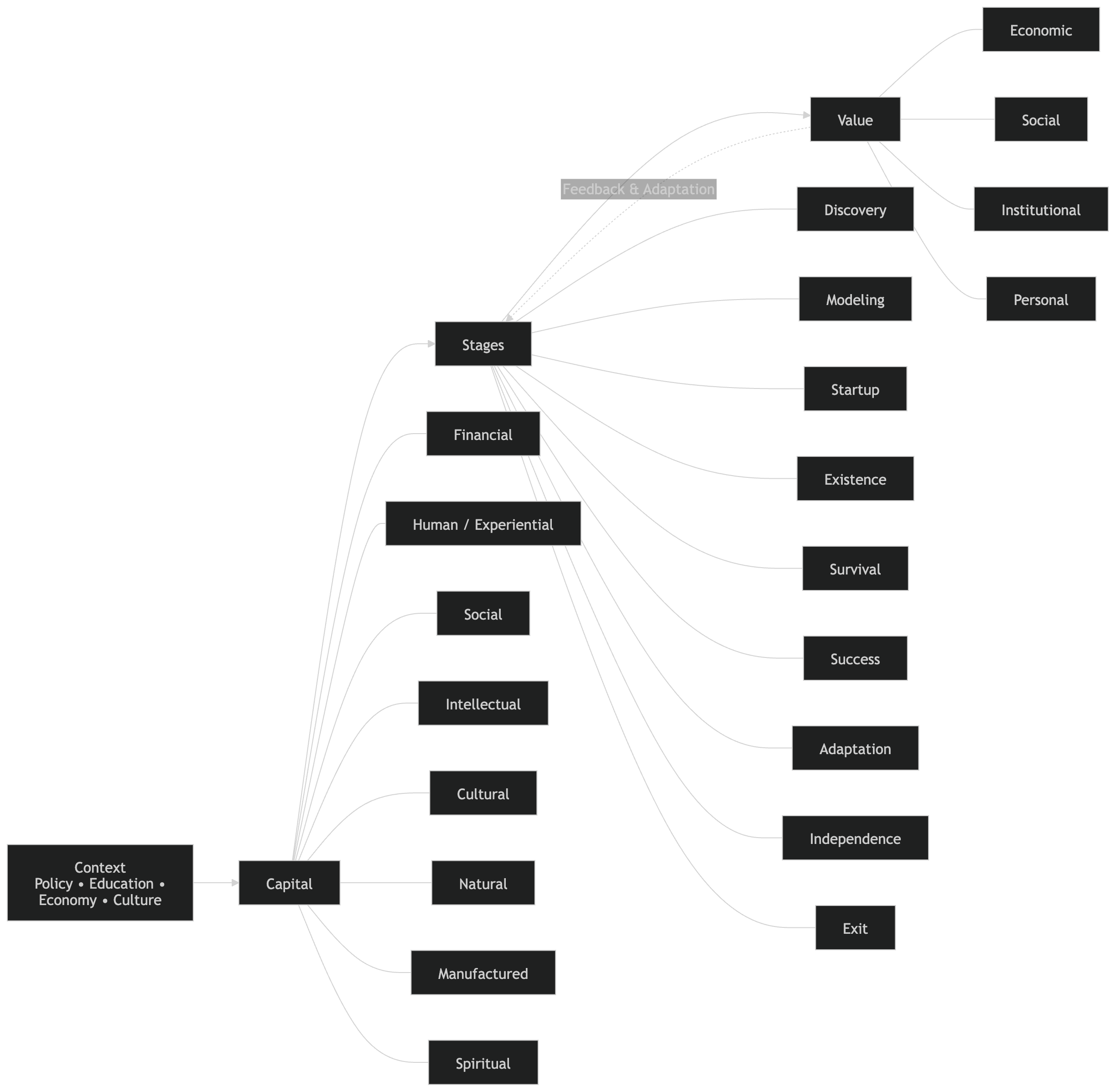
    Integrated Entrepreneurship Framework

    This framework is deliberately simple but conceptually powerful.

    • Capital represents the resources available
    • Stages represent the process through which entrepreneurship unfolds
    • Value represents the outcome
    • Context shapes and constrains the system

    Most existing approaches focus on only one of these elements. Effective entrepreneurship requires understanding all four—and, critically, how they interact.


    Implications for Universities: From Knowledge to Capability

    This framework exposes a fundamental weakness in higher education.

    Universities largely focus on knowledge transfer, while entrepreneurship requires capability development.

    Students are taught:

    • Business planning
    • Marketing theory
    • Financial modelling

    But they are rarely taught:

    • How to mobilise different forms of capital
    • How to navigate different stages of development
    • How to create and measure value in real contexts

    As a result, graduates leave with theoretical understanding but limited practical capability.

    To address this, universities must:

    1. Embed capital awareness into curricula
      Students should understand the different forms of capital and how to access them.
    2. Align learning with stages
      Programmes should simulate the progression from discovery to growth, not just start-up.
    3. Measure value creation capability
      Assessment should focus on outcomes, not outputs.

    This is not a marginal adjustment. It is a structural shift in how education is designed.


    Implications for Policy: From Start-Ups to Systems

    The same issue applies at the policy level.

    Entrepreneurship policy has become overly focused on:

    • Start-up grants
    • Incubators and accelerators
    • Venture capital ecosystems

    While these have value, they represent only a small part of the system.

    A more effective approach would focus on capital ecosystems:

    • Strengthening networks (social capital)
    • Investing in skills and education (human capital)
    • Supporting infrastructure (manufactured capital)
    • Enabling knowledge transfer (intellectual capital)

    This is particularly important in regional and rural contexts, where traditional start-up models often fail to translate.

    You cannot build entrepreneurial economies by funding businesses alone. You must build the systems that enable value creation.


    Implications for Entrepreneurs: Better Decisions, Better Outcomes

    For practitioners, this framework provides a more realistic lens.

    Instead of asking:

    • “Is this a good idea?”

    Entrepreneurs should ask:

    • “What value am I creating?”
    • “What capital do I need—and what am I missing?”
    • “What stage am I in—and what does that require?”

    This shift leads to better decision-making.

    It reduces overconfidence in early stages, improves resource allocation, and increases the likelihood of sustainable growth.


    Conclusion: A Necessary Shift

    Entrepreneurship matters—not because it creates businesses, but because it creates value.

    If we continue to define entrepreneurship as start-up activity, we will continue to miseducate students, misallocate resources, and misunderstand economic growth.

    The alternative is clear.

    We must move toward a model that recognises:

    • The role of capital
    • The importance of process
    • The centrality of value
    • The influence of context

    This is not simply an academic exercise. It is a practical necessity.

    The future of entrepreneurship lies not in more businesses—but in better value creation.


    References (APA Style)

    Acs, Z. J., Autio, E., & Szerb, L. (2014). National systems of entrepreneurship: Measurement issues and policy implications. Research Policy, 43(3), 476–494.

    Drucker, P. F. (1985). Innovation and entrepreneurship: Practice and principles. Harper & Row.

    Schumpeter, J. A. (1934). The theory of economic development. Harvard University Press.

    Rostow, W. W. (1960). The stages of economic growth: A non-communist manifesto. Cambridge University Press.

    Neck, H. M., Greene, P. G., & Brush, C. G. (2014). Teaching entrepreneurship: A practice-based approach. Edward Elgar.

    World Bank. (2020). Doing business 2020: Comparing business regulation in 190 economies. World Bank Publications.

    OECD. (2021). Entrepreneurship at a glance 2021. OECD Publishing.