Tag: customer discovery

  • Can a Student Venture Be Designed to Become a £100 Million Business?

    Can a Student Venture Be Designed to Become a £100 Million Business?

    Most student ventures are designed to pass an assessment, win a competition or generate a modest income. Very few are designed from the outset to become businesses worth £100 million.

    That is not because students lack ambition or creativity. It is because entrepreneurship education often starts with the resources immediately available to the student rather than the scale of the problem worth solving. The result is frequently a small, local and easily copied business. It may provide an excellent learning experience, but it is unlikely to become a significant venture.

    So, can a student venture genuinely be designed to reach a £100 million valuation? The answer is yes—but it cannot be guaranteed. The purpose of the ambition is not to predict the eventual valuation. It is to impose a more demanding standard on the opportunity, business model, technology, team and evidence from the beginning.

    Start with a problem large enough to matter

    A £100 million company must normally address a substantial market, solve an expensive problem or create value for a large number of customers. A venture selling a low-value service to a small local audience faces a mathematical limit, regardless of the founders’ enthusiasm.

    This does not mean every student must invent a global technology platform. It means they must understand the relationship between customer value, market size, revenue potential and enterprise value. A narrow starting market can be sensible, but it should provide an entry point into a much larger opportunity.

    The first question should therefore not be, “What business can we start?” It should be, “What important problem can we solve at scale?”

    That change in language matters. It moves students away from imitation and towards investigation. They must identify who experiences the problem, how frequently it occurs, what it costs, why current solutions are inadequate and whether customers will pay for a better outcome.

    Design for scale before growth begins

    Growth and scale are not the same. A business grows by adding resources as it adds customers. A scalable business can increase revenue much faster than its cost base.

    Students therefore need to examine the economic engine behind the idea. Can delivery be standardised? Can technology automate important processes? Can the product be distributed beyond the founders’ personal networks? Does each new customer improve the economics, data or usefulness of the venture? Can the model operate across regions or sectors without being rebuilt each time?

    A consultancy may grow into a successful firm, but a service dependent upon the founder’s time is inherently constrained. By contrast, a productised service, software platform, licensable system or repeatable marketplace may have a more credible path to scale.

    This is not an argument that technology automatically creates value. Many digital products fail because they automate something customers do not consider important. Scale must begin with demonstrated value, not technical possibility.

    Build evidence, not theatre

    Early-stage entrepreneurship can become dominated by pitch decks, slogans and optimistic financial projections. None of these proves that a venture works.

    A £100 million ambition requires stronger evidence at every stage. Have prospective customers confirmed the problem? Will they commit time, data, access or money to a trial? Can the team deliver a working solution? What does it cost to acquire and serve a customer? Do customers return, renew or recommend it? Is there a believable route from a small pilot to a repeatable commercial model?

    The venture should progress through evidence gates. At each point, the team must demonstrate that key uncertainties have been reduced before receiving further support or investment. This makes ambition more disciplined, because evidence can strengthen, reshape or stop the venture.

    Stopping is not failure. Continuing with an idea after the evidence has turned against it is the more serious failure.

    Create a team around the venture’s needs

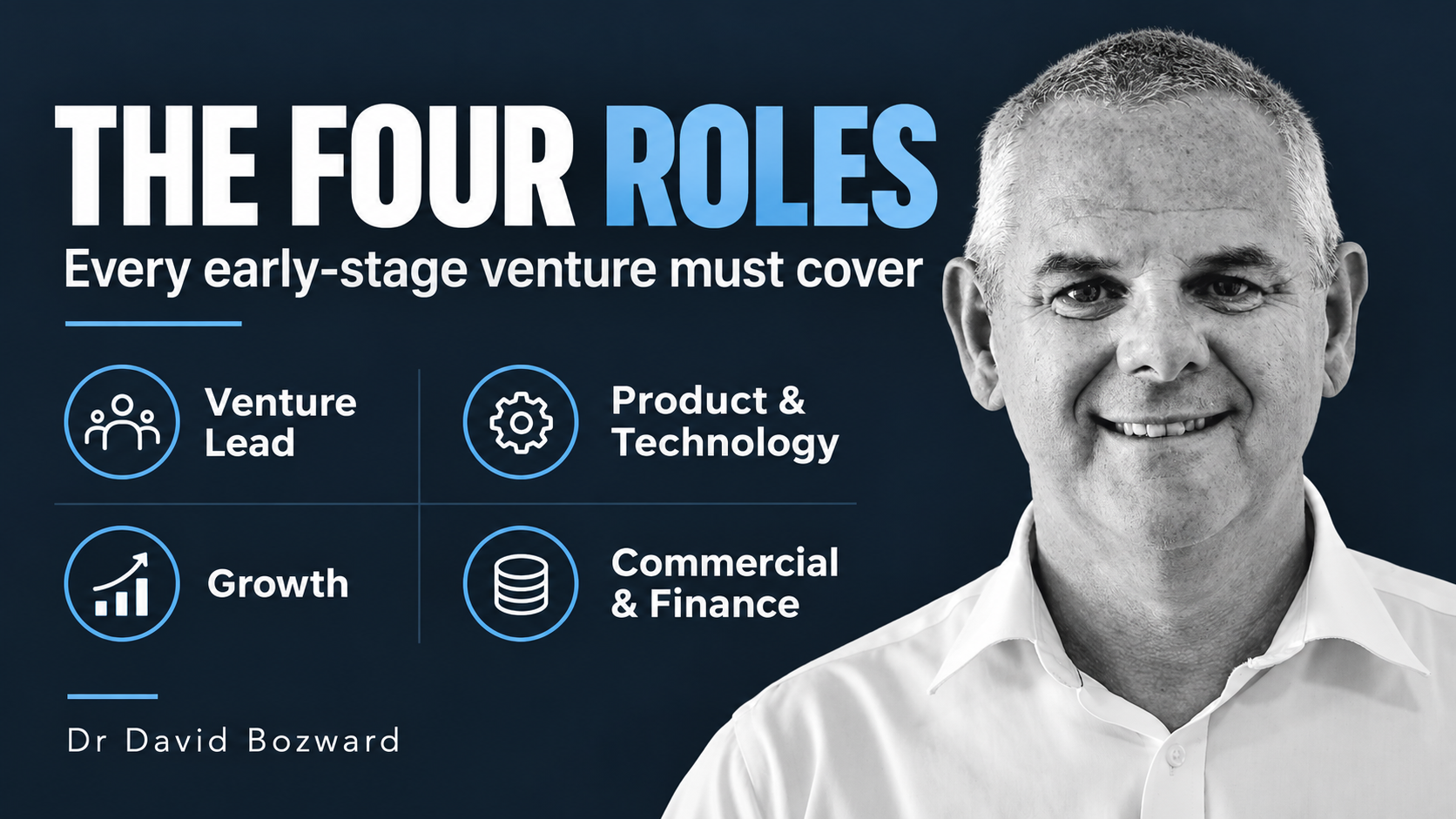
    Large opportunities are rarely developed by one person. Student teams need complementary capabilities covering four essential functions: venture leadership and operations; product and technology; customer growth and partnerships; and commercial management and finance.

    These are functions, not necessarily four grand job titles. What matters is that the work is owned. A technically strong team without sales capability may build something nobody buys. A persuasive team without product discipline may sell a promise it cannot deliver. A creative team without financial control may grow activity while destroying value.

    The educational environment must also change. Students need access to experienced founders, sector specialists, technologists, customers, investors and professional advisers. Mentors should challenge assumptions and open relevant doors, not simply offer encouragement.

    Treat ownership as a responsibility

    Once students form a real company and allocate equity, entrepreneurship stops being a classroom simulation. Decisions about founders, intellectual property, vesting, governance and investment can have lasting consequences.

    Equity should reflect contribution, commitment and risk. Where participation develops over time, ownership can vest progressively against agreed milestones. This protects the venture if someone leaves early while recognising the value already created.

    Governance need not become bureaucratic, but it should establish clear decision rights, reporting expectations and standards of conduct. Investors are more likely to support ambitious founders who understand accountability as well as opportunity.

    Use £100 million as a design discipline

    The value of the £100 million question is not that every student business will achieve it. Most will not. The value lies in what the question forces founders to confront.

    Is the problem sufficiently important? Is the addressable market large enough? Can the model scale? Is there a defensible advantage? Does the team possess—or know how to acquire—the necessary capabilities? What evidence would justify the next investment of time and money?

    This is the philosophy behind programmes such as Sky High Ventures: students should not merely learn about entrepreneurship or operate temporary projects. They should experience the discipline of building a real company with genuine customers, ownership, milestones and consequences.

    Universities often encourage students to “think big” but then place them inside small, short and assessment-led projects. If we want students to create consequential ventures, we must give them a longer runway, multidisciplinary teams, external expertise, demanding evidence gates and meaningful exposure to markets and investment.

    A student venture cannot be guaranteed a £100 million future. It can, however, be designed so that such a future remains credible. That begins by replacing easy optimism with a serious problem, a scalable architecture and relentless evidence. Ambition then becomes more than a slogan. It becomes a method.

  • The Missing Middle of Innovation: Why Promising Ideas Die Between TRL 2 and TRL 4

    The Missing Middle of Innovation: Why Promising Ideas Die Between TRL 2 and TRL 4

    Innovation rarely fails because people lack ideas. It fails because promising ideas struggle to cross the space between an interesting concept and credible evidence that it works.

    This is the missing middle of innovation: the journey from Technology Readiness Level 2, where a technological concept has been formulated, through TRL 3, where proof of concept is established, to TRL 4, where the technology has been validated under laboratory conditions.

    It sounds like a short step. In practice, it is where many potentially valuable innovations die.

    The evidence gap

    At TRL 2, an innovator may have a strong hypothesis, early research and a convincing description of the problem. What they lack is sufficient evidence. Customers cannot see a working solution. Investors cannot assess whether the principal technical risks have been reduced. Funders cannot distinguish between a bold proposition and an unsupported claim.

    The innovator therefore faces a paradox: they need resources to generate evidence, but they need evidence to secure resources.

    This is often described as a funding gap, but money is only part of the problem. There is also a capability gap. Moving towards TRL 4 requires experimental design, systems engineering, customer discovery, project governance and commercial judgement. The creator may not possess all those capabilities.

    Activity is not the same as progress

    Many early projects appear busy without becoming more investable. Teams build features before confirming the core technical hypothesis. They commission prototypes that demonstrate appearance rather than function. They speak to supportive contacts instead of prospective buyers. They report tasks completed rather than uncertainties reduced.

    This produces the illusion of progress.

    A credible TRL 3 project should be organised around explicit questions. What must be true for the technology to work? Which assumption presents the greatest risk? What experiment would test it? What counts as success or failure?

    TRL progression is not simply a matter of spending time on development. It is the disciplined reduction of uncertainty.

    Technology cannot progress alone

    Another mistake is treating readiness as purely technical. A proof of concept can work while the wider proposition remains unviable. The customer may not consider the problem important. Integration may be too complex. Data may be inaccessible. Security, regulation or operating costs may prevent adoption.

    Technical evidence must develop alongside market and delivery evidence. By TRL 4, a team should understand whether the technology can work, who might buy it, why they would act and what barriers stand in the way.

    Building a bridge across the missing middle

    Promising ideas need a structured evidence plan, not simply encouragement. This should define the critical hypotheses, experiments, acceptance criteria, responsibilities, costs and evidence needed for the next investment decision. Each activity should answer a material question or retire a significant risk.

    Universities, accelerators and innovation agencies also need to rethink their support. Too many programmes reward pitching, generic mentoring and participation. Innovators need technical facilities, product leadership, relevant customers, commercial expertise and patient funding tied to learning milestones.

    The objective should not be to protect every idea. Some should stop. A well-designed experiment that disproves a concept is more valuable than months spent sustaining false optimism.

    The real purpose of the missing middle is selection through evidence. Ideas that survive emerge stronger, more focused and more credible. Those that do not release their people, time and capital for better opportunities.

    Innovation policy often celebrates discovery and later-stage scale-up. Between them lies the less glamorous work of proving, testing and learning. Until we invest properly in that work, too many good ideas will continue to disappear before they are given a fair chance to succeed.

  • ABCD Framework for Business Ideation

    ABCD Framework for Business Ideation

    A simple, powerful 4-step model for generating, shaping, testing, and preparing to deliver your business idea. Ideal for workshops, classrooms, startups, and solo entrepreneurs.


    🅰️ A is for AudienceWho are you helping?

    Every business begins with understanding who you’re serving. Great ideas solve problems for specific people. The more clearly you define your audience, the more relevant and valuable your solution becomes.

    🔍 Actions:

    • Identify your target user or customer (persona).
    • Research their lifestyle, challenges, values, and goals.
    • Observe what frustrates or delights them.

    💬 Prompt Questions:

    • Who is your ideal customer?
    • What are they struggling with?
    • What are they trying to achieve?

    🛠️ Tools:
    Empathy Map | Personas | User Interviews | Customer Journey Map


    🅱️ B is for BreakthroughWhat’s the big insight or idea?

    This is the “aha” moment — your unique solution, innovation, or creative twist that delivers value in a new way. It might be simpler, faster, cheaper, greener, or more delightful than existing alternatives.

    🔍 Actions:

    • Ideate around observed needs and frustrations.
    • Connect trends, tech, and customer desires.
    • Define your core value proposition.

    💬 Prompt Questions:

    • What’s the new way to solve this?
    • Why hasn’t someone done this better?
    • What’s your key innovation or twist?

    🛠️ Tools:
    Brainstorming | Value Proposition Canvas | Pain-Gain Mapping | SCAMPER Technique


    🅲️ C is for Concept ValidationDoes it work for real people?

    Before building a full product or service, you must test whether your idea resonates. Validation means getting real-world feedback to see if people understand, want, and will use or pay for it.

    🔍 Actions:

    • Create a simple version of your offer (MVP, mockup, prototype).
    • Share it with potential users.
    • Collect feedback, track behavior, refine the idea.

    💬 Prompt Questions:

    • Do people get it?
    • Do they say, “I need this”?
    • Will they use it or pay for it?

    🛠️ Tools:
    Landing Pages | Prototypes | Customer Surveys | Smoke Tests | A/B Tests


    🅳️ D is for Delivery ModelHow will you make it happen?

    Once you’ve validated the idea, it’s time to figure out how to deliver it. This means planning how the business will operate — how you’ll create, distribute, and capture value.

    🔍 Actions:

    • Define your business model (revenue, costs, logistics).
    • Choose your go-to-market strategy.
    • Plan your first version or launch steps.

    💬 Prompt Questions:

    • How will you deliver your product or service?
    • How will you make money?
    • What resources and systems will you need?

    🛠️ Tools:
    Lean Canvas | Business Model Canvas | Pricing Strategy | Go-to-Market Plan


    🧩 Summary: The ABCD of Business Ideation

    LetterFocusKey Outcome
    A – AudienceUnderstand the customerClear user needs and target profile
    B – BreakthroughDefine the unique solutionCompelling idea aligned with user needs
    C – Concept ValidationTest it in the real worldEvidence that people want it
    D – Delivery ModelPlan how to bring it to lifeStrategy to build, market, and earn revenue

    🚀 Real Example: ABCD in Action

    👟 Business Idea: Custom Sneakers for Nurses

    • A – Audience: Nurses who work long shifts and need comfortable, stylish footwear.
    • B – Breakthrough: Design ergonomic sneakers with built-in support and personalization options.
    • C – Concept Validation: Build a landing page with designs, get feedback from nursing groups, offer pre-orders.
    • D – Delivery Model: Direct-to-consumer model using print-on-demand and affiliate marketing through health influencers.

    ✅ Why Use ABCD?

    • Simple & Memorable: Great for students, founders, or teams.
    • Practical & Actionable: Guides you from idea to implementation.
    • Flexible: Can be used in workshops, hackathons, or ideation sprints.
  • The 7 Ps of Ideation: A Powerful Framework for Generating Business Ideas

    The 7 Ps of Ideation: A Powerful Framework for Generating Business Ideas

    The role of ideation in entreprenuership can not be underestimated, however there is little written on the structure of it, nor simple ways to develop ideas.

    Enter the 7 Ps of Ideation — a structured, practical, and repeatable framework designed to help you generate meaningful, viable, and innovative business ideas.

    Whether you’re launching your first venture, pivoting your current business, or looking to spark creativity in your team, this framework gives you a systematic lens through which to discover opportunities.

    Let’s dive into each of the seven Ps: People, Place, Process, Problems, Patterns, Passions, and Potential.


    1. People: Understanding Human Needs

    At the heart of every great business is a clear understanding of people. Customers are not just data points or demographics; they’re real humans with emotions, habits, frustrations, and dreams. Business ideas that matter usually start with empathy.

    How to apply it:

    • Observe people in everyday life — commuting, shopping, working, relaxing.
    • Interview friends, colleagues, or potential users. Ask about their challenges or what wastes their time.
    • Segment different user groups: working parents, remote freelancers, students, retirees — and ask, “What do they wish was easier?”

    Example:

    Melanie Perkins started Canva after observing how difficult it was for non-designers (especially students and teachers) to use professional design software. Her empathy for everyday users birthed a billion-dollar idea.


    2. Place: Leveraging Context and Environment

    “Place” refers to the environment — both physical and digital — where problems and opportunities arise. Local culture, geography, infrastructure, and even online spaces can influence needs. A business idea that works in one region may not in another, but that’s where niche opportunities thrive.

    How to apply it:

    • Explore how needs differ between urban vs rural, or developed vs developing locations.
    • Consider online communities as “places” with shared challenges (e.g. remote workers, gamers, small Etsy sellers).
    • Walk your neighborhood. Notice what’s missing or underdeveloped.

    Example:

    Gojek emerged in Indonesia where traffic congestion and underdeveloped transport systems were a massive issue. By understanding the place, they created a super-app that now powers logistics, payments, and rides in Southeast Asia.


    3. Process: Improving How Things Are Done

    The third P is all about how things get done. Every task — whether booking a holiday, onboarding a new employee, or cooking dinner — involves a process. If a process is slow, confusing, outdated, or overly manual, there’s a business opportunity in improving it.

    How to apply it:

    • Ask: “What takes too long or requires too many steps?”
    • Watch people perform tasks: Where do they get stuck, frustrated, or make mistakes?
    • Look at automation, platformization, or integration as solutions.

    Example:

    Zapier recognized that many non-technical professionals wanted to connect different apps (Gmail, Slack, Trello, etc.) without coding. By simplifying that process, they built a tool for “automation without developers” and tapped into a huge productivity market.


    4. Problems: Solving Real Pain Points

    While the first three Ps focus on observation, this P focuses on pain. At its core, every business idea is a solution to a problem. The bigger and more painful the problem, the more valuable the solution becomes.

    The key is to fall in love with the problem, not the solution.

    How to apply it:

    • Keep a journal of annoyances or recurring frustrations in your life.
    • Ask others: “What do you hate doing?” or “What do you wish someone would fix?”
    • Explore “workarounds” — whenever people find hacks or tricks, it signals a problem worth solving.

    Example:

    Dropbox was born out of founder Drew Houston’s frustration with USB drives and emailing himself files. The problem — seamless file access and syncing — led to one of the most popular cloud storage services in the world.


    5. Patterns: Spotting Trends and Emerging Behaviors

    This P is about looking forward. Successful entrepreneurs are often excellent at noticing subtle shifts before the rest of the market catches up. They see patterns in behavior, technology, demographics, or economics — and then build for where the world is going, not where it is now.

    How to apply it:

    • Read trend reports, follow innovation blogs, or scan product launches.
    • Observe Gen Z or niche online subcultures — they often point to emerging mainstream habits.
    • Look at how new technology (AI, AR, crypto, biotech) is changing what’s possible.

    Example:

    Headspace and Calm saw the rising pattern of mental health awareness, mindfulness, and wellness long before it became mainstream. They created digital meditation tools at the perfect time — aligning with cultural shifts and mobile-first habits.


    6. Passions: Building From What You Love

    Many successful lifestyle businesses start not from a market gap, but from personal passion. When you’re deeply interested in something — whether it’s coffee, gardening, art, or gaming — you’re more likely to see opportunities, endure challenges, and build with authenticity.

    Passion doesn’t guarantee success, but it fuels resilience and helps create genuine value.

    How to apply it:

    • List hobbies or causes you’re enthusiastic about.
    • Ask: “What would I do all day even if no one paid me?”
    • Join forums or communities around your interests — notice what people complain about or ask for help with.

    Example:

    Tim Ferriss wrote The 4-Hour Workweek based on his obsession with lifestyle design and productivity hacks. That book became a business empire — podcast, supplements, tools, investments — all fueled by passion.


    7. Potential: Evaluating Viability and Growth

    Finally, the seventh P helps you test whether your idea can actually become a business. Passion and insight are important, but so is understanding market size, competition, feasibility, and return on effort.

    Some ideas may only serve a tiny niche, while others can scale across regions or industries. Evaluating potential ensures you don’t just have a good idea — but a sustainable one.

    How to apply it:

    • Do a quick TAM-SAM-SOM exercise (Total Addressable Market, Serviceable Market, Obtainable Market).
    • Run a Lean Canvas or use tools like SimVenture Validate or Y Combinator’s Idea Test.
    • Ask: “Would people pay for this? How much? How often?”

    Example:

    Airbnb started with a simple idea — renting air mattresses to guests. But the potential to disrupt global travel accommodation was massive. They validated early, expanded rapidly, and turned a scrappy concept into a global platform.


    Putting It All Together: The Power of the 7 Ps

    Each “P” is a lens — a way of seeing the world slightly differently:

    PFocusOutcome
    PeopleHuman needs, desires, behaviorsEmpathetic, user-driven ideas
    PlaceEnvironmental contextLocalised or situational opportunities
    ProcessInefficient systemsStreamlined, innovative workflows
    ProblemsPain pointsUrgent, valuable solutions
    PatternsTrends & market shiftsFuture-facing, high-growth opportunities
    PassionsPersonal interestsAuthentic, resilient ventures
    PotentialViability and scalabilityStrategic, long-term business models

    Using this model, you can generate a portfolio of ideas and then filter or test them based on alignment with your values, skills, time, and resources.

    Let’s see how these 7 Ps work together using a hypothetical example:


    Case Study: Urban Plant Kit Startup

    People – Young urban professionals living in small apartments with no garden.
    Place – Dense cities where access to greenery is limited and grocery stores are expensive.
    Process – Growing food at home is seen as difficult, messy, or time-consuming.
    Problems – People want fresh herbs/veggies but have no space or knowledge.
    Patterns – Trends in sustainability, self-sufficiency, home aesthetics, and mental wellness.
    Passions – Founder loves plants, cooking, and eco-living.
    Potential – Large urban millennial market, possible subscription model, scalable across cities.

    This could evolve into a smart indoor gardening kit with a mobile app for reminders and tutorials — blending tech, design, and sustainability into a clear value proposition.


    Why Use the 7 Ps?

    The 7 Ps framework turns the vague, often intimidating task of “coming up with a business idea” into a methodical exploration of the world around you. Instead of waiting for a “lightbulb moment,” you now have a toolbox of prompts and lenses through which to explore opportunities.

    It also helps ensure that your idea is:

    • Rooted in real needs (People, Problems)
    • Context-aware (Place, Process)
    • Future-focused (Patterns)
    • Personally meaningful (Passions)
    • Strategically sound (Potential)

    🚀 Want to try it yourself?

    Use this simple exercise:

    • Take one hour.
    • List three observations for each of the 7 Ps.
    • Then combine insights from at least 3 Ps to develop one idea.
    • Bonus: Run that idea through a quick validation checklist (Would people pay for it? Can you build a simple prototype?).

    Let your creativity collide with structure — and watch the sparks fly.