
Tag: consulting

  • Entrepreneurship Is Not Start-Up: A New Framework for Value Creation, Education, and Economic Growth

    Entrepreneurship Is Not Start-Up: A New Framework for Value Creation, Education, and Economic Growth

    Entrepreneurship has been reduced to a narrow and ultimately unhelpful idea: starting a business.

    Across universities, policy frameworks, and media narratives, entrepreneurship is framed through start-up activity—pitch decks, venture capital, and the pursuit of rapid scale. This interpretation is not simply incomplete; it is distorting how we educate students, design economic policy, and evaluate success.

    The consequence is a system that rewards activity over impact, formation over function, and visibility over value.

    If we are serious about improving productivity, employability, and long-term economic resilience, we need to move beyond the start-up myth and return to a more fundamental question:

    What is entrepreneurship actually for?


    The Problem: We Are Measuring the Wrong Thing

    Entrepreneurship policy and education are dominated by simplistic metrics:

    • Number of start-ups created
    • Amount of funding raised
    • Survival rates over three to five years

    These measures are easy to quantify, but they are poor proxies for what really matters: value creation.

    A business can be launched, funded, and sustained without creating meaningful economic or social value. Equally, significant value can be created within existing organisations, communities, or informal economies without ever appearing in start-up statistics.

    This misalignment has three critical consequences.

    First, it leads to policy inefficiency. Governments invest heavily in start-up ecosystems without understanding whether those ventures contribute to productivity, innovation, or regional development.

    Second, it creates educational distortion. Universities design entrepreneurship programmes around venture creation rather than capability development, leaving graduates underprepared for complex, non-linear careers.

    Third, it results in entrepreneurial failure. Founders are encouraged to pursue ideas without understanding the resources, processes, and conditions required to create sustainable value.

    In short, we are optimising for the wrong outcome.


    Reframing Entrepreneurship: From Activity to Value

    To correct this, entrepreneurship must be redefined.

    Entrepreneurship is not the act of starting a business. It is:

    The process of creating, capturing, and sustaining value through the effective orchestration of resources over time.

    This definition shifts the focus in three important ways.

    First, it places value at the centre, not activity. The purpose of entrepreneurship is not formation but transformation.

    Second, it emphasises process, recognising that entrepreneurship unfolds over time rather than occurring at a single moment of creation.

    Third, it highlights resource orchestration, acknowledging that entrepreneurs do not simply use resources—they combine, adapt, and transform them.

    This reframing aligns more closely with established economic theory. Joseph Schumpeter, for example, positioned the entrepreneur as an agent of “creative destruction,” reshaping markets through innovation rather than merely creating firms (Schumpeter, 1934). Similarly, Peter Drucker emphasised entrepreneurship as a systematic practice of innovation and value creation (Drucker, 1985).

    Yet despite this intellectual foundation, contemporary systems have drifted toward a far narrower interpretation.


    The Missing Mechanism: Understanding Entrepreneurial Capital

    If entrepreneurship is about value creation, the next question is straightforward:

    How is value actually created?

    The answer lies in capital—not just financial capital, but a broader set of resources that entrepreneurs draw upon and combine.

    The Eight Capitals Model provides a more complete view:

    • Financial Capital (money and funding)
    • Human/Experiential Capital (skills, knowledge, experience)
    • Social Capital (networks and relationships)
    • Intellectual Capital (ideas, IP, systems)
    • Cultural Capital (norms, behaviours, identity)
    • Natural Capital (environmental and physical resources)
    • Manufactured Capital (infrastructure, tools, technology)
    • Spiritual Capital (purpose, values, motivation)

    Traditional approaches overemphasise financial capital, yet evidence consistently shows that access to networks, knowledge, and institutional support often matters more in determining entrepreneurial outcomes (Acs et al., 2014).

    Entrepreneurs do not simply deploy these capitals independently. They orchestrate them—combining different forms of capital to create new forms of value.

    A founder launching a digital platform, for example, may rely heavily on intellectual and social capital in early stages, while scaling requires increasing levels of financial and manufactured capital.

    Understanding this dynamic is critical. Without it, both education and policy remain fundamentally incomplete.


    The Process Layer: The 9 Stages of Enterprise Development

    While capital explains what resources are used, it does not explain how entrepreneurship unfolds.

    Entrepreneurship is not a single act but a staged process. The 9 Stages of Enterprise Development provide a structured way to understand this progression:

    1. Discovery
    2. Modeling
    3. Startup
    4. Existence
    5. Survival
    6. Success
    7. Adaptation
    8. Independence
    9. Exit

    Each stage represents a different configuration of challenges, decisions, and resource requirements.

    Crucially, value is created differently at each stage.

    • In Discovery, value lies in identifying opportunities
    • In Startup, it lies in mobilising resources
    • In Survival, it lies in achieving cash flow stability
    • In Adaptation, it lies in responding to environmental change

    This staged perspective aligns with broader economic development theories, such as Walt Rostow’s model of economic growth, which highlights the importance of sequential development phases (Rostow, 1960). However, unlike linear economic models, entrepreneurship is iterative and adaptive.

    The key insight is this:

    Entrepreneurship is the dynamic interaction between capital and stages, producing value over time.


    An Integrated Framework for Entrepreneurship

    To move beyond fragmented thinking, these elements must be brought together into a single model.

    Integrated Entrepreneurship Framework
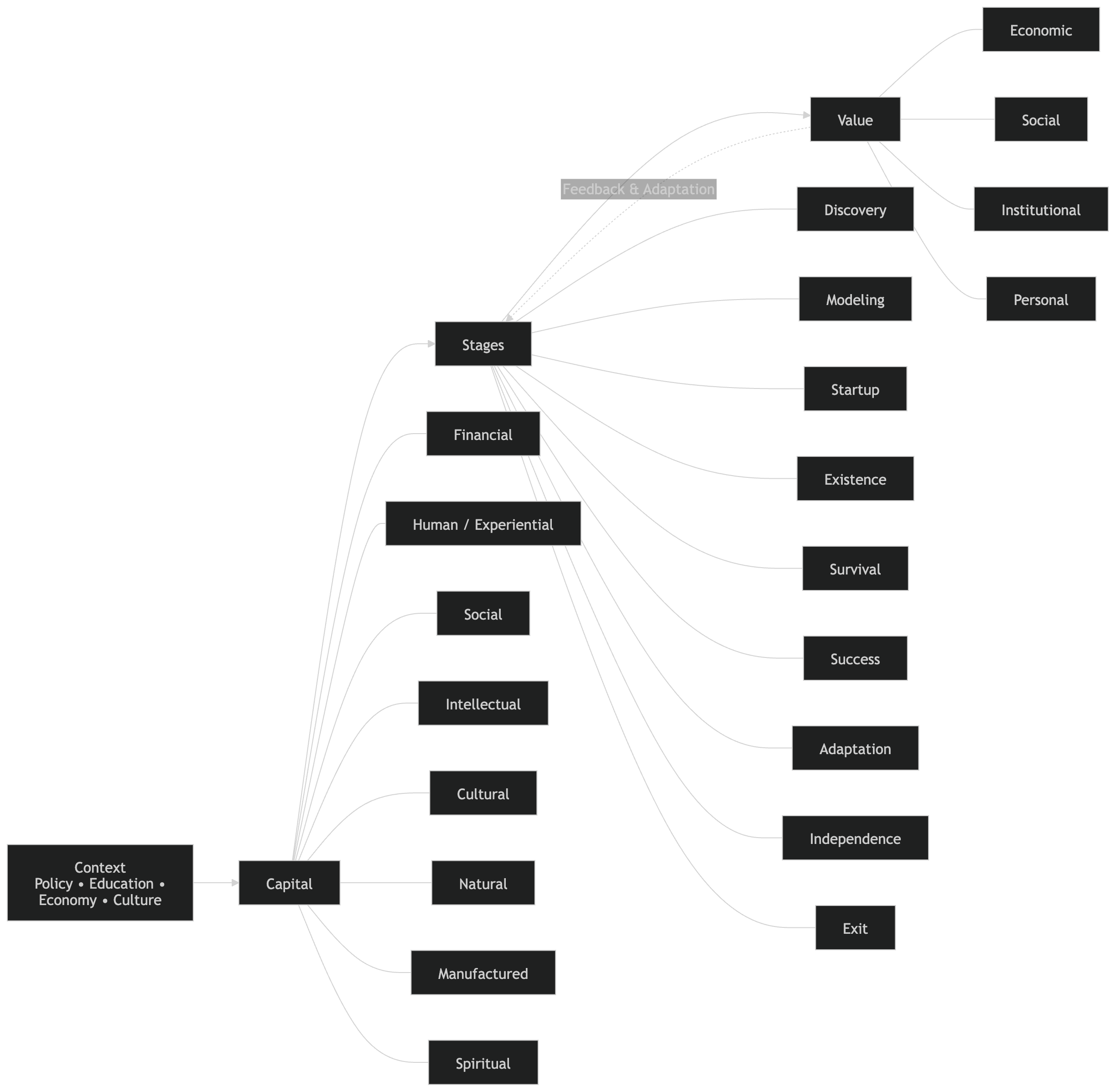
    This framework is deliberately simple but conceptually powerful.

    • Capital represents the resources available
    • Stages represent the process through which entrepreneurship unfolds
    • Value represents the outcome
    • Context shapes and constrains the system

    Most existing approaches focus on only one of these elements. Effective entrepreneurship requires understanding all four—and, critically, how they interact.


    Implications for Universities: From Knowledge to Capability

    This framework exposes a fundamental weakness in higher education.

    Universities largely focus on knowledge transfer, while entrepreneurship requires capability development.

    Students are taught:

    • Business planning
    • Marketing theory
    • Financial modelling

    But they are rarely taught:

    • How to mobilise different forms of capital
    • How to navigate different stages of development
    • How to create and measure value in real contexts

    As a result, graduates leave with theoretical understanding but limited practical capability.

    To address this, universities must:

    1. Embed capital awareness into curricula
      Students should understand the different forms of capital and how to access them.
    2. Align learning with stages
      Programmes should simulate the progression from discovery to growth, not just start-up.
    3. Measure value creation capability
      Assessment should focus on outcomes, not outputs.

    This is not a marginal adjustment. It is a structural shift in how education is designed.


    Implications for Policy: From Start-Ups to Systems

    The same issue applies at the policy level.

    Entrepreneurship policy has become overly focused on:

    • Start-up grants
    • Incubators and accelerators
    • Venture capital ecosystems

    While these have value, they represent only a small part of the system.

    A more effective approach would focus on capital ecosystems:

    • Strengthening networks (social capital)
    • Investing in skills and education (human capital)
    • Supporting infrastructure (manufactured capital)
    • Enabling knowledge transfer (intellectual capital)

    This is particularly important in regional and rural contexts, where traditional start-up models often fail to translate.

    You cannot build entrepreneurial economies by funding businesses alone. You must build the systems that enable value creation.


    Implications for Entrepreneurs: Better Decisions, Better Outcomes

    For practitioners, this framework provides a more realistic lens.

    Instead of asking:

    • “Is this a good idea?”

    Entrepreneurs should ask:

    • “What value am I creating?”
    • “What capital do I need—and what am I missing?”
    • “What stage am I in—and what does that require?”

    This shift leads to better decision-making.

    It reduces overconfidence in early stages, improves resource allocation, and increases the likelihood of sustainable growth.


    Conclusion: A Necessary Shift

    Entrepreneurship matters—not because it creates businesses, but because it creates value.

    If we continue to define entrepreneurship as start-up activity, we will continue to miseducate students, misallocate resources, and misunderstand economic growth.

    The alternative is clear.

    We must move toward a model that recognises:

    • The role of capital
    • The importance of process
    • The centrality of value
    • The influence of context

    This is not simply an academic exercise. It is a practical necessity.

    The future of entrepreneurship lies not in more businesses—but in better value creation.


    References (APA Style)

    Acs, Z. J., Autio, E., & Szerb, L. (2014). National systems of entrepreneurship: Measurement issues and policy implications. Research Policy, 43(3), 476–494.

    Drucker, P. F. (1985). Innovation and entrepreneurship: Practice and principles. Harper & Row.

    Schumpeter, J. A. (1934). The theory of economic development. Harvard University Press.

    Rostow, W. W. (1960). The stages of economic growth: A non-communist manifesto. Cambridge University Press.

    Neck, H. M., Greene, P. G., & Brush, C. G. (2014). Teaching entrepreneurship: A practice-based approach. Edward Elgar.

    World Bank. (2020). Doing business 2020: Comparing business regulation in 190 economies. World Bank Publications.

    OECD. (2021). Entrepreneurship at a glance 2021. OECD Publishing.

  • Beyond the Bake Sale: Reimagining University-Industry Partnerships for Genuine Impact

    Title: Reimagining the University-Industry Partnership: A New Model for Impact

    There’s a certain quaintness to the traditional image of university-industry partnerships. Think career fairs, bake sales to fund student projects, perhaps a guest lecture from an industry leader. These are valuable initiatives, certainly, but they often feel like peripheral activities – a polite nod towards the ‘real world’ rather than a fundamental shift in how universities operate.

    I’m not dismissing these efforts, mind you. I’ve participated in them myself, organizing career workshops and facilitating industry mentorship programmes. But after years of observing these interactions from both sides – as an academic deeply invested in research and a consultant advising businesses – I’m convinced that we need to fundamentally reimagine the university-industry partnership. We need a model that moves beyond simple transactional exchanges and embraces genuine collaboration, one that prioritizes shared value creation over short-term gains.

    I’m not suggesting a radical overhaul, but rather a subtle recalibration – a shift in mindset that recognizes the inherent strengths of both institutions and leverages them to address complex societal challenges. It’s a vision born from witnessing firsthand the frustrating disconnect between academic research and real-world application, and fueled by a deep conviction that universities have a crucial role to play in driving innovation, productivity and economic growth.

    The Current Landscape: A History of Missed Opportunities

    Let’s be honest, the current landscape is often characterized by a degree of mutual skepticism. Universities are perceived as ivory towers, disconnected from the practical needs of businesses. Businesses, in turn, view universities as slow-moving bureaucracies, resistant to change and unwilling to commercialize their research.

    This isn’t entirely unwarranted. The traditional model often prioritizes academic publications over practical impact, incentivizing researchers to publish in high-impact (don’t get me started on those) journals rather than seeking solutions to today’s real-world problems. The intellectual property landscape can be a minefield, with complex licensing agreements and conflicting interests hindering commercialization efforts. And let’s not forget the inherent cultural differences – the academic emphasis on rigorous peer review clashes with the business imperative for rapid iteration and market validation.

    I recall one particularly frustrating experience advising a medtech startup that was struggling to secure funding for a promising new intervention. The university’s technology transfer office, while well-intentioned, was bogged down in lengthy negotiations with potential investors, delaying the project and ultimately jeopardizing its future. It was a stark reminder that good intentions alone aren’t enough; we need streamlined processes, clear incentives, and a shared commitment to driving impact.

    A New Model: Shared Value Creation at the Core, Grounded in Experiential Learning

    My vision for a reimagined university-industry partnership centres on the concept of shared value creation (The central premise of enterprise creation). It’s about moving beyond transactional exchanges and fostering deep, collaborative relationships that benefit both institutions and society as a whole. Crucially, this requires embedding experiential learning at the heart of our approach. Tools like SimVenture, for instance, offer unparalleled opportunities for students to grapple with real-world business challenges in a safe and engaging environment. Imagine undergraduate teams developing strategic plans for simulated companies, making investment decisions, navigating market fluctuations – all while receiving mentorship from industry professionals. This isn’s just theoretical learning; it’s applied knowledge, forged in the crucible of simulated experience.

    Key Pillars of a Collaborative Future:

    Here are some concrete steps we can take to build this collaborative future:

    1. Embedded Industry Fellows: Imagine a programme where experienced industry professionals are embedded at the same level, within university departments, working alongside faculty and students on real-world projects. These fellows would bring valuable insights into market needs, provide mentorship to aspiring entrepreneurs, and help bridge the gap between academic research and commercial application.
    2. Challenge-Driven Research: Instead of pursuing research topics in isolation, universities should actively solicit challenges from businesses and policymakers. This would ensure that our research is aligned with real-world needs, increasing its relevance and impact.
    3. Flexible Intellectual Property Frameworks: We need to move away from rigid, one-size-fits-all intellectual property frameworks and embrace more flexible models that encourage collaboration and innovation.
    4. Cross-Disciplinary Innovation Hubs: Universities should establish cross-disciplinary innovation hubs that bring together faculty, students, and industry partners from diverse fields to tackle complex challenges.
    5. Data-Driven Impact Assessment: We need to develop robust data-driven impact assessment frameworks that measure the real-world benefits of our research.
    6. Robust Subcontractual Oversight: Recognizing that complex projects often involve subcontracting, universities must implement rigorous oversight mechanisms. As detailed in my work on this topic, clear contractual provisions, independent audits, and transparent reporting are essential to ensure accountability, mitigate risks, and safeguard the integrity of collaborative ventures. This includes establishing clear lines of responsibility for performance, quality control, and ethical conduct across all tiers of the project.

    The Role of Policy: Incentivizing Collaboration

    Government policy also has a crucial role to play in incentivizing collaboration between universities and businesses. This could involve providing tax breaks for companies that invest in university research, creating grant programmes that specifically target collaborative projects, and streamlining regulatory processes to facilitate commercialization.

    I remember advocating for a policy change in my own state that provided tax credits to companies that partnered with universities on research projects. The impact was immediate – we saw a surge in collaborative initiatives, leading to the creation of new businesses and high-paying jobs.

    Embracing Imperfection: A Journey, Not a Destination

    This isn’t about creating a utopian vision of perfect collaboration. It’s about acknowledging that the journey will be fraught with challenges, setbacks, and disagreements. There will be times when we stumble, make mistakes, and question our assumptions. But it’s through these experiences that we learn, adapt, and ultimately build a more effective partnership.

    As I reflect on my own experiences, I’m filled with a sense of optimism and hope. I believe that universities have a vital role to play in driving innovation, creating jobs, and addressing some of the world’s most pressing challenges. And I believe that by reimagining our partnerships with businesses, incorporating experiential learning tools like SimVentures and implementing robust subcontractual oversight, we can unlock a new era of shared value creation and lasting impact.

  • The Digital Toolkit of a Dual Life: My Essential Tech Stack for Academia & Consulting

    The Digital Toolkit of a Dual Life: My Essential Tech Stack for Academia & Consulting

    There’s a certain poetry to the juxtaposition, isn’t there? One foot planted firmly in the hallowed halls of academia, the other navigating the fast-paced world of consulting. For years, I’ve wrestled with this dual existence – a constant dance between rigorous research and practical application. And let me tell you, it’s not always a graceful waltz. There have been moments of sheer digital chaos, frantic searches for misplaced files, and the occasional existential dread that comes with realizing you’re drowning in a sea of tabs, acrynoms and un-managed connections.

    But over time, I’ve curated a digital toolkit – a collection of software and platforms that have become as indispensable to my workflow as a well-worn pen or a stack of research papers. It’s not about flashy new gadgets; it’s about finding tools that genuinely streamline my process, allowing me to focus on what truly matters: generating insights and driving impact.

    This isn’t a comprehensive list, of course. Every academic or consultant develops their own idiosyncratic preferences. But these are the tools I find myself returning to time and again, the ones that have genuinely transformed how I navigate this dual life.

    1. The Research Backbone: Notion & Zotero

    Let’s start with the foundation – research. For years, I was a loyal Evernote user (having over 10,000 notes), but its limitations in handling complex citation management proved frustrating. Then came Notion – and it was a revelation. I’m not going to wax lyrical about its endless customization options (though, admittedly, that is part of the appeal). What I appreciate most is its ability to centralize everything. My research notes, project outlines, client briefs – it all lives within Notion’s interconnected pages.

    But Notion alone isn’t enough for serious academic research. That’s where Zotero comes in. This open-source citation manager is a lifesaver. It seamlessly integrates with my browser, allowing me to capture citations with a single click. The ability to generate bibliographies in various styles (APA, MLA, Chicago – you name it) is a non-negotiable. I remember one particularly stressful conference paper deadline where Zotero saved me from hours of manual formatting – a moment I’m eternally grateful for.

    2. Project Management: Asana (with a healthy dose of imperfection)

    Asana is my go-to for project management, both in my academic and consulting roles. I’ve experimented with other platforms (Trello, Monday.com), but Asana’s balance of structure and flexibility consistently wins me over. I’m a firm believer in breaking down large projects into smaller, manageable tasks – Asana facilitates that beautifully.

    Now, I’ll be honest: my Asana setup isn’s always pristine. There are inevitably tasks that linger, deadlines that slip (I’m only human!), and the occasional rogue comment thread. But even with its imperfections, Asana provides a crucial overview of my workload and keeps me (mostly) on track. I’m particularly fond of its integration with Google Calendar – a simple yet powerful feature that prevents double-booking and ensures I don’t miss important meetings.

    3. Communication Hub: Slack (and the art of mindful channel management)

    Slack has become the de facto communication platform for most professionals, and for good reason. It’s a fantastic tool for real-time collaboration, quick feedback, and informal discussions. However, I’ve learned the hard way that unchecked Slack usage can quickly devolve into a productivity black hole.

    My strategy? Ruthless channel management. I’m incredibly selective about which channels I join, and I mute notifications for anything that isn’t essential. The key is to create a system that minimizes distractions and maximizes focus. I also find myself increasingly drawn to the “Do Not Disturb” function – a simple yet powerful tool for reclaiming my attention.

    4. Writing & Editing: Google Docs (and Quillbot’s gentle corrections)

    Google Docs remains my primary writing tool. Its collaborative features are invaluable for co-authoring papers, drafting proposals, referencing on the fly, and sharing feedback with co-autheoring and clients. I’m a staunch believer in the power of shared documents – it fosters transparency, encourages constructive criticism, and ultimately leads to better outcomes.

    I’m also a confessed Quillbot addict. I know, it’s not the most glamorous tool on this list, but its gentle corrections and suggestions have significantly improved my writing. It catches those pesky typos I inevitably miss, and its tone detection feature helps me ensure my communication is clear and professional.

    5. The Unexpected Hero: Otter.ai (for capturing those fleeting thoughts)

    Otter.ai is a transcription service that has become an unexpected hero in my workflow. I use it to record meetings, lectures, and brainstorming sessions – then Otter transcribes everything into text. It’s a lifesaver for capturing those fleeting thoughts and ideas that often disappear before I can write them down. The accuracy is surprisingly good, and the ability to search through transcripts makes it easy to find specific information.

    The Human Element: Embracing Imperfection and Prioritizing Focus

    Ultimately, this digital toolkit is just that – a collection of tools. It’s not a magic bullet for productivity; it requires discipline, focus, and a willingness to embrace imperfection. There will be days when I feel overwhelmed by the sheer volume of information, when my inbox is overflowing, and when my to-do list seems insurmountable.

    But I’m learning to be kinder to myself, to prioritize my tasks, and to focus on what truly matters. It’s about finding a system that works for me, not against me – a digital ecosystem that supports my dual life and allows me to make a meaningful impact, one carefully curated tool at a time.

    What are your essential tools? I’d love to hear about them in the comments below!

  • Bridging Academia and Consulting: My Journey in Entrepreneurial Impact

    Bridging Academia and Consulting: My Journey in Entrepreneurial Impact

    Introduction: The Dual Lens of Academia and Consulting

    As I sit at my desk in Worcester, England, surrounded by decades-old books on entrepreneurship and a whiteboard filled with frameworks for scaling startups, I can’t help but reflect on how my career has unfolded. Over the past 25 years, I’ve oscillated between academia and consulting—roles that at first glance might seem incompatible but, in reality, are deeply intertwined. My work spans university leadership, board governance, and advising governments on entrepreneurial ecosystems, all while publishing research that informs both sectors.

    This post is a candid exploration of my journey: how I built credibility as an academic while cultivating expertise as a consultant, and the lessons I’ve learned along the way. It’s also a guide to those navigating similar paths, blending scholarly rigor with the actionable insights that consultants thrive on.


    The Academic Foundation: Teaching, Research, and “Failing Forward”

    My academic roots began in engineering, a discipline that taught me to value precision and systems thinking—a mindset I’ve carried into entrepreneurship. In 2015, as Senior Lecturer and Course Leader for Entrepreneurship at the University of Worcester, I designed a BA in Entrepreneurship that combined theory with practice. (A paper reviewing this course is here) Students weren’t just learning about business models; they were building them, often in collaboration with local businesses.

    One pivotal moment came when I tried to integrate rural entrepreneurship into the curriculum at the Royal Agricultural University (RAU). I envisioned a programme where students could apply innovation to agricultural challenges, like sustainable food systems. But early attempts faltered—the disconnect between theoretical concepts and the practical needs of rural communities left me frustrated. I realized success required more than just syllabus design; it demanded partnerships with entreprenurial ecosystem: farmers, policymakers, and local startups.

    Tip #1: Build bridges between academia and industry early. My learning at the RAU led to a revised approach: co-creating curricula with stakeholders.


    The Consultant’s Edge: From Theory to Tangible Impact

    Consulting forced me to abandon the comfort of academic abstraction. When I became Director of Employability and Entrepreneurship at GBS in 2022, I faced a stark reality: over 15,000 students—many from disadvantaged backgrounds—needed support moving beyond academia into meaningful careers.

    The challenge was twofold: scaling services without diluting quality and addressing systemic barriers like poor English proficiency. My solution? A “staged competency approach,” rooted in my research, which tailored support to students’ readiness. We embedded employability into classroom curricula, paired struggling learners with language tutors, and built employer networks. The numbers? 2,639 new roles secured by students in one year—proof that frameworks matter when paired with execution.

    Tip #2: Turn research into action. My 9 Stages of Entrepreneurial Lifecycle model wasn’t born in a vacuum; it emerged from years watching startups succeed or fail. When consulting, use your research as a lens—but adapt it to the client’s reality.


    The Tension of Dual Roles: When Worlds Collide

    Balancing academia and consulting isn’t without friction. At Albion Business School, where I serve as a Board Trustee, I championed globalizing entrepreneurship education. Yet negotiating institutional bureaucracy to adopt innovative programmes tested my patience. Similarly, advising startups in mobile gaming (via dojit, a past venture) taught me that the academic rigor of “agile methodologies” must flex to suit corporate timelines.

    Emotional Insight: There were nights when I questioned whether my dual path was sustainable. My breakthrough? Embracing the dichotomy: academia lets me explore why entrepreneurship works; consulting forces me to answer how.


    Emerging Frontiers: Opportunities in EdTech, Policy, and Rural Innovation

    The future of entrepreneurial education is digital. While my work on open educational resources with Beijing Foreign Studies University showed promise, I’ve realized scalability requires more than just free content. Hybrid formats—like virtual incubators for African startups—could democratize access, especially in regions where universities are underfunded.

    As a Fellow of The Centre for Entrepreneurs, I’ve advised governments on startup programmes and rural innovation hubs. My takeaway? Policy should incentivize ecosystems, not just businesses—for example, tax breaks for universities collaborating with local SMEs.

    Tip #3: Advocate for systems change, not just individual success. My recent work in South Sudan reflects this philosophy: educating women isn’t about creating lone entrepreneurs but fostering an ecosystem where they can thrive.


    Practical Takeaways for Aspiring Academic/Consultants

    1. Leverage interdisciplinary expertise: My engineering background informs tech ventures, while my research on rural entrepreneurship shapes policy. Never dismiss a skill as irrelevant.
    2. Embrace “messy” collaboration: My EdTech projects with China and India succeeded because we allowed cultural nuances to shape outcomes—not the other way around.
    3. Measure what matters: When I assessed the impact of student startups, I shifted focus from mere business counts to metrics like job creation and community investment.

    Conclusion: The Power of Dual Vision

    Bridging academia and consulting isn’t just a career choice—it’s a lens. By wearing both hats, I’ve crafted frameworks that endure (my 9 Stages) and programmes that scale (at GBS). For newcomers, I urge you to resist silos: publish research and pitch it to boards; teach courses that align with industry trends.

    As I look toward the next chapter, I’m focused on expanding free education models in Africa and refining my digital toolkits. Will it be easy? No. But then again, neither was convincing a roomful of farmers in Cirencester that gaming startups could revolutionize agriculture.


    Final Thought: Your expertise has value in both ivory towers and boardrooms—use it to build bridges, not barriers.