Tag: china

  • The World Economy Is Shifting: What It Means for Starting, Growing and Selling a Business

    The World Economy Is Shifting: What It Means for Starting, Growing and Selling a Business

    A changing world economy affects more than government rankings. It changes where entrepreneurs encounter customers, competitors, suppliers and potential buyers for their businesses. The accompanying graph shows how the shares of global nominal GDP held by China, the United States, Europe and India have changed. For us, as business owners, its value lies in the strategic questions it raises.
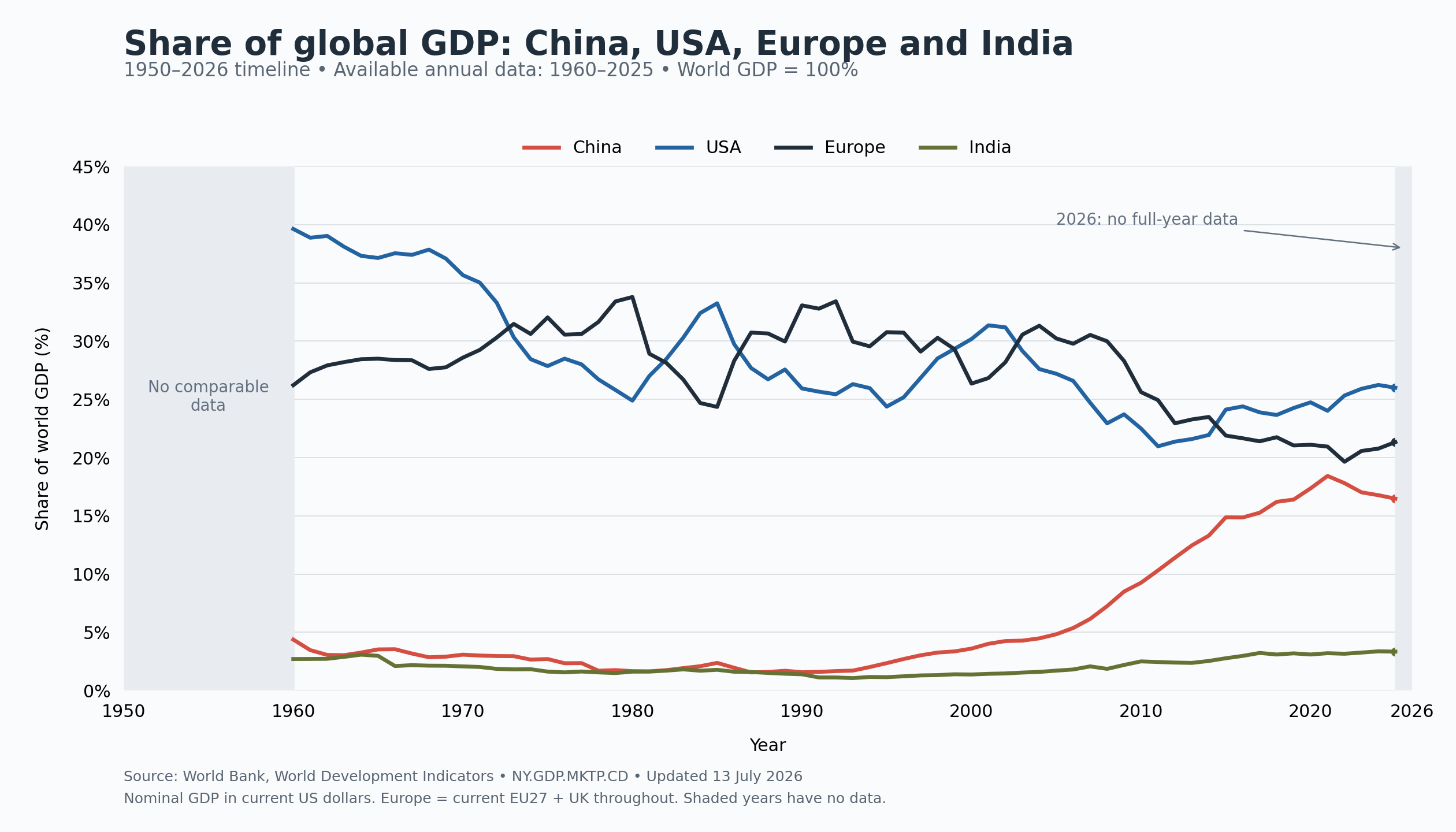
    World GDP = 100% each year. Europe = EU27 + UK. Available observations: 1960–2025.

    What the graphic tells us

    In 2000, the United States accounted for 30.18% of world GDP, Europe for 26.35%, China for 3.60% and India for 1.38%. By 2025, those shares were 26.00%, 21.33%, 16.47% and 3.34%, respectively. China’s expansion is the most pronounced change, while India’s share has more than doubled since 2000.

    Europe means today’s EU27 countries plus the UK throughout the series. The timeline runs from 1950 to 2026, but comparable observations cover 1960–2025 when the World Bank started collecting data. GDP is measured in US dollars, so exchange rates and prices affect the lines. A declining share does not necessarily mean an economy is shrinking: it can mean other economies are expanding faster than that economy.

    Nor is the direction irreversible. China’s share peaked at approximately 18.43% in 2021 before falling to 16.47% in 2025. The United States recovered considerably from its lower share in 2011. As entrepreneurs, we should therefore read the graph as evidence of changing economic weight, rather than a forecast of inevitable winners and losers.

    For people starting a business: choose a customer before a country

    A large economy is not automatically an accessible market. A founder needs a specific customer with a problem, a budget and a practical route to purchase. National GDP provides context; sector demand, competition and the cost of reaching customers determine whether a business can work.

    The Department for Business and Trade’s market-selection guidance makes this distinction explicit: demand must be considered alongside ease of entry and the firm’s own capabilities. For a new business, the useful question is therefore: where can we secure our first profitable, repeatable sales?

    Start with a narrow segment. A specialist software service might test one customer group in one market. A training provider could validate demand through one institutional partner. A manufacturer might trial a distributor before committing to facilities overseas. These are possible approaches, not opportunities established by the GDP figures.

    Before expanding, compare the full economics: acquisition costs, local pricing, delivery, support, payment collection and working capital. Set a small test budget and clear criteria for continuing. International ambition becomes valuable when it produces evidence of demand rather than additional complexity.

    Sweat Equity Club offers a relevant community approach for founders who need more than financial capital. By bringing together entrepreneurs and people willing to contribute skills, time and experience, it creates opportunities for peer learning and practical collaboration. For a new venture, this can help turn a broad ambition into a clearer proposition, a prototype or a focused market test. Contributions and any equity participation should be agreed explicitly.

    For established entrepreneurs: examine exposure as well as opportunity

    The graph also invites existing owners to review where their businesses depend on the world economy. Customers may be domestic while suppliers, technology platforms or competitors are international. Geographic exposure therefore extends beyond export revenue.

    Map revenue, supplier dependence and margins by market. Ask what would happen if an important supplier became unavailable, a currency moved sharply or a major customer delayed payment. These scenarios help turn a broad economic trend into decisions about pricing, cash reserves and alternative supply arrangements.

    Diversification should have a commercial purpose. Entering several countries can reduce some concentrations while introducing others, including dependence on a single overseas distributor. Expansion is stronger when the business can support customers reliably and demonstrate acceptable margins after all additional costs.

    Europe and the United States remain substantial economies, while China and India warrant attention within a wider market review. The graph does not establish which location is best for a particular firm. A profitable domestic niche may offer better returns than an expensive attempt to capture a tiny share of a much larger foreign market.

    Water & Shark is relevant when growth crosses borders and commercial decisions become questions of business structure, tax and legal obligations. Its international tax, business setup and advisory services provide a route to examining those issues before committing to expansion. The entrepreneurial implication is straightforward: assess the operating structure alongside the market opportunity, rather than treating it as an administrative task after sales begin.

    Centre of Defence Readiness brings a complementary perspective: can the business continue delivering when conditions deteriorate? The relevant lens is organisational resilience and defence readiness: understanding essential functions, supply-chain dependencies and preparedness for disruption. For entrepreneurs, the practical questions concern essential functions, critical dependencies and rehearsed responses. These considerations can strengthen continuity planning and the evidence available to customers, partners and prospective buyers.

    For owners selling a business: make the opportunity transferable

    For a seller, global economic change matters when it connects to a credible buyer rationale. An acquirer might value customer relationships, specialist capabilities, intellectual property or an established route into a market. These are potential strategic benefits to investigate, rather than valuation premiums demonstrated by the graph.

    A business is easier to assess when its growth story is supported by records. The British Business Bank highlights profits, cash flow, a broad customer base and visibility over future contracts, while identifying dependence on the owner or one customer as potential obstacles to an exit.

    Build the sale narrative around demonstrated performance. Show revenue and margins by geography, customer retention, the strength of the management team and the evidence behind projections. Distinguish signed contracts and completed pilots from speculative market potential.

    International exposure can create both value and risk. A buyer may welcome established overseas demand but question concentrated revenue, distributor dependence or volatile margins. Clean records and a business that operates without the founder help make those issues assessable.

    Birmingham Business Broker connects this preparation with the practical work of exit readiness, valuation, buyer search and business transfer. For an owner considering a sale, its relevance is in making the business easier to assess and presenting a credible proposition to appropriate buyers. A compelling international growth story should support, rather than substitute for, evidence of earnings, management capability and a workable handover.

    The practical entrepreneurial lesson

    Use the graphic to challenge assumptions about where opportunity lies. Then move from economic scale to customer evidence, and from customer evidence to a viable business model.

    For founders, the priority is proving demand. For growing businesses, it is profitable expansion with manageable exposure. For sellers, it is demonstrating earnings and capabilities that a buyer can take over. Global trends frame the opportunity; the quality of the business determines what can be captured.

    Depending on the stage of your journey, consider a conversation with Sweat Equity Club about collaborative founder support, Water & Shark about international structuring, Centre of Defence Readiness about resilience, or Birmingham Business Broker about preparing for exit. Each addresses a different practical challenge raised by a changing global economy.

    Sources and method

    GDP shares calculated from World Bank indicator NY.GDP.MKTP.CD, download updated 13 July 2026. Entrepreneurial implications are the author’s analysis.


  • Beyond the Bake Sale: Reimagining University-Industry Partnerships for Genuine Impact

    Title: Reimagining the University-Industry Partnership: A New Model for Impact

    There’s a certain quaintness to the traditional image of university-industry partnerships. Think career fairs, bake sales to fund student projects, perhaps a guest lecture from an industry leader. These are valuable initiatives, certainly, but they often feel like peripheral activities – a polite nod towards the ‘real world’ rather than a fundamental shift in how universities operate.

    I’m not dismissing these efforts, mind you. I’ve participated in them myself, organizing career workshops and facilitating industry mentorship programmes. But after years of observing these interactions from both sides – as an academic deeply invested in research and a consultant advising businesses – I’m convinced that we need to fundamentally reimagine the university-industry partnership. We need a model that moves beyond simple transactional exchanges and embraces genuine collaboration, one that prioritizes shared value creation over short-term gains.

    I’m not suggesting a radical overhaul, but rather a subtle recalibration – a shift in mindset that recognizes the inherent strengths of both institutions and leverages them to address complex societal challenges. It’s a vision born from witnessing firsthand the frustrating disconnect between academic research and real-world application, and fueled by a deep conviction that universities have a crucial role to play in driving innovation, productivity and economic growth.

    The Current Landscape: A History of Missed Opportunities

    Let’s be honest, the current landscape is often characterized by a degree of mutual skepticism. Universities are perceived as ivory towers, disconnected from the practical needs of businesses. Businesses, in turn, view universities as slow-moving bureaucracies, resistant to change and unwilling to commercialize their research.

    This isn’t entirely unwarranted. The traditional model often prioritizes academic publications over practical impact, incentivizing researchers to publish in high-impact (don’t get me started on those) journals rather than seeking solutions to today’s real-world problems. The intellectual property landscape can be a minefield, with complex licensing agreements and conflicting interests hindering commercialization efforts. And let’s not forget the inherent cultural differences – the academic emphasis on rigorous peer review clashes with the business imperative for rapid iteration and market validation.

    I recall one particularly frustrating experience advising a medtech startup that was struggling to secure funding for a promising new intervention. The university’s technology transfer office, while well-intentioned, was bogged down in lengthy negotiations with potential investors, delaying the project and ultimately jeopardizing its future. It was a stark reminder that good intentions alone aren’t enough; we need streamlined processes, clear incentives, and a shared commitment to driving impact.

    A New Model: Shared Value Creation at the Core, Grounded in Experiential Learning

    My vision for a reimagined university-industry partnership centres on the concept of shared value creation (The central premise of enterprise creation). It’s about moving beyond transactional exchanges and fostering deep, collaborative relationships that benefit both institutions and society as a whole. Crucially, this requires embedding experiential learning at the heart of our approach. Tools like SimVenture, for instance, offer unparalleled opportunities for students to grapple with real-world business challenges in a safe and engaging environment. Imagine undergraduate teams developing strategic plans for simulated companies, making investment decisions, navigating market fluctuations – all while receiving mentorship from industry professionals. This isn’s just theoretical learning; it’s applied knowledge, forged in the crucible of simulated experience.

    Key Pillars of a Collaborative Future:

    Here are some concrete steps we can take to build this collaborative future:

    1. Embedded Industry Fellows: Imagine a programme where experienced industry professionals are embedded at the same level, within university departments, working alongside faculty and students on real-world projects. These fellows would bring valuable insights into market needs, provide mentorship to aspiring entrepreneurs, and help bridge the gap between academic research and commercial application.
    2. Challenge-Driven Research: Instead of pursuing research topics in isolation, universities should actively solicit challenges from businesses and policymakers. This would ensure that our research is aligned with real-world needs, increasing its relevance and impact.
    3. Flexible Intellectual Property Frameworks: We need to move away from rigid, one-size-fits-all intellectual property frameworks and embrace more flexible models that encourage collaboration and innovation.
    4. Cross-Disciplinary Innovation Hubs: Universities should establish cross-disciplinary innovation hubs that bring together faculty, students, and industry partners from diverse fields to tackle complex challenges.
    5. Data-Driven Impact Assessment: We need to develop robust data-driven impact assessment frameworks that measure the real-world benefits of our research.
    6. Robust Subcontractual Oversight: Recognizing that complex projects often involve subcontracting, universities must implement rigorous oversight mechanisms. As detailed in my work on this topic, clear contractual provisions, independent audits, and transparent reporting are essential to ensure accountability, mitigate risks, and safeguard the integrity of collaborative ventures. This includes establishing clear lines of responsibility for performance, quality control, and ethical conduct across all tiers of the project.

    The Role of Policy: Incentivizing Collaboration

    Government policy also has a crucial role to play in incentivizing collaboration between universities and businesses. This could involve providing tax breaks for companies that invest in university research, creating grant programmes that specifically target collaborative projects, and streamlining regulatory processes to facilitate commercialization.

    I remember advocating for a policy change in my own state that provided tax credits to companies that partnered with universities on research projects. The impact was immediate – we saw a surge in collaborative initiatives, leading to the creation of new businesses and high-paying jobs.

    Embracing Imperfection: A Journey, Not a Destination

    This isn’t about creating a utopian vision of perfect collaboration. It’s about acknowledging that the journey will be fraught with challenges, setbacks, and disagreements. There will be times when we stumble, make mistakes, and question our assumptions. But it’s through these experiences that we learn, adapt, and ultimately build a more effective partnership.

    As I reflect on my own experiences, I’m filled with a sense of optimism and hope. I believe that universities have a vital role to play in driving innovation, creating jobs, and addressing some of the world’s most pressing challenges. And I believe that by reimagining our partnerships with businesses, incorporating experiential learning tools like SimVentures and implementing robust subcontractual oversight, we can unlock a new era of shared value creation and lasting impact.

  • Bridging Academia and Consulting: My Journey in Entrepreneurial Impact

    Bridging Academia and Consulting: My Journey in Entrepreneurial Impact

    Introduction: The Dual Lens of Academia and Consulting

    As I sit at my desk in Worcester, England, surrounded by decades-old books on entrepreneurship and a whiteboard filled with frameworks for scaling startups, I can’t help but reflect on how my career has unfolded. Over the past 25 years, I’ve oscillated between academia and consulting—roles that at first glance might seem incompatible but, in reality, are deeply intertwined. My work spans university leadership, board governance, and advising governments on entrepreneurial ecosystems, all while publishing research that informs both sectors.

    This post is a candid exploration of my journey: how I built credibility as an academic while cultivating expertise as a consultant, and the lessons I’ve learned along the way. It’s also a guide to those navigating similar paths, blending scholarly rigor with the actionable insights that consultants thrive on.


    The Academic Foundation: Teaching, Research, and “Failing Forward”

    My academic roots began in engineering, a discipline that taught me to value precision and systems thinking—a mindset I’ve carried into entrepreneurship. In 2015, as Senior Lecturer and Course Leader for Entrepreneurship at the University of Worcester, I designed a BA in Entrepreneurship that combined theory with practice. (A paper reviewing this course is here) Students weren’t just learning about business models; they were building them, often in collaboration with local businesses.

    One pivotal moment came when I tried to integrate rural entrepreneurship into the curriculum at the Royal Agricultural University (RAU). I envisioned a programme where students could apply innovation to agricultural challenges, like sustainable food systems. But early attempts faltered—the disconnect between theoretical concepts and the practical needs of rural communities left me frustrated. I realized success required more than just syllabus design; it demanded partnerships with entreprenurial ecosystem: farmers, policymakers, and local startups.

    Tip #1: Build bridges between academia and industry early. My learning at the RAU led to a revised approach: co-creating curricula with stakeholders.


    The Consultant’s Edge: From Theory to Tangible Impact

    Consulting forced me to abandon the comfort of academic abstraction. When I became Director of Employability and Entrepreneurship at GBS in 2022, I faced a stark reality: over 15,000 students—many from disadvantaged backgrounds—needed support moving beyond academia into meaningful careers.

    The challenge was twofold: scaling services without diluting quality and addressing systemic barriers like poor English proficiency. My solution? A “staged competency approach,” rooted in my research, which tailored support to students’ readiness. We embedded employability into classroom curricula, paired struggling learners with language tutors, and built employer networks. The numbers? 2,639 new roles secured by students in one year—proof that frameworks matter when paired with execution.

    Tip #2: Turn research into action. My 9 Stages of Entrepreneurial Lifecycle model wasn’t born in a vacuum; it emerged from years watching startups succeed or fail. When consulting, use your research as a lens—but adapt it to the client’s reality.


    The Tension of Dual Roles: When Worlds Collide

    Balancing academia and consulting isn’t without friction. At Albion Business School, where I serve as a Board Trustee, I championed globalizing entrepreneurship education. Yet negotiating institutional bureaucracy to adopt innovative programmes tested my patience. Similarly, advising startups in mobile gaming (via dojit, a past venture) taught me that the academic rigor of “agile methodologies” must flex to suit corporate timelines.

    Emotional Insight: There were nights when I questioned whether my dual path was sustainable. My breakthrough? Embracing the dichotomy: academia lets me explore why entrepreneurship works; consulting forces me to answer how.


    Emerging Frontiers: Opportunities in EdTech, Policy, and Rural Innovation

    The future of entrepreneurial education is digital. While my work on open educational resources with Beijing Foreign Studies University showed promise, I’ve realized scalability requires more than just free content. Hybrid formats—like virtual incubators for African startups—could democratize access, especially in regions where universities are underfunded.

    As a Fellow of The Centre for Entrepreneurs, I’ve advised governments on startup programmes and rural innovation hubs. My takeaway? Policy should incentivize ecosystems, not just businesses—for example, tax breaks for universities collaborating with local SMEs.

    Tip #3: Advocate for systems change, not just individual success. My recent work in South Sudan reflects this philosophy: educating women isn’t about creating lone entrepreneurs but fostering an ecosystem where they can thrive.


    Practical Takeaways for Aspiring Academic/Consultants

    1. Leverage interdisciplinary expertise: My engineering background informs tech ventures, while my research on rural entrepreneurship shapes policy. Never dismiss a skill as irrelevant.
    2. Embrace “messy” collaboration: My EdTech projects with China and India succeeded because we allowed cultural nuances to shape outcomes—not the other way around.
    3. Measure what matters: When I assessed the impact of student startups, I shifted focus from mere business counts to metrics like job creation and community investment.

    Conclusion: The Power of Dual Vision

    Bridging academia and consulting isn’t just a career choice—it’s a lens. By wearing both hats, I’ve crafted frameworks that endure (my 9 Stages) and programmes that scale (at GBS). For newcomers, I urge you to resist silos: publish research and pitch it to boards; teach courses that align with industry trends.

    As I look toward the next chapter, I’m focused on expanding free education models in Africa and refining my digital toolkits. Will it be easy? No. But then again, neither was convincing a roomful of farmers in Cirencester that gaming startups could revolutionize agriculture.


    Final Thought: Your expertise has value in both ivory towers and boardrooms—use it to build bridges, not barriers.

  • Student Led Incubators

    Student Led Incubators

    There is always a real need to get student involved in Enterprise and Entrepreneurship within the university. They have a real need for enterprise skills and developing it into an Entrepreneurial career or a full blown Entrepreneur.

    So on a recent visit to the the Tianjin Urban Construction Management Vocational Technology College, we had the opportunity to visit their incubator.

    This college is looking at developing Energy Entrepreneurship, developing new businesses which address saving energy or using it in a more effective way, especially within China.

    IMG_7685

    So the real surprise was the cafe within the business incubator was run by Students for Students and business owners. We had the chance to meet the three owners of the business and provide some advice and support. The development of this student led cafe provides a real insight into both the management of the college and also the students within it.

    The management have placed trust in the students to start, run and make a success of the cafe. This has resulted in:

    1, Trusting students is such an important part of Entrepreneurship and we sometime forget to place this on students.

    2, The students have taken a opportunity to run the cafe, something which every student on campus will have an opinion about. I know many students wouldn’t do this as their peers would look down on them or have something to say. The risks and rewards associated with this is a great lesson, but the greatest one is that these students have the largest network on campus.

    3, Having a go, should always provide winners, as experience of entrepreneurship will ensure students leave with more skills that we educators could ever teach them.

    IMG_7688

    The cafe was the centre of the business incubator and so made it student led, the cafe was the heart of the space, just as it should be.

    So when we arrange, we were saw a great space being used by other students and it was the centre of campus live. So good luck.