The modern university faces a credibility problem. Not because knowledge has lost value—but because the translation of that knowledge into real-world capability is increasingly uncertain. Across the UK and globally, graduate outcomes are under scrutiny. Employment rates fluctuate, underemployment persists, and employers continue to report skills gaps despite rising qualification levels.
The issue is not that graduates lack intelligence or effort. It is that the system they emerge from is misaligned with how capability is actually developed, demonstrated, and deployed in the real world.
This blog argues for a fundamental shift: from measuring what students know to understanding what they can do. From classroom achievement to capability formation.
The Illusion of Outcomes
Graduate outcomes are typically measured through metrics such as employment rates, salary levels, and progression into further study. In the UK, frameworks linked to the Office for Students (OfS), particularly B3 conditions, reinforce these indicators as proxies for institutional performance.
But these metrics mask deeper structural problems.
A graduate employed six months after finishing their degree may appear as a success in data terms. Yet this tells us little about:
- The relevance of their role to their studies
- Their long-term career trajectory
- Their capacity to adapt, innovate, or lead
- Their ability to create value—either for themselves or others
The result is a system optimised for short-term outputs, not long-term capability.
This is the graduate employability illusion: a belief that employment equals preparedness.
What Employers Actually Value
Employer surveys consistently highlight a mismatch between graduate skills and workplace expectations. While technical knowledge remains important, employers increasingly prioritise:
- Problem-solving in ambiguous environments
- Communication across disciplines and cultures
- Initiative and self-direction
- Commercial awareness
- Adaptability and resilience
These are not easily taught through lectures or assessed through exams. They are developed through experience, reflection, and application.
In other words, capability is not a product of curriculum delivery alone. It is the result of a developmental process that integrates knowledge, action, and context.
Capability vs Competence
To rethink graduate outcomes, we must first distinguish between competence and capability.
Competence refers to the ability to perform specific tasks to a defined standard. It is often narrow, measurable, and context-dependent.
Capability, by contrast, is broader and more dynamic. It includes:
- The ability to apply knowledge in unfamiliar situations
- The capacity to learn, unlearn, and relearn
- The confidence to act under uncertainty
- The judgement to make decisions with incomplete information
Universities have become highly effective at delivering competence. But the future economy demands capability.
This distinction matters because competence can be assessed at a single point in time. Capability must be observed over time, across contexts.
The Structural Problem: Education Without Application
The dominant model of higher education remains rooted in knowledge transmission. Despite decades of reform, many programmes still follow a familiar pattern:
- Content delivery (lectures, readings)
- Knowledge testing (exams, essays)
- Qualification awarding (degree classification)
What is often missing is systematic application.
Students may complete a degree having:
- Never worked on a real-world problem
- Never engaged with an external stakeholder
- Never experienced failure in a safe but meaningful environment
- Never reflected deeply on their own development
This is not a criticism of individual academics. It is a structural issue embedded in how programmes are designed, validated, and funded.
From Curriculum to Capability Systems
If we are serious about improving graduate outcomes, we need to move beyond curriculum design and towards capability systems.
A capability system integrates five core elements:
1. Knowledge Foundations
Disciplinary knowledge remains essential. But it must be framed not as an endpoint, but as a tool.
The question is not “What should students know?” but “What should they be able to do with what they know?”
2. Applied Experience
Capability develops through doing. This includes:
- Live projects with industry
- Simulations and experiential learning
- Internships and placements
- Entrepreneurial ventures
These experiences must be embedded, not optional.
Tools like SimVenture demonstrate how simulation-based learning can provide structured environments for decision-making under uncertainty—bridging the gap between theory and practice.
3. Reflective Practice
Experience alone is not enough. Without reflection, learning remains superficial.
Students need structured opportunities to:
- Analyse their decisions
- Understand their strengths and weaknesses
- Develop self-awareness
- Build a narrative of their capability
Reflection transforms activity into learning.
4. Capability Signalling
One of the biggest challenges graduates face is not capability itself, but the ability to demonstrate it.
Traditional CVs and degree classifications are blunt instruments. They do not capture:
- How a student solved a problem
- How they worked in a team
- How they responded to failure
Emerging approaches—such as digital credentials and portfolio-based assessment—offer more nuanced ways of signalling capability.
Platforms like AlmaBridge illustrate how verifiable, granular credentials can provide a richer picture of what graduates can actually do.
5. Transition Support
The final stage is the transition from education to employment—or entrepreneurship.
This is where many systems fail.
Careers services are often:
- Reactive rather than proactive
- Transactional rather than developmental
- Focused on job search rather than capability building
A capability-based model requires a reimagined transition system—one that supports:
- Career exploration
- Skill articulation
- Network building
- Opportunity creation
The Role of Entrepreneurship
Entrepreneurship provides a powerful lens through which to rethink graduate outcomes.
Not because every student should start a business—but because entrepreneurial thinking develops core capabilities:
- Opportunity recognition
- Resourcefulness
- Value creation
- Risk management
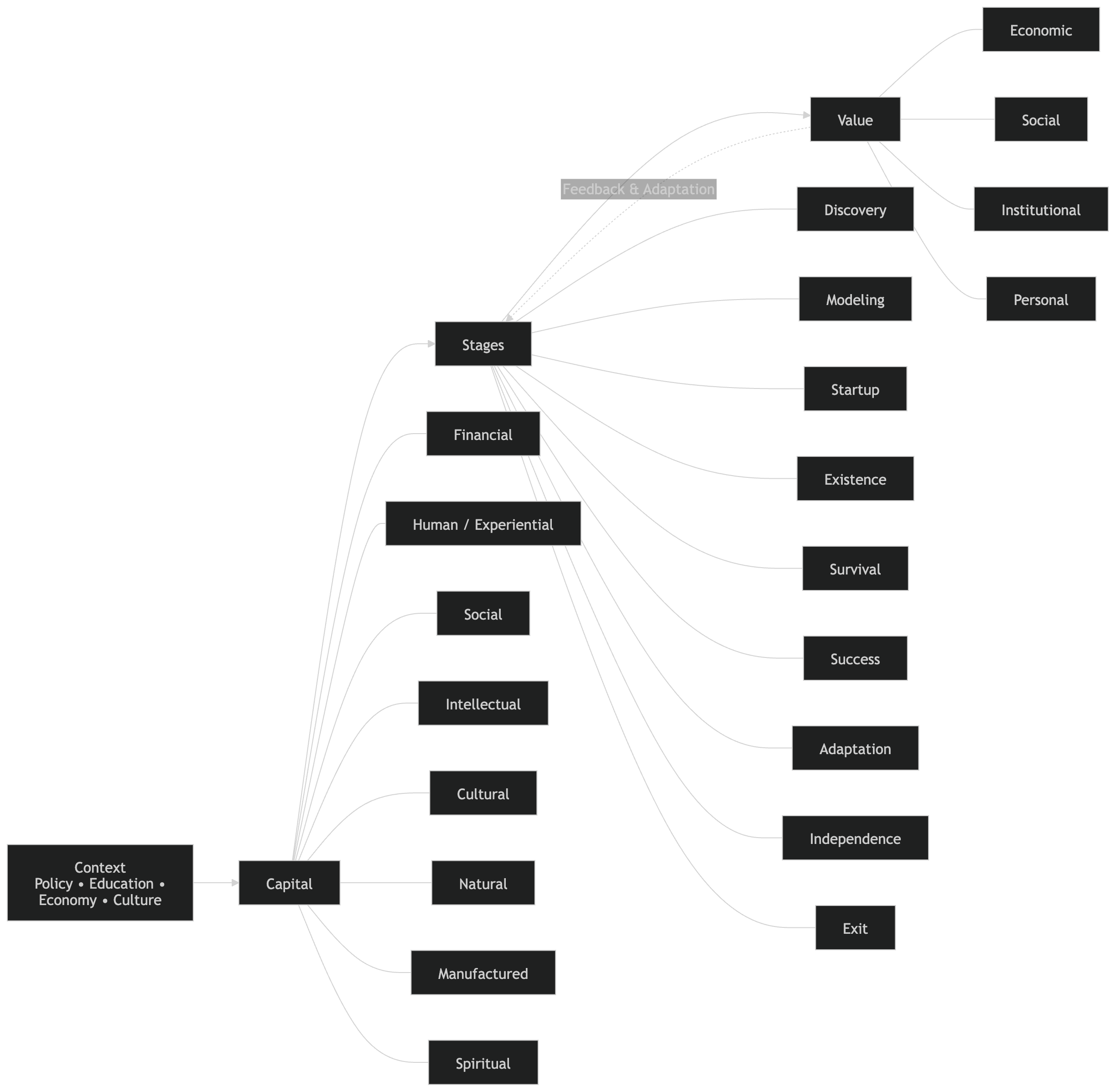
Your own 9 Stages of Entrepreneurial Lifecycle model offers a useful framework here. From discovery through to exit, each stage requires different capabilities—and exposes students to different forms of learning.
Embedding entrepreneurial thinking across disciplines can shift education from passive consumption to active creation.
Measurement: What Should We Actually Track?
If we move towards capability, our metrics must evolve.
Instead of focusing solely on employment outcomes, institutions should track:
1. Capability Development
- Evidence of applied learning
- Progression in key capabilities (e.g. problem-solving, communication)
- Student self-efficacy
2. Engagement with Practice
- Participation in live projects
- Industry interaction
- Experiential learning hours
3. Value Creation
- Contributions to organisations or communities
- Entrepreneurial activity
- Innovation outputs
4. Longitudinal Outcomes
- Career progression over 3–5 years
- Role complexity and responsibility
- Income growth relative to sector
5. Adaptability
- Career changes
- Upskilling and reskilling activity
- Ability to navigate transitions
This requires better data systems, but more importantly, a shift in mindset.
The Institutional Challenge
Rethinking graduate outcomes is not a minor adjustment. It requires systemic change.
1. Academic Culture
Academics must be supported to integrate application and reflection into their teaching—not as an add-on, but as core practice.
2. Programme Design
Courses need to be structured around capability development pathways, not just content coverage.
3. Partnerships
Stronger relationships with industry, public sector organisations, and communities are essential to provide real-world contexts.
4. Technology Infrastructure
Platforms that track, verify, and showcase capability must be integrated into the student journey.
5. Policy Alignment
Regulators and funding bodies must move beyond narrow outcome metrics and support more holistic approaches.
A Practical Model: The Capability Loop
To make this operational, consider a simple but powerful model: the Capability Loop.
- Learn – Acquire knowledge and frameworks
- Apply – Use them in real or simulated contexts
- Reflect – Analyse performance and learning
- Signal – Capture and communicate capability
- Transition – Deploy capability in the real world
This loop repeats throughout the student journey.
The key is not any single element, but the integration of all five.
Why This Matters Now
Several forces are converging to make this shift urgent:
1. Labour Market Volatility
Careers are no longer linear. Graduates must be prepared for multiple transitions.
2. Technological Change
Automation and AI are reshaping roles. Knowledge alone is insufficient; adaptability is critical.
3. Rising Student Expectations
Students increasingly question the return on investment of higher education. They want outcomes that are tangible and meaningful.
4. Policy Pressure
Frameworks like those from the Office for Students are intensifying scrutiny on outcomes, creating both risk and opportunity for institutions.
From System Efficiency to Human Capability
At its core, this is a philosophical shift.
Higher education has, in many ways, become a system optimised for efficiency:
- Standardised curricula
- Scalable delivery
- Measurable outputs
But capability is not easily standardised. It is:
- Contextual
- Developmental
- Individual
If universities are to remain relevant, they must rebalance—maintaining rigour while embracing complexity.
Conclusion: A New Contract with Students
Rethinking graduate outcomes is not just about metrics or pedagogy. It is about redefining the implicit contract between universities and students.
The old contract was:
“We will provide knowledge, and you will translate it into success.”
The new contract must be:
“We will help you develop the capability to create value—in any context you choose.”
This is a more demanding promise. It requires deeper engagement, more complex systems, and greater accountability.
But it is also a more honest one.
Because in the end, what matters is not what students know when they leave the classroom.
It is what they can do when they enter the world.