Tag: business growth

  • Entrepreneurship Is Not Start-Up: A New Framework for Value Creation, Education, and Economic Growth

    Entrepreneurship Is Not Start-Up: A New Framework for Value Creation, Education, and Economic Growth

    Entrepreneurship has been reduced to a narrow and ultimately unhelpful idea: starting a business.

    Across universities, policy frameworks, and media narratives, entrepreneurship is framed through start-up activity—pitch decks, venture capital, and the pursuit of rapid scale. This interpretation is not simply incomplete; it is distorting how we educate students, design economic policy, and evaluate success.

    The consequence is a system that rewards activity over impact, formation over function, and visibility over value.

    If we are serious about improving productivity, employability, and long-term economic resilience, we need to move beyond the start-up myth and return to a more fundamental question:

    What is entrepreneurship actually for?


    The Problem: We Are Measuring the Wrong Thing

    Entrepreneurship policy and education are dominated by simplistic metrics:

    • Number of start-ups created
    • Amount of funding raised
    • Survival rates over three to five years

    These measures are easy to quantify, but they are poor proxies for what really matters: value creation.

    A business can be launched, funded, and sustained without creating meaningful economic or social value. Equally, significant value can be created within existing organisations, communities, or informal economies without ever appearing in start-up statistics.

    This misalignment has three critical consequences.

    First, it leads to policy inefficiency. Governments invest heavily in start-up ecosystems without understanding whether those ventures contribute to productivity, innovation, or regional development.

    Second, it creates educational distortion. Universities design entrepreneurship programmes around venture creation rather than capability development, leaving graduates underprepared for complex, non-linear careers.

    Third, it results in entrepreneurial failure. Founders are encouraged to pursue ideas without understanding the resources, processes, and conditions required to create sustainable value.

    In short, we are optimising for the wrong outcome.


    Reframing Entrepreneurship: From Activity to Value

    To correct this, entrepreneurship must be redefined.

    Entrepreneurship is not the act of starting a business. It is:

    The process of creating, capturing, and sustaining value through the effective orchestration of resources over time.

    This definition shifts the focus in three important ways.

    First, it places value at the centre, not activity. The purpose of entrepreneurship is not formation but transformation.

    Second, it emphasises process, recognising that entrepreneurship unfolds over time rather than occurring at a single moment of creation.

    Third, it highlights resource orchestration, acknowledging that entrepreneurs do not simply use resources—they combine, adapt, and transform them.

    This reframing aligns more closely with established economic theory. Joseph Schumpeter, for example, positioned the entrepreneur as an agent of “creative destruction,” reshaping markets through innovation rather than merely creating firms (Schumpeter, 1934). Similarly, Peter Drucker emphasised entrepreneurship as a systematic practice of innovation and value creation (Drucker, 1985).

    Yet despite this intellectual foundation, contemporary systems have drifted toward a far narrower interpretation.


    The Missing Mechanism: Understanding Entrepreneurial Capital

    If entrepreneurship is about value creation, the next question is straightforward:

    How is value actually created?

    The answer lies in capital—not just financial capital, but a broader set of resources that entrepreneurs draw upon and combine.

    The Eight Capitals Model provides a more complete view:

    • Financial Capital (money and funding)
    • Human/Experiential Capital (skills, knowledge, experience)
    • Social Capital (networks and relationships)
    • Intellectual Capital (ideas, IP, systems)
    • Cultural Capital (norms, behaviours, identity)
    • Natural Capital (environmental and physical resources)
    • Manufactured Capital (infrastructure, tools, technology)
    • Spiritual Capital (purpose, values, motivation)

    Traditional approaches overemphasise financial capital, yet evidence consistently shows that access to networks, knowledge, and institutional support often matters more in determining entrepreneurial outcomes (Acs et al., 2014).

    Entrepreneurs do not simply deploy these capitals independently. They orchestrate them—combining different forms of capital to create new forms of value.

    A founder launching a digital platform, for example, may rely heavily on intellectual and social capital in early stages, while scaling requires increasing levels of financial and manufactured capital.

    Understanding this dynamic is critical. Without it, both education and policy remain fundamentally incomplete.


    The Process Layer: The 9 Stages of Enterprise Development

    While capital explains what resources are used, it does not explain how entrepreneurship unfolds.

    Entrepreneurship is not a single act but a staged process. The 9 Stages of Enterprise Development provide a structured way to understand this progression:

    1. Discovery
    2. Modeling
    3. Startup
    4. Existence
    5. Survival
    6. Success
    7. Adaptation
    8. Independence
    9. Exit

    Each stage represents a different configuration of challenges, decisions, and resource requirements.

    Crucially, value is created differently at each stage.

    • In Discovery, value lies in identifying opportunities
    • In Startup, it lies in mobilising resources
    • In Survival, it lies in achieving cash flow stability
    • In Adaptation, it lies in responding to environmental change

    This staged perspective aligns with broader economic development theories, such as Walt Rostow’s model of economic growth, which highlights the importance of sequential development phases (Rostow, 1960). However, unlike linear economic models, entrepreneurship is iterative and adaptive.

    The key insight is this:

    Entrepreneurship is the dynamic interaction between capital and stages, producing value over time.


    An Integrated Framework for Entrepreneurship

    To move beyond fragmented thinking, these elements must be brought together into a single model.

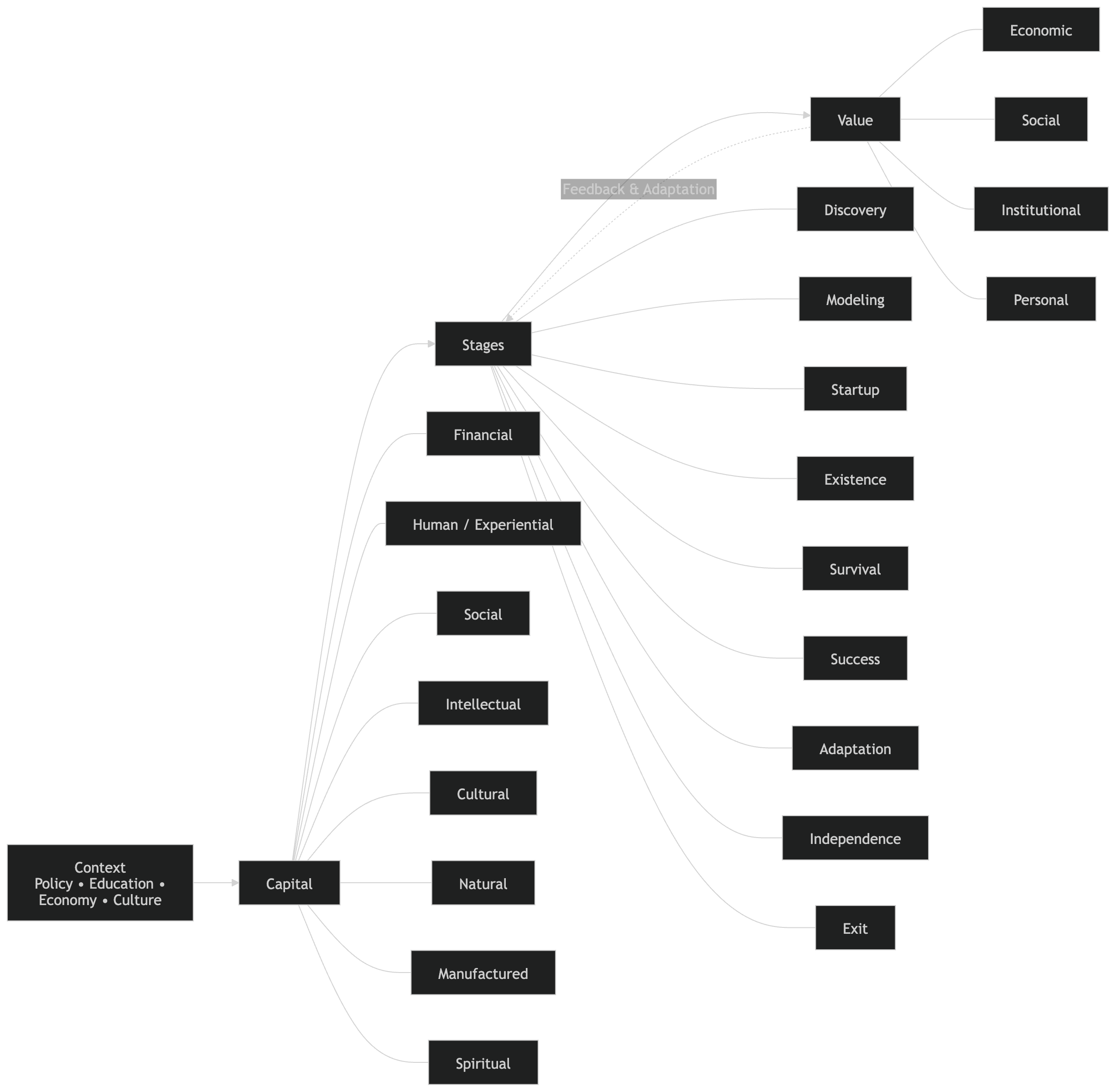
    Integrated Entrepreneurship Framework

    This framework is deliberately simple but conceptually powerful.

    • Capital represents the resources available
    • Stages represent the process through which entrepreneurship unfolds
    • Value represents the outcome
    • Context shapes and constrains the system

    Most existing approaches focus on only one of these elements. Effective entrepreneurship requires understanding all four—and, critically, how they interact.


    Implications for Universities: From Knowledge to Capability

    This framework exposes a fundamental weakness in higher education.

    Universities largely focus on knowledge transfer, while entrepreneurship requires capability development.

    Students are taught:

    • Business planning
    • Marketing theory
    • Financial modelling

    But they are rarely taught:

    • How to mobilise different forms of capital
    • How to navigate different stages of development
    • How to create and measure value in real contexts

    As a result, graduates leave with theoretical understanding but limited practical capability.

    To address this, universities must:

    1. Embed capital awareness into curricula
      Students should understand the different forms of capital and how to access them.
    2. Align learning with stages
      Programmes should simulate the progression from discovery to growth, not just start-up.
    3. Measure value creation capability
      Assessment should focus on outcomes, not outputs.

    This is not a marginal adjustment. It is a structural shift in how education is designed.


    Implications for Policy: From Start-Ups to Systems

    The same issue applies at the policy level.

    Entrepreneurship policy has become overly focused on:

    • Start-up grants
    • Incubators and accelerators
    • Venture capital ecosystems

    While these have value, they represent only a small part of the system.

    A more effective approach would focus on capital ecosystems:

    • Strengthening networks (social capital)
    • Investing in skills and education (human capital)
    • Supporting infrastructure (manufactured capital)
    • Enabling knowledge transfer (intellectual capital)

    This is particularly important in regional and rural contexts, where traditional start-up models often fail to translate.

    You cannot build entrepreneurial economies by funding businesses alone. You must build the systems that enable value creation.


    Implications for Entrepreneurs: Better Decisions, Better Outcomes

    For practitioners, this framework provides a more realistic lens.

    Instead of asking:

    • “Is this a good idea?”

    Entrepreneurs should ask:

    • “What value am I creating?”
    • “What capital do I need—and what am I missing?”
    • “What stage am I in—and what does that require?”

    This shift leads to better decision-making.

    It reduces overconfidence in early stages, improves resource allocation, and increases the likelihood of sustainable growth.


    Conclusion: A Necessary Shift

    Entrepreneurship matters—not because it creates businesses, but because it creates value.

    If we continue to define entrepreneurship as start-up activity, we will continue to miseducate students, misallocate resources, and misunderstand economic growth.

    The alternative is clear.

    We must move toward a model that recognises:

    • The role of capital
    • The importance of process
    • The centrality of value
    • The influence of context

    This is not simply an academic exercise. It is a practical necessity.

    The future of entrepreneurship lies not in more businesses—but in better value creation.


    References (APA Style)

    Acs, Z. J., Autio, E., & Szerb, L. (2014). National systems of entrepreneurship: Measurement issues and policy implications. Research Policy, 43(3), 476–494.

    Drucker, P. F. (1985). Innovation and entrepreneurship: Practice and principles. Harper & Row.

    Schumpeter, J. A. (1934). The theory of economic development. Harvard University Press.

    Rostow, W. W. (1960). The stages of economic growth: A non-communist manifesto. Cambridge University Press.

    Neck, H. M., Greene, P. G., & Brush, C. G. (2014). Teaching entrepreneurship: A practice-based approach. Edward Elgar.

    World Bank. (2020). Doing business 2020: Comparing business regulation in 190 economies. World Bank Publications.

    OECD. (2021). Entrepreneurship at a glance 2021. OECD Publishing.

  • Why Most Entrepreneurship Policy Fails Rural Economies

    Why Most Entrepreneurship Policy Fails Rural Economies

    Rural economies are often positioned as fertile ground for entrepreneurship. They are rich in natural resources, community cohesion, and untapped opportunity. Yet, despite decades of policy interventions—from grants and incubators to training programmes—entrepreneurial outcomes in rural regions frequently lag behind urban counterparts. Business creation rates are lower, survival rates are fragile, and scale remains elusive.

    The uncomfortable truth is this: most entrepreneurship policy fails rural economies not because of a lack of investment, but because of a misunderstanding of how rural entrepreneurship actually works.


    The Urban Bias Problem

    Much of modern entrepreneurship policy is designed with an implicit urban bias. Policymakers often assume that what works in cities—dense networks, access to finance, and rapid market validation—can simply be replicated in rural areas.

    This assumption is flawed.

    Urban ecosystems benefit from:

    • High population density
    • Access to venture capital
    • Proximity to universities and innovation hubs
    • Established infrastructure and supply chains

    Rural economies, by contrast, operate under entirely different conditions:

    • Sparse populations and dispersed markets
    • Limited access to finance and talent
    • Infrastructure gaps (digital, transport, logistics)
    • Strong reliance on local identity and informal networks

    When policy frameworks fail to recognise these structural differences, they impose solutions that are misaligned from the outset.


    Misunderstanding Opportunity in Rural Contexts

    Entrepreneurship policy often emphasises high-growth, innovation-led ventures, typically in sectors such as technology. While this is important, it overlooks the nature of opportunity in rural economies.

    Rural entrepreneurship is frequently:

    • Place-based – rooted in local resources (agriculture, tourism, crafts)
    • Incremental – focused on steady income rather than rapid scaling
    • Diversified – combining multiple income streams (e.g. farming + hospitality + digital services)

    Policies that prioritise “unicorns” over sustainable, diversified enterprises risk overlooking the real drivers of rural economic resilience.

    The result is a mismatch between:

    • What policymakers fund
    • What rural entrepreneurs actually need

    Fragmented Support Systems

    Another major failure lies in the fragmentation of support systems. Rural entrepreneurs often face a complex and disjointed landscape of agencies, funding streams, and advisory services.

    Typical challenges include:

    • Multiple organisations offering overlapping support
    • Lack of coordination between local, regional, and national bodies
    • Short-term funding cycles that disrupt continuity

    For entrepreneurs, this creates confusion and inefficiency. Instead of enabling progress, the system becomes a barrier to navigation.

    In urban environments, density compensates for fragmentation—networks fill the gaps. In rural areas, fragmentation is amplified by distance and isolation.


    Access to Capital: A Structural Barrier

    Access to finance remains one of the most persistent challenges in rural entrepreneurship.

    Traditional policy responses—grants, loans, and subsidies—often fail because they do not address underlying structural issues:

    • Lower perceived investment attractiveness
    • Higher transaction costs for lenders
    • Limited local financial ecosystems

    Moreover, many rural entrepreneurs do not seek venture capital. They require:

    • Patient capital
    • Microfinance
    • Community-based investment models

    Policies designed around conventional finance mechanisms fail to recognise these needs, leaving a critical gap between supply and demand.


    The Infrastructure Deficit

    Entrepreneurship does not occur in a vacuum. It depends on enabling infrastructure.

    In rural economies, this is often lacking:

    • Digital connectivity may be unreliable
    • Transport links are limited
    • Access to markets is constrained

    While governments frequently invest in entrepreneurship programmes, they underinvest in the foundational infrastructure required for those programmes to succeed.

    The consequence is predictable: businesses are created, but they struggle to grow.


    Human Capital and Skills Mismatch

    A further issue lies in the development of human capital. Entrepreneurship policies often focus on generic training programmes, assuming that skills are transferable across contexts.

    However, rural entrepreneurship requires a distinct skill set:

    • Resourcefulness and bricolage (making do with limited resources)
    • Multi-skilling across sectors
    • Deep understanding of local markets and communities

    Additionally, rural areas often experience:

    • Outmigration of young talent
    • Ageing populations
    • Limited access to higher education and training

    Without addressing these structural dynamics, skills programmes alone cannot deliver meaningful change.


    Ignoring Social and Cultural Capital

    One of the most overlooked dimensions of rural entrepreneurship is social and cultural capital.

    Rural communities are characterised by:

    • Strong social networks
    • High levels of trust
    • Deep-rooted cultural identities

    These are powerful assets. They shape:

    • Opportunity recognition
    • Resource mobilisation
    • Market access

    Yet, most entrepreneurship policies focus almost exclusively on financial and human capital, neglecting these relational and cultural dimensions.

    This represents a significant missed opportunity.


    The Scale Obsession

    Policy success is often measured through metrics such as:

    • Number of startups
    • Growth rates
    • Investment raised

    While these are important, they reinforce a narrow view of success.

    In rural economies, success may look different:

    • Sustaining local employment
    • Supporting community resilience
    • Enhancing quality of life

    By prioritising scale over sustainability, policymakers risk undervaluing the types of enterprises that are most relevant to rural contexts.


    Towards a New Model of Rural Entrepreneurship Policy

    If current approaches are failing, what should replace them?

    A more effective model of rural entrepreneurship policy should be built on the following principles:

    1. Contextualisation

    Policies must be tailored to the specific characteristics of rural economies. This requires:

    • Place-based strategies
    • Local stakeholder engagement
    • Flexibility in design and implementation

    2. Systems Thinking

    Entrepreneurship should be viewed as part of a broader system, including:

    • Infrastructure
    • Education
    • Finance
    • Community networks

    Interventions must be coordinated rather than fragmented.

    3. Multi-Capital Approach

    Drawing on emerging frameworks such as the Entrepreneurial Capital Model, policy should recognise multiple forms of capital:

    • Financial
    • Human
    • Social
    • Cultural
    • Natural

    Rural economies, in particular, are rich in non-financial capital that can be leveraged for development.

    4. Long-Term Investment

    Short-term programmes are insufficient. Rural entrepreneurship requires:

    • Sustained investment
    • Long-term capacity building
    • Institutional continuity

    5. Redefining Success

    Metrics must evolve to reflect:

    • Resilience
    • Inclusivity
    • Sustainability

    Rather than focusing solely on high-growth ventures, policy should support a diverse portfolio of enterprises.


    Conclusion

    Rural entrepreneurship holds enormous potential—not just for economic growth, but for addressing some of the most pressing challenges of our time, including inequality, sustainability, and community resilience.

    However, unlocking this potential requires a fundamental shift in how we design and implement policy.

    The failure of current approaches is not inevitable. It is the result of misaligned assumptions, fragmented systems, and narrow definitions of success.

    By embracing a more nuanced, context-sensitive, and system-oriented approach, policymakers can move beyond failure and begin to build rural economies that are not only entrepreneurial, but truly thriving.


    If you’re working in government, higher education, or regional development and want to rethink your approach to entrepreneurship policy, this is the moment to act. Rural economies do not need more of the same—they need something fundamentally better.

  • Unlocking Growth: The 9 Stages of the Entrepreneurial Lifecycle

    Unlocking Growth: The 9 Stages of the Entrepreneurial Lifecycle

    How a structured approach to entrepreneurship can drive national economic development


    Entrepreneurship is often romanticized as a chaotic, unpredictable journey—but the truth is, behind every successful business lies a lifecycle. Just as humans grow through distinct stages, so do entrepreneurial ventures.

    Over the past few years—through my work in academia, consultancy, and government advising—I’ve found that helping people understand where they are in the entrepreneurial journey can make the difference between failure and flourishing.

    That’s why I developed a practical framework called the 9 Stages of the Entrepreneurial Lifecycle. This model doesn’t just help entrepreneurs navigate their own paths—it also provides governments, educators, and economic developers with a blueprint for building an entrepreneurial nation.

    Let’s take a closer look.


    The 9 Stages of the Entrepreneurial Lifecycle

    Each stage reflects a different phase in a business’s evolution—from the first spark of an idea to a successful exit. Here’s how it breaks down:

    1. DiscoverySpotting the Opportunity

    This is where it all begins. Entrepreneurs identify problems, needs, or gaps in the market.
    🧠 Connected blogs:

    Why Every Entrepreneur Needs to Master the Art of Opportunity Recognition

    9 Stages of Enterprise Creation: Stage 1 – Discovery

    2. ModelingDesigning the Business Blueprint

    Once the opportunity is clear, the focus shifts to business models, customer segments, value propositions, and revenue streams.

    🧠 Connected blogs:

    9 Stages of Enterprise Creation: Stage 2 – Modeling

    The Business Plan – Deep Dive into Financial Planning

    Developing a business process diagram for your startup

    3. StartupFrom Idea to Action

    The venture becomes real—founders mobilize resources, form teams, build MVPs, and launch early versions of their product or service.

    🧠 Connected blogs:

    9 Stages of Enterprise Creation: Stage 3 – Startup

    Revolutionizing Startups: Harnessing AI for Efficiency and Growth Without Relying on Cheap Labour

    4. ExistenceValidating the Market Fit

    The business acquires early customers and proves the value proposition. It’s about proving the concept works in the real world.

    🧠 Connected blogs:

    9 Stages of Enterprise Creation: Stage 4 – Existence

    Its Sunday Afternoon, what should I do?

    5. SurvivalAchieving Sustainability

    This is where many ventures struggle. They need enough cash flow to cover costs, scale operations, and survive the lean times.

    🧠 Connected blogs:

    9 Stages of Enterprise Creation: Stage 5 – Survival

    The Importance of Mental Health for Entrepreneurs

    6. SuccessGrowing and Expanding

    Now it’s about taking off. Businesses in this stage often seek funding, expand their teams, enter new markets, or optimize their operations.

    🧠 Connected blogs:

    9 Stages of Enterprise Creation: Stage 6 – Success

    The Role of Mentorship in Entrepreneurial Success

    Understanding Locus of Control: A Key to Entrepreneurial Success

    7. AdaptationResponding to Change

    Markets shift. Competitors appear. New technologies disrupt. Adaptable businesses innovate and pivot to stay relevant.

    🧠 Connected blogs:

    9 Stages of Enterprise Creation: Stage 7 – Adaptation

    Building an Inclusive Culture from the Ground Up: A Guide for Leaders and Founders

    8. IndependenceOwning the Market

    These businesses are now robust, profitable, and self-sustaining. They often become leaders in their space.

    🧠 Connected blogs:

    9 Stages of Enterprise Creation: Stage 8 – Independence

    Remember your motive for starting a business

    9. ExitPassing the Torch

    Founders may sell the company, go public, or transition to a new leadership team. This frees capital and energy for the next idea.

    🧠 Connected blogs:

    9 Stages of Enterprise Creation: Stage 9 – Exit

    Do you know your Exit Strategy?


    Why This Model Matters for National Economic Development

    Too often, economic development policy focuses narrowly on startup support—but this ignores the reality that entrepreneurial needs evolve.

    By using the 9-stage model, governments and support organizations can:

    ✅ Design targeted interventions (e.g., ideation grants vs. scale-up finance)
    ✅ Measure success more accurately across each stage
    ✅ Create stage-specific training, mentoring, and funding tools
    ✅ Avoid one-size-fits-all policies that fail to meet real needs
    ✅ Support entrepreneurial ecosystems that are holistic, not fragmented

    Just imagine the power of national strategies that don’t just encourage people to start businesses—but help them grow, adapt, succeed, and exit effectively.


    Embedding the Lifecycle in Education and Practice

    At Albion Business School and through our entrepreneurship programmes, we’re embedding this lifecycle into student learning—from foundation year to graduate-level projects. We also encourage schools to introduce the concept at an earlier age.

    🧠 Connected blog: Building Entrepreneurial Mindsets in Teenagers: Lessons from Education and Practice

    When young people understand the journey of entrepreneurship, they stop expecting overnight success—and start building step by step.


    Final Thoughts: A Pathway to Prosperity

    We live in an age where economic transformation is urgently needed—whether due to climate challenges, digital disruption, or population shifts.

    Entrepreneurship, when supported well, has the power to revitalise economies, create meaningful jobs, and build national resilience.

    The 9 Stages of the Entrepreneurial Lifecycle provides more than just a roadmap for individuals—it offers a strategic tool for countries and communities to design better support, smarter policies, and more successful ventures.

    Let’s stop guessing what entrepreneurs need—and start guiding them with clarity and purpose.

  • 8 factors which control productivity

    8 factors which control productivity

    The productivity of a business is controlled by a number of factors and as entrepreneurs we need to understand these factors to ensure we have sustainable businesses. So what do we mean by productivity?

    Productivity is very simply defined as the ratio between output and input. Therefore increasing productivity means greater efficiency in producing output of goods and services from labour, capital, materials and any other necessary inputs.

    It’s more important metric than just measuring this ratio, as it provides a benchmark by which you can measure nations, regions, industries and and most importantly for us entrepreneurs, businesses. Businesses which have higher productivity are more sustainable and therefore employees have safer jobs, paying more taxes and enable stable economic structures surrounding these businesses.

    So when I review the literature on productivity I have found a number of factors which control productivity, we can put these down to eight controlling factors, In alphabetical order:

    1. Finance
    2. Industry & Market
    3. International Trade
    4. Management
    5. People
    6. Place
    7. Processes
    8. Technology

    Finance

    The financial capital structure of a business dictates the productivity of the business.  Managers are instructed to maximize shareholders benefits and if this requires short-term (annual) rewards then this may not beneficial for the longer term productivity aims. Hill, C. W., & Snell, S. A. (1989) found that businesses with one or more of the following; a diversification strategy, R&D expenditure, capital intensity and stock concentration were all important financial factors in a business productivity.  At a national level Guariglia, A., & Santos-Paulino, A. U. (2008) found that national GDP per capita and national investment generally exert a positive and significant effect on business productivity.

    Industry & Market

    The level of productivity is related to the industry as some industries are highly automated whilst others are still manual handmade.  It’s also dictated by the market, some customers require personalised service while others want fully online and automated. One example is holidays, some people want book online without ever talking to a person from that company whilst others require a home visit and discussion of every aspect of the holiday.

    The OECD provides a detailed list of productivity data sets whilst the UK provides this, and many other countries do the same.

    International Trade

    Trade increases productivity. Badinger, H., & Breuss, F. (2008) found an increase in the export ratio of a manufacturing business by one percentage point increases productivity by 0.6 percent on average. To be able to export your products or services a business should be of a comparable price and quality and therefore productivity. Export focused businesses have therefore higher productivity Guariglia, A., & Santos-Paulino, A. U. (2008).

    Management

    A number of these factors requires good management and leadership. However, a considerable amount of research has consistently found that use of effective human resource management practices enhances firm performance. Specifically, extensive recruitment, selection, and training procedures; formal information sharing, attitude assessment, job design, grievance procedures, and labour-management participation programs; and performance appraisal, promotion, and incentive compensation systems that recognize and reward employee merit have all been widely linked with valued firm-level outcomes. Huselid, M. A. (1995) and others have argued that the use of these practices will result in greater business performance, independent of the industry and business size.

    People

    Bakker (2014) demonstrated that to ensure a knowledge worker is optimally productive and happy, it is important that he or she can attain personal objectives and that facilities and services fit with personal needs. Bailey (1993) noted that the contribution of even a highly skilled and motivated workforce will be limited if jobs are structured, or programmed, in such a way that employees, who presumably know their work better than anyone else, do not have the opportunity to use their skillset. Most academic frameworks present variables including buildings and facilities, work processes, organisational characteristics, personal characteristics and the external context may have an impact on labour productivity (Clements-Croome, 2000; Van der Voordt, 2003; Batenburg and Van der Voordt, 2008; Mawson, 2002; Haynes, 2007).

    Place

    Especially within the service industry, location is one of the most important factors. The best coffee in the world may be served in Seattle but living in Cirencester doesn’t allow me to get my daily fix from there. However, the competitive environment in these two places will be different and therefore I would guess the productivity of a coffee shop in Seattle will have to be higher than that in Cirencester. (Due to taxes, real estate costs, staffing, ..etc)

    We should also take into consideration business clusters, which also draws in the people and process factors. Business which form clusters will end up employing the same staff over time and therefore develop similar processes. Clusters are concentrations of highly specialized skills and knowledge, institutions, rivals, related businesses, and sophisticated customers in a particular nation or region. Proximity in geographic, cultural, and institutional terms allows special access, special relationships, better information, powerful incentives, and other advantages in productivity and productivity growth that are difficult to tap from a distance. As a result, in a cluster, the whole is greater than the sum of the parts.

    Each location has a unique set of taxes, international trade arrangements and laws which dictate the level of productivity. Some industries are protected by law and therefore can operate with lower or higher productivity.

    Processes

    The first set of innovation around productivity was designing processes to improve productivity by simplifying the task, for example Ford’s production line and McDonald’s restaurant. Process engineering focuses on the design, operation, control, optimization and intensification of processes. In a knowledge economy this is typically information and data through electronic means. Data like money is not worth anything if it is not used or traded, also like money needs to be kept secure and have some form of traceability.

    Technology

    In traditional manufacturing (Think car manufacturing) the first stage of increasing productivity was designing the processes so that a person could do a smaller task faster, then using a machine to semi-automate the task and finally reducing the role of the person down to supervision and maintenance.  

    The computer has increased the productivity of many increases, most notable the Banking which now allow us access to our money from our phones, no longer having to go to a branch. Service industry productivity is increasing faster than manufacturing over the last twenty years.

    For the knowledge and service economy this requires typically a computer to have knowledge and provide service. So if we are booking a flight, then the computer needs to have been programmed with a process to book one or more flights and a complete list of flights and there availability. The problem arises when you say I want to fly anywhere on friday night. So in these industries AI will provide the increased productivity that robots have provided in the car manufacturing industry.

  • UK Entrepreneurs Policy Wish List 2019

    UK Entrepreneurs Policy Wish List 2019

    The UK is one of the best places for entrepreneurs to start a business but it still has a number of issues which needs to be resolved if this is to continue post Brexit.
    The UK government has stated in its Industrial Strategy white paper “Our ambition to make the UK the best place to start and grow a business requires us to safeguard the things we do that already contribute to our success, and to act where necessary to make us even more attractive.”

    So what action is needed to help Small Businesses?

    The Patient Capital review industry panel identified the real issues and stated stated that “opportunities remain for improvement across the ecosystem, particularly with respect to the transformational development of some of these start-ups into large-scale businesses, where the proportion of UK start-ups which scale into large businesses lags significantly behind the US. This indicates that many UK-based businesses are unable to reach their full potential and either remain “stuck” in a mode of incremental growth, or accept a trade sale as the most convenient exit, both of which are ultimately to the detriment of the UK economy, tax receipts and job creation.”
    … so I thought I would brainstorm an 11 point action plan for the UK government to act on in 2019, my:

    UK Entrepreneurs Policy Wish List 2019.

    1. Global Business Language

    • All business owners to be able to learn at least one of the top 5 business languages for free online: Top five languages: Chinese, Hindi, Spanish, Arabic and Portuguese
    • Business language and industry terms should be taught in all secondary schools
    • All schools teach Chinese as second language and not French to reflect international trade opportunities

    2. Knowledge Economy

    • Online Knowledge Centres hosted by one business focused university per region which cover topics such as:  Export, International Financial Transactions, International Legal Contracts, Global Insurance, International Taxation
    • Graduates who start businesses (and pay Corporation Tax) which employ more than 5 people (and pay PAYE) for more than 2 years get their student loan deleted
    • Creation of the national Innovation/Entrepreneurship/Export awards televised and sponsored by large businesses

    3. Business Productivity

    • All businesses must report a productivity metric in their annual accounts to companies house. This should force them to look at how to improve it, to ensure they are inline with international benchmarks
    • An industry strategy for UK low productivity industries should be set and implemented within 2 years
    • Support for increasing productivity through cloud and freemium technology platforms should be free for all SMEs

    4. UK companies should be able to create subsidiaries through UK companies house online

    5. To develop a better UK business centric culture, the BBC/Channel 4 news (government owned and run channels) to report good news stories on UK businesses and how they are exporting.

    • BBC/C4 measured on how many different UK based/citizen owned businesses they report on per year. The Total should be good news stories minus bad new stories.
    • The BBC/C4 charter to be changed to mandate promoting British Business Interests, especially British citizen owned SMEs and startups. It is currently the other way around.

    6. Government Spending (Local, County, Region Government and NHS)

    • Local governments to report on how they support SMEs through awarding smaller multiple awarding contracts
    • All local council/NHS offered contracts to be offered to SME who have registered office within 30 miles of the county/region boundary

    7. UK embassies driving UK exports

    • Set core focus of UK embassies to developing trade links and opportunities for UK businesses
    • To offer quarterly business networking sessions (<£50 per ticket)
    • To provide national reports/opportunities on monthly basis (free)
    • Set a new foreign office metric (UKP exports to that country per citizen of that country) which is reported to parliament each year

    8. Business Taxation

    • Streamline the HMRC business tax system so everything can be done online without an accountant or dedicated software. If it can’t be done delete that aspect of the tax system
    • Business rates for UK headquartered businesses set to zero for businesses less than £10m turnover
    • Business corporation tax at 12.5% same as Ireland, our neighbour

    9. SME Finance

    • British Business Bank to have focused fund for SME growth ( especially for businesses with £1m to £10m turnover)
    • Startup loans to continue with greater support in mentoring and global-export business best practice
    • CSR and charity donations to get better tax relief to encourage the long term development of a sustainable third sector

    10. All new processes post Brexit

    • For import and export to be done online within 24 hours
    • For bringing talent to UK (immigration) streamlined to 36 hours with online forms (e.g. getting Visa and NI) and pay less than £200 per person/employee

    11. Business Buildings infrastructure set for the new century

    • All new business parks/buildings have renewable energy generation
    • All new building (business+housing+retail) to have fibre broadband into the property (and not up to the curb) as the vast majority of businesses are run from home
  • 9 Stages of Enterprise Creation

    9 Stages of Enterprise Creation

    The way we start businesses is changing and through academic research, additional knowledge, skills and tools, the process and issues around growing businesses have profoundly changed Entrepreneurship in the last twenty years.  This article develops a new 9 Stages of Enterprise Creation model which is based on today entrepreneurial mindset and the business community ecosystem which molds entrepreneurs and allows their ventures grow.

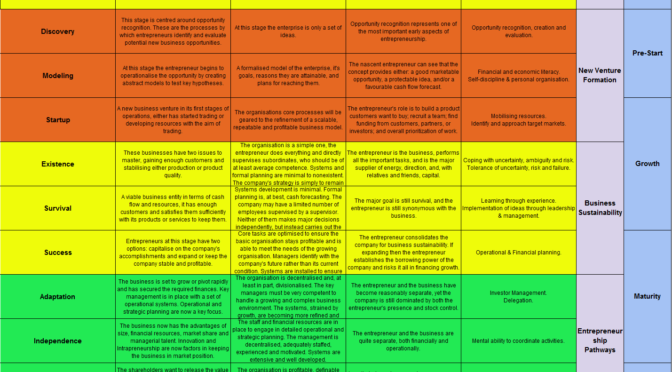
    The first three stages of the Enterprise Creation stages which emerged are: Discovery, Modeling, and Startup which form the new venture formation stages. The next three Existence , Survival and Success develop the business into a sustainable business entity. The last three stages: Adaption, Independence and Exit provide the entrepreneurship pathways for the entrepreneur.  These final elements complete the entrepreneurship model by focusing on the success of the business, how the entrepreneur progresses beyond the business, their separation into different entities and the entrepreneurs eventual exit. The 9 Stages of Enterprise Creation are set out below:

    Stage 1 – Discovery

    This first stage of the 9 Stages of Enterprise Creation  is centred around the focal competency of Opportunity recognition, creation and evaluation. These are the processes by which entrepreneurs identify and evaluate potential new business opportunities. An opportunity by definition is a favorable set of circumstances which creates a need for a new product, business, or service. Opportunity recognition is the process by which the entrepreneur comes up with a prospective idea for a new venture. Evaluating the opportunity takes research, exploration, and understanding of current needs, demands, and trends from consumers and others. The process of researching and surveying allows the product or service idea to develop, so that it can be modelled.

    Stage 2 – Modeling

    The second stage is about developing the business logic to create a business model. This is split into three parts and starts by setting out a Strategy, formulating a business model and setting the business processes to achieve the strategy . These form the key elements for the plan to start the business and, are an integral piece of submitting any proposal for an entrepreneurial or intrapreneurial business. The model should be underpinned by the resources available and those which may still need to be secured. Resource allocation and availability are extremely important to startups because sustainability and profit (not loss) depend on proper planning and understanding of the internal and external environments.

    Stage 3 – Startup

    The fourth stage is starting the enterprise. Once the resources detailed in the business plan are mobilised the entrepreneurial process can be effected and implementation can take place. In this stage the business may be trading or begin to research or develop a product. The aim of this stage is to have the processes in place so that the business can have a scalable, repeatable and profitable business focused on distinct customers within an identified market.

    Stage 4 – Existence

    At this stage the business has two core focuses; to gain enough customers to create a profitable business and, at the same time establishing production or product quality. The majority of businesses fail at this stage due, in part, to either one or both of these factors. At this stage the organisation is a simple one, the entrepreneur does everything and directly supervises subordinates, who should be of at least average competence. Systems and formal planning are minimal to nonexistent. The company’s strategy is simply to remain alive  which requires the focal competency of tolerance of uncertainty, risk and failure

    Stage 5 – Survival

    At this stage the business should be a viable entity in terms of cash flow and resources, it has enough customers and satisfies them sufficiently with its products or services to gain repeat sales. The organisation is still simple. The company may have a limited number of employees supervised by a junior manager or supervisor. Neither of them makes major decisions independently, but instead carries out the rather well-defined orders of the entrepreneur. Formal planning is, at best, cash forecasting. The major goal is still survival, and the entrepreneur is still synonymous with the business. The entrepreneur starts to implement ideas through leadership and management which provides opportunities to scale.

    Stage 6 – Success

    Entrepreneurs at this point of the 9 Stages of Enterprise Creation have a number of options: capitalise on the company’s accomplishments, expand or, keep the company stable and profitable. The entrepreneur has a number of ways to capitalise, from exit to taking a ‘founders dividend’ from the business. If the entrepreneur want to expand  then the core tasks are to make sure the basic organisation stays profitable so that it will not outrun its source of cash and, to develop managers to meet the needs of the growing organisation. Through the entrepreneurs leadership all managers within the business should now identify with the company’s future opportunities rather than its current condition demonstrating a success to its stakeholders.

    Stage 7 – Adaptation

    Businesses which reach this stage normally have a number of factors pushing them to adapt, these are normally grounded in changes either to the micro or macro environments. Businesses at this stage will normally be entering a phase of rapid change and will have to have secured the required finances to develop. At this point key management is in place with a set of operational systems. Operational and strategic planning are now a key focus. The organisation is decentralised and, at least in part, divisionalised. The key managers must be very competent to handle a growing and complex business environment. The systems, strained by growth, are becoming more refined and extensive. Both operational and strategic planning are being done and involve specific managers. The entrepreneur and the business have become reasonably separate, yet the company is still dominated by both the entrepreneur’s presence and stock control.

    Stage 8 – Independence

    A business at this stage should now has the advantages of size, financial resources, market share and managerial talent. Innovation and Intrapreneurship  are now key factors in keeping the business in market position. The organisation has the staff and financial resources to engage in detailed operational and strategic planning. The management is decentralised, adequately staffed, and experienced. Business systems are extensive and well developed. The entrepreneur and the business are quite separate, both financially and operationally.

    Stage 9 – Exit

    The last of the Enterprise Creation stages is focused on exiting the business and making their separation permanent. An exit strategy will give the entrepreneur a way to reduce or eliminate their stake in the business and, if the business is successful, make a substantial profit. This stage removes the entrepreneur from primary ownership and decision-making structure of the business. Common types of exit strategies include Initial Public Offerings (IPO), strategic acquisitions and management buyouts. The organisation at this stage is generally profitable, has a definable set of resources with a clear and realistic strategy to continue. The CEO and founder(s) are separate.


    9 stages of Enterprise Creation
    9 stages of Enterprise Creation

    The full paper which develops the 9 Stages of Enterprise Creation:  Bozward, David and Rogers-Draycott, Matthew Charles (2017) Developing a Staged Competency Based Approach to Enterprise Creation. Proceedings of the International Conference for Entrepreneurship, Innovation and Regional Development. ISSN 2411-5320, can be found at http://eprints.worc.ac.uk/5377/

    A textbook that supports learning with multiple case studies is available on Amazon.

  • Venture Creation – BA (Hons) Entrepreneurship Programme

    Venture Creation – BA (Hons) Entrepreneurship Programme

    In the last year I have had the amazing  opportunity to design a venture creation BA (Hons) Entrepreneurship Programme which is oriented towards students who wish to combine study towards an honours degree with the opportunity to start their own business in a supported environment with guidance from specialist lecturers, practising entrepreneurs and mentors. Over the years I have seen many programmes and wanted to create something for Entrepreneurs, the student and for practitioners.

    This is a practice-oriented degree, which focuses on the development of the students’ entrepreneurial effectiveness. This is achieved by embracing the concept of ‘learning by doing’ which ensures students are acquiring real knowledge and practical expertise to support their business start-up and business growth aspirations. There is a focus on real business experiences including master classes, enterprise events and interactions with local and global entrepreneurs. This philosophy is extended within the assessment primarily for (rather than ‘of’) learning Entrepreneurship (QAA (2012) Enterprise and Entrepreneurship Education: Guidance for UK Higher Education Providers, pp9).

    Similarly, although there is an inherent emphasis on learning within the learner’s own start-up venture, the Entrepreneurship skills acquired will be transferable to other business environments and learning opportunities.

    This BA (Hons) Entrepreneurship Programme aligns with the nation and international government agenda (The Impact and Effectiveness of Entrepreneurship Policy, NESTA 2013) and seeks to increase the number of entrepreneurs in the economy.

    A range of teaching pedagogies are adopted to ensure the curriculum enhances the learning of all students both in the startup and in group learning environments. In addition to lectures, seminars, videos, podcasts, presentations and visiting entrepreneurs, students will participate in action learning sets and interactive activities to apply learning from businesses experiences in their startup. These approaches are intended to take into account the principles of inclusivity: the types of learner, their startup business, their prior experience and expectations and how they learn and will be supported to learn effectively.

    Given the focus on developing a continued learning environment in which students develop an entrepreneurial mindset, there is an emphasis within the BA (Hons) Entrepreneurship Programme on tutoring and mentoring to support individual requirements, and also to reflect (at a meta-cognitive level) on their learning process. The programme is supported by more than 10 Entrepreneurs in Residence, regional business support agencies and local businesses.