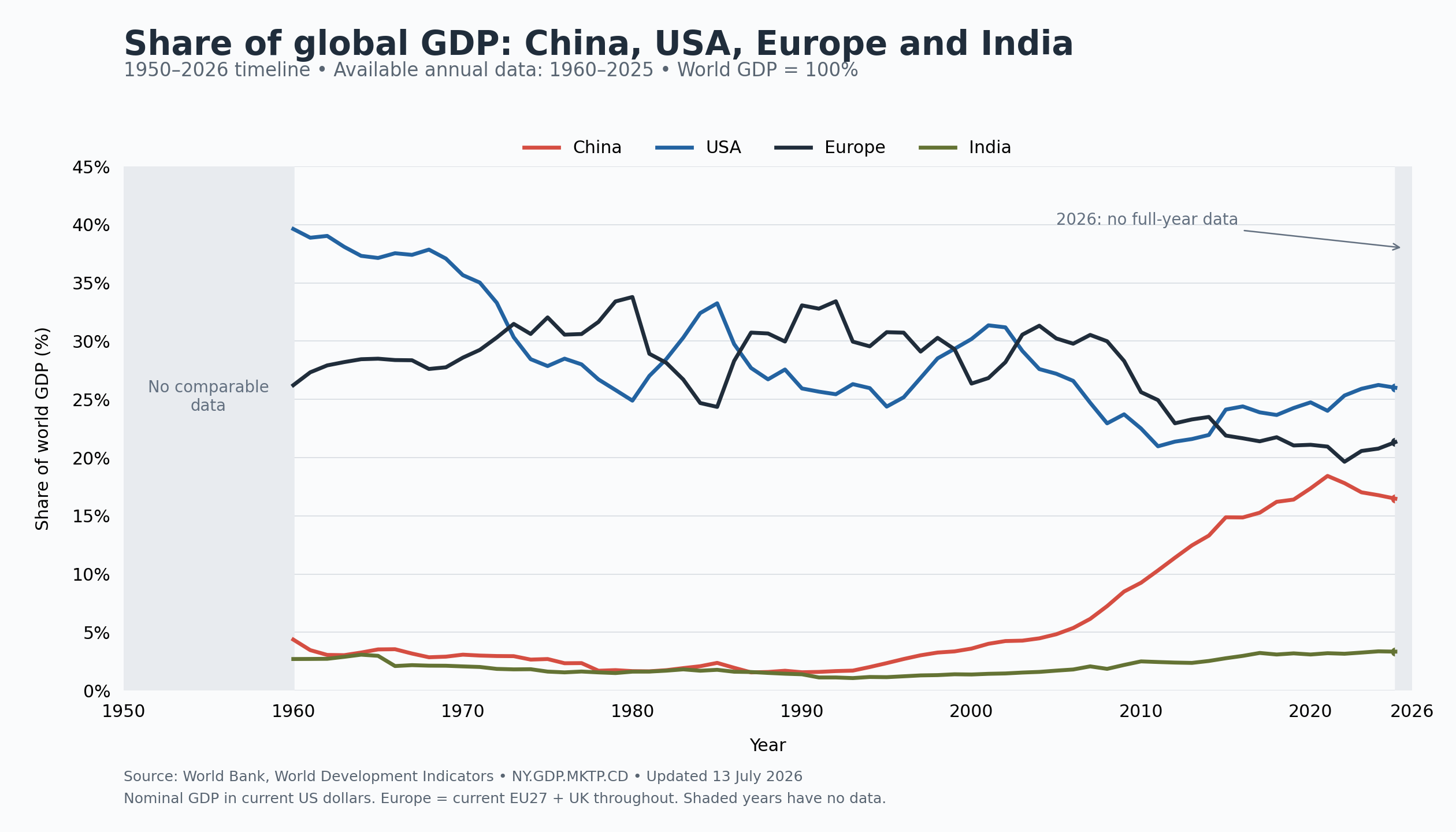
A changing world economy affects more than government rankings. It changes where entrepreneurs encounter customers, competitors, suppliers and potential buyers for their businesses. The accompanying graph shows how the shares of global nominal GDP held by China, the United States, Europe and India have changed. For us, as business owners, its value lies in the strategic questions it raises.
What the graphic tells us
In 2000, the United States accounted for 30.18% of world GDP, Europe for 26.35%, China for 3.60% and India for 1.38%. By 2025, those shares were 26.00%, 21.33%, 16.47% and 3.34%, respectively. China’s expansion is the most pronounced change, while India’s share has more than doubled since 2000.
Europe means today’s EU27 countries plus the UK throughout the series. The timeline runs from 1950 to 2026, but comparable observations cover 1960–2025 when the World Bank started collecting data. GDP is measured in US dollars, so exchange rates and prices affect the lines. A declining share does not necessarily mean an economy is shrinking: it can mean other economies are expanding faster than that economy.
Nor is the direction irreversible. China’s share peaked at approximately 18.43% in 2021 before falling to 16.47% in 2025. The United States recovered considerably from its lower share in 2011. As entrepreneurs, we should therefore read the graph as evidence of changing economic weight, rather than a forecast of inevitable winners and losers.
For people starting a business: choose a customer before a country
A large economy is not automatically an accessible market. A founder needs a specific customer with a problem, a budget and a practical route to purchase. National GDP provides context; sector demand, competition and the cost of reaching customers determine whether a business can work.
The Department for Business and Trade’s market-selection guidance makes this distinction explicit: demand must be considered alongside ease of entry and the firm’s own capabilities. For a new business, the useful question is therefore: where can we secure our first profitable, repeatable sales?
Start with a narrow segment. A specialist software service might test one customer group in one market. A training provider could validate demand through one institutional partner. A manufacturer might trial a distributor before committing to facilities overseas. These are possible approaches, not opportunities established by the GDP figures.
Before expanding, compare the full economics: acquisition costs, local pricing, delivery, support, payment collection and working capital. Set a small test budget and clear criteria for continuing. International ambition becomes valuable when it produces evidence of demand rather than additional complexity.
Sweat Equity Club offers a relevant community approach for founders who need more than financial capital. By bringing together entrepreneurs and people willing to contribute skills, time and experience, it creates opportunities for peer learning and practical collaboration. For a new venture, this can help turn a broad ambition into a clearer proposition, a prototype or a focused market test. Contributions and any equity participation should be agreed explicitly.
For established entrepreneurs: examine exposure as well as opportunity
The graph also invites existing owners to review where their businesses depend on the world economy. Customers may be domestic while suppliers, technology platforms or competitors are international. Geographic exposure therefore extends beyond export revenue.
Map revenue, supplier dependence and margins by market. Ask what would happen if an important supplier became unavailable, a currency moved sharply or a major customer delayed payment. These scenarios help turn a broad economic trend into decisions about pricing, cash reserves and alternative supply arrangements.
Diversification should have a commercial purpose. Entering several countries can reduce some concentrations while introducing others, including dependence on a single overseas distributor. Expansion is stronger when the business can support customers reliably and demonstrate acceptable margins after all additional costs.
Europe and the United States remain substantial economies, while China and India warrant attention within a wider market review. The graph does not establish which location is best for a particular firm. A profitable domestic niche may offer better returns than an expensive attempt to capture a tiny share of a much larger foreign market.
Water & Shark is relevant when growth crosses borders and commercial decisions become questions of business structure, tax and legal obligations. Its international tax, business setup and advisory services provide a route to examining those issues before committing to expansion. The entrepreneurial implication is straightforward: assess the operating structure alongside the market opportunity, rather than treating it as an administrative task after sales begin.
Centre of Defence Readiness brings a complementary perspective: can the business continue delivering when conditions deteriorate? The relevant lens is organisational resilience and defence readiness: understanding essential functions, supply-chain dependencies and preparedness for disruption. For entrepreneurs, the practical questions concern essential functions, critical dependencies and rehearsed responses. These considerations can strengthen continuity planning and the evidence available to customers, partners and prospective buyers.
For owners selling a business: make the opportunity transferable
For a seller, global economic change matters when it connects to a credible buyer rationale. An acquirer might value customer relationships, specialist capabilities, intellectual property or an established route into a market. These are potential strategic benefits to investigate, rather than valuation premiums demonstrated by the graph.
A business is easier to assess when its growth story is supported by records. The British Business Bank highlights profits, cash flow, a broad customer base and visibility over future contracts, while identifying dependence on the owner or one customer as potential obstacles to an exit.
Build the sale narrative around demonstrated performance. Show revenue and margins by geography, customer retention, the strength of the management team and the evidence behind projections. Distinguish signed contracts and completed pilots from speculative market potential.
International exposure can create both value and risk. A buyer may welcome established overseas demand but question concentrated revenue, distributor dependence or volatile margins. Clean records and a business that operates without the founder help make those issues assessable.
Birmingham Business Broker connects this preparation with the practical work of exit readiness, valuation, buyer search and business transfer. For an owner considering a sale, its relevance is in making the business easier to assess and presenting a credible proposition to appropriate buyers. A compelling international growth story should support, rather than substitute for, evidence of earnings, management capability and a workable handover.
The practical entrepreneurial lesson
Use the graphic to challenge assumptions about where opportunity lies. Then move from economic scale to customer evidence, and from customer evidence to a viable business model.
For founders, the priority is proving demand. For growing businesses, it is profitable expansion with manageable exposure. For sellers, it is demonstrating earnings and capabilities that a buyer can take over. Global trends frame the opportunity; the quality of the business determines what can be captured.
Depending on the stage of your journey, consider a conversation with Sweat Equity Club about collaborative founder support, Water & Shark about international structuring, Centre of Defence Readiness about resilience, or Birmingham Business Broker about preparing for exit. Each addresses a different practical challenge raised by a changing global economy.
Sources and method
GDP shares calculated from World Bank indicator NY.GDP.MKTP.CD, download updated 13 July 2026. Entrepreneurial implications are the author’s analysis.